


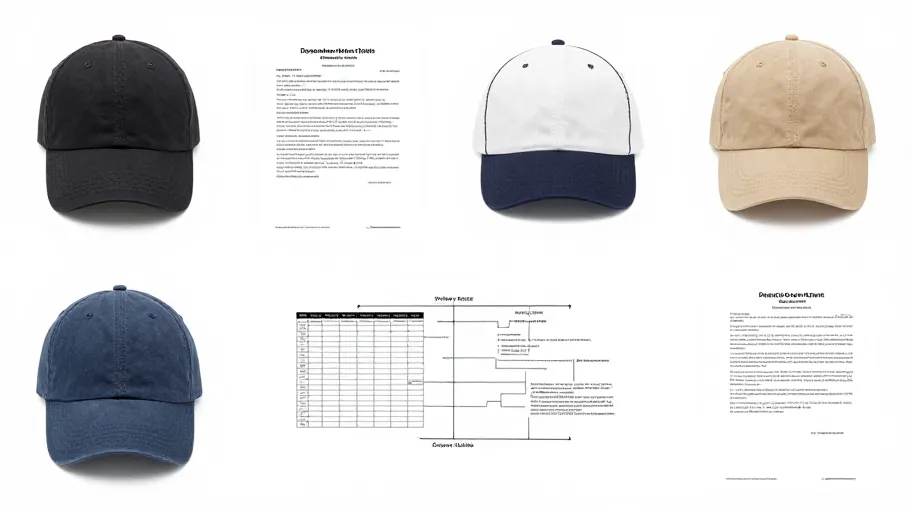
A private label hats manufacturer needs seven inputs before quoting accurately: a style or reference cap, complete construction specifications, decoration method details, compliance and labelling requirements, production-ready artwork, your delivery roadmap, and your commercial terms. Send all seven in your first enquiry and every supplier on your shortlist can quote against the same file — making their responses genuinely comparable.
Why vague enquiries produce useless quotes
Most sourcing frustration is not caused by a bad factory. It is caused by an incomplete enquiry. When a private label brand sends "please quote 500 caps with logo," each manufacturer fills the gaps with assumptions — different fabrics, different decoration methods, different packaging — and the quotes that come back cannot be compared line by line.
The fix is simple: send one complete specification file to every supplier on your shortlist, and require each of them to quote against it. The framework below gives you that file.
The SPEC-ART framework for quotation readiness
S — Style. Provide a base style (for example, six-panel snapback, five-panel camp cap, unstructured dad cap, bucket hat, knitted beanie) or a reference photo or physical sample of a cap you want matched. A reference image alone invites interpretation; a named style plus construction notes reduces it.
P — Panel and construction Specification. Document the details that change cost and difficulty: crown construction and panel count, closure type, visor shape and material, eyelets, sweatband material, seaming method, and fabric or yarn composition. Where you do not know the technical term, photograph the reference cap and annotate it.
E — Execution of decoration. State the decoration method you intend — embroidery, appliqué, printing, woven or rubber patches, heat transfer, or a combination — plus placement, approximate size, and stitch or colour count where relevant. If you are open to the supplier recommending a method, say so explicitly and ask them to quote alternatives separately.
C — Compliance and labelling. Flag the destination market and any labelling, fibre-content, safety or chemical requirements you need the supplier to support, and ask what documentation they can provide for your market. Do not assume; ask each candidate to confirm in writing what they can and cannot support. Confirm the current policy directly.
A — Artwork. Supply vector files where possible, with colour references, and state whether labels, hangtags, inner taping or custom packaging are in scope. Ask how the supplier manages artwork revision and approval before production.
R — Roadmap. Share your target ship or delivery window, incoterm preference, destination port or address, and any seasonal deadline. Ask the supplier to confirm what they can commit to against that roadmap rather than quoting in a vacuum.
T — Terms. Define what you are asking the quote to include: tooling or setup, sampling stages, packaging, third-party inspection, and payment structure questions. Ask each supplier to itemise so you can compare like with like. Confirm the current policy directly.
Decision table: complete file vs vague enquiry
| Dimension | Vague enquiry | Complete SPEC-ART file |
|---|---|---|
| Quote comparability | Each supplier quotes different assumptions | All suppliers quote the same specification |
| Round trips | Multiple clarification emails | Fewer clarification cycles |
| Cost visibility | Single lump number | Itemised: product, decoration, tooling, packaging |
| Risk of surprises | Specification gaps surface after ordering | Gaps surface before you commit |
| Supplier signal | Hard to judge competence | Each supplier's questions reveal their expertise |
| Negotiation position | Weak — you are comparing unknowns | Strong — you are comparing defined line items |
Approval questions to put to any candidate manufacturer
Before you approve a supplier, ask these in writing and keep the answers on file:
- Can you confirm every line in our specification, or which lines need to change — and why?
- What sampling stages do you propose before production, and what approval gates exist at each stage?
- How do you document and approve colour, artwork and construction sign-off?
- What documentation can you provide for our destination market's requirements?
- How will you communicate if a specification element affects feasibility or cost, and at what point?
- Can you accept third-party inspection, and what is your process for handling findings?
- How do you handle artwork confidentiality and brand-asset protection?
A manufacturer's willingness to answer precisely — and to push back where a specification is risky — is itself a selection criterion. Suppliers who quote instantly without questions may not have read your file.
Preparing your first enquiry: a checklist
- Named base style plus annotated reference photos or physical sample
- Construction specification: panels, closure, visor, sweatband, fabric composition
- Decoration method, placement and size defined
- Destination market and labelling requirements stated as questions
- Vector artwork, colour references, packaging scope
- Roadmap: target window, incoterm, destination
- Requested quote structure: itemised line items
- Written answers to the seven approval questions above
FAQ
Do I need a tech pack, or is a reference cap enough to start? A reference cap plus annotations is a workable starting point, but a written specification is what makes quotes comparable across suppliers. Start with the reference, then confirm the written spec with the supplier before quoting proceeds.
Should I send the same enquiry to several manufacturers? Yes — comparison is the point. Send one identical SPEC-ART file to each candidate and require itemised responses, so differences in the quotes reflect the suppliers rather than your brief.
How do I compare quotes that include different things? Reject any quote that is not itemised. Ask each supplier to break out product cost, decoration, tooling or setup, packaging and inspection separately, and to state explicitly what is excluded. Confirm the current policy directly.
What if a supplier recommends a different decoration method than I specified? Treat it as useful information, not an inconvenience. Ask them to quote both options against your file and explain the trade-offs in construction, durability and appearance — this is one of the fastest ways to assess technical depth.
Who owns the artwork and moulds or tooling after the project? Ask before you commit, in writing, and record the answer. Ownership and reuse terms are project-specific; confirm the current policy directly.
获取开发 Brief
Ready to prepare a complete, comparable enquiry file? Get the Development Brief — a structured template covering style, specification, decoration, artwork, roadmap and terms — and send it to every manufacturer on your shortlist, including New Generation. A complete brief is the fastest route to an accurate, comparable quote.
Quick-start checklist CTA
Not ready for a full brief yet? Copy the eight-point enquiry checklist above into your next email to any candidate private label hats manufacturer. It takes minutes to assemble and immediately improves the quality of every quote you receive back.
#cap manufacturers china, #headwear manufacturers china, #cap factory








