


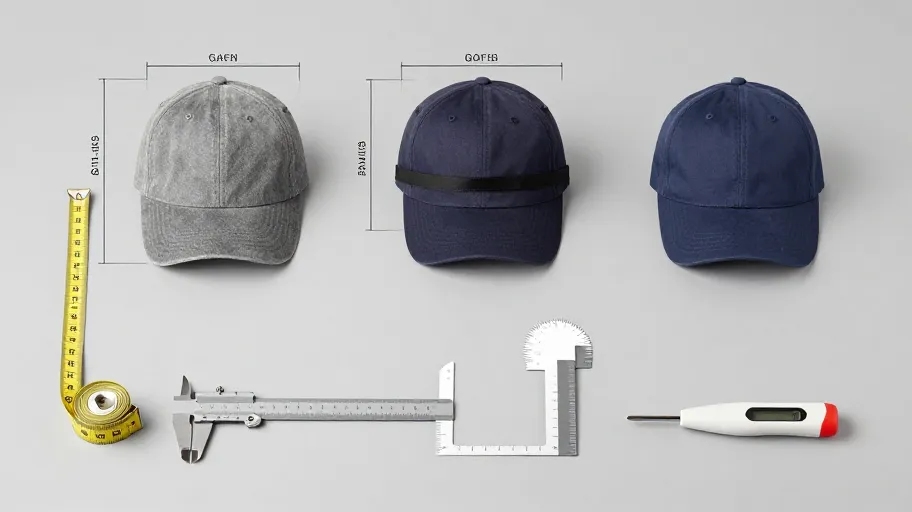
When comparing a private label hats manufacturer, most first briefs specify only head circumference and a fabric color — and that is exactly why quotes and samples arrive inconsistent and hard to compare. The Six-Measurement Gate gives you the six specification areas to document before you contact any supplier.
Why the first brief decides the whole sourcing outcome
A first brief is not just a request for a sample. It is the instrument that makes supplier quotes comparable. If two manufacturers receive different specifications — or interpretations of the same sketch — the prices you receive are not comparable, and neither are the samples.
The pattern we see repeatedly among private label buyers is a brief built from a mood board: a photo, a color, a logo file, and a hope. The manufacturer fills in every gap with their own reading, and the buyer discovers the differences at the third sample round, when time and budget have already been spent. The fix is not a longer brief. It is a structured one — a fixed set of measurement and specification fields that every supplier answers in the same way.
That is the purpose of the Six-Measurement Gate. Before you send anything to a private label hats manufacturer, you complete six specification areas yourself. The result: every quote you receive back is an answer to the same question, and comparison becomes possible.
The Six-Measurement Gate
| Gate | What you must define | Why buyers miss it | What happens if left vague |
|---|---|---|---|
| 1. Head sizing range | Target head circumference range and how the closure adjusts within it | Buyers state one size, not a range | Samples fit the model head, not your market |
| 2. Crown depth and profile | Crown height and silhouette, described in written terms, not just a photo | Photos are treated as specifications | The "same" hat from two suppliers looks different on shelf |
| 3. Brim specification | Brim width, curvature, stiffness and edge finish | Curvature and stiffness feel subjective, so they are skipped | Flat vs. curved vs. structured brims get mixed in one sample round |
| 4. Panel and construction | Number of panels, seaming, eyelets, closure type | Construction details are assumed "obvious" from the photo | Quotes reflect different constructions, so prices diverge |
| 5. Materials and weight | Fabric composition, weight class, lining, sweatband, and where each applies | Buyers name a color but not a material reference | Sample fabric and bulk fabric may not match |
| 6. Branding placement | Logo method, position, size relative to a fixed reference point, and label details | Branding is added after sampling instead of in the brief | Placement and size arguments at approval stage |
Complete all six gates before you request a quote. Any manufacturer — including the ones you ultimately shortlist — should be able to respond to each gate in writing. A supplier's willingness and ability to answer the gates in detail is itself a useful comparison signal.
The measurement areas buyers miss
1. A sizing range, not a size. A single head circumference number is not a sizing specification. Your market's sizing range, and how the closure (strapback, snapback, fitted, elastic, or other) covers that range, is a design decision that belongs in the brief. Ask each prospective manufacturer how their proposed closure maps onto your stated range, and require the answer in writing.
2. Crown profile in words. Two hats can share a head circumference and still sit entirely differently on the head. Describe crown depth and silhouette in words — low profile, mid, structured high crown — and require the sample to be measured against that description at approval.
3. Brim width and stiffness as separate fields. Brim width and brim stiffness are independent decisions, and both affect how the product photographs and wears. Specify them separately, and note the edge finish you expect.
4. Panel count and construction. Panel count changes the crown shape, the seaming, and therefore the cost basis. State it explicitly so that every quote is built on the same construction.
5. Material reference, not just a color. A color code without a material reference invites substitution. Identify the fabric class and weight you intend, and ask each supplier what material reference they propose against it — then compare those answers side by side.
6. Branding placement against a fixed reference. "Logo on the front" is not a specification. Define position relative to a fixed point, size relative to a fixed dimension, and the decoration method. For private label work, also specify inner labels, hangtags, and any packaging marking at this stage, not later.
Turning visuals into written measurements
Keep your mood board — but attach a specification table to it. For each visual reference, write the dimension or descriptor the photo cannot convey: crown depth descriptor, brim width class, stiffness descriptor, closure type, material reference. Then, when a manufacturer returns a sample, approve or reject it against the written table, not against your memory of the photo. This single habit removes most of the ambiguity that drives sample-round loops.
Private label specifics to lock in the brief
Because you are building a private label product, three specification fields deserve their own lines in the brief:
- Decoration method per placement — embroidery, print, patch, woven label or other, defined per position.
- Label set — main inner label, care/content label requirements, size label, and hangtag, each with placement.
- Artwork handover format — what file types and detail level you will provide, and what the supplier must return (mockup, sample photos, dimensioned drawings) for your approval.
Each manufacturer will handle these differently. The brief does not tell them what to do — it makes their answers comparable.
Approval questions to ask before each sample round
Before you approve any sample, send these questions in writing and record the answers:
- Which gates in the specification table does this sample deviate from, if any?
- What material reference and closure type is used in this sample, and is it the same one proposed for bulk?
- What is included in this sample round, and what does the next stage require? (Confirm current sample terms and any associated costs directly with the supplier — these are policy matters each manufacturer defines for itself.)
- What must change, in writing, before bulk production can start, and who confirms it?
- How will bulk goods be checked against the approved sample, and what documentation will we receive?
Question three deserves emphasis: sample terms, fees, shipping responsibility and what a next stage includes are supplier-specific policies. Do not assume; ask each shortlisted manufacturer to state its current policy in writing, and compare those statements as part of your decision.
FAQ
1. How detailed should my first brief be if I have no sample yet? Detailed enough that two different manufacturers would quote the same product. That means all six gates of the Six-Measurement Gate are filled in, even where you write "propose options with reasoning." The brief's job is to structure the supplier's response, not to eliminate their input.
2. Can I just send a reference hat instead of measurements? You can, and a physical reference helps — but it does not replace the written table. A reference hat still requires you to state which attributes to copy and which to change, in writing, per gate. Otherwise every supplier interprets the reference differently and your quotes stop being comparable.
3. What if a manufacturer says some measurements are not needed at quoting stage? Ask them to state, in writing, which assumptions they are making for each unspecified gate. Those written assumptions become the comparison sheet you evaluate quotes against. If a supplier declines to document assumptions, treat that as decision-relevant information about how the project would run.
4. Should branding placement really be in the first brief? Yes. Decoration method and placement interact with panel construction and material, so leaving branding until after sampling can force changes that ripple through the whole specification. Private label buyers who define branding early tend to reach approval with fewer revision loops — document it, confirm it, and approve it in writing at each stage.
5. How do I compare sample policies between manufacturers? Ask each shortlisted supplier the same written questions: what the sample round includes, any fees involved, shipping arrangements, and what the path to bulk production looks like. These are each manufacturer's own policies and can change, so confirm current terms directly rather than relying on anything you read — including this article.
Get the development brief
If you are preparing to contact a private label hats manufacturer, use the structured development brief we built for this exact purpose. It contains the Six-Measurement Gate as a fill-in table, the branding and labeling fields, and the approval questions — so every supplier you approach answers the same specification, and every quote you receive is comparable.
Request the development brief — tell us your product direction and market, and we will send the fill-in template you can use with any manufacturer, including us.
Before you contact any supplier, run this quick self-check:
- I have stated a head sizing range, not a single size
- Crown depth and profile are described in words
- Brim width, curvature and stiffness are separate fields
- Panel count and closure type are written down
- Material reference and weight class are named, not just a color
- Branding placement, method, size reference and label set are specified
- My approval questions are ready to send in writing
All figures, sample terms, lead times, capacities and policies mentioned in supplier responses must be verified and documented directly with each manufacturer before you commit to an order.
#cap manufacturers china, #headwear manufacturers china, #cap factory








