


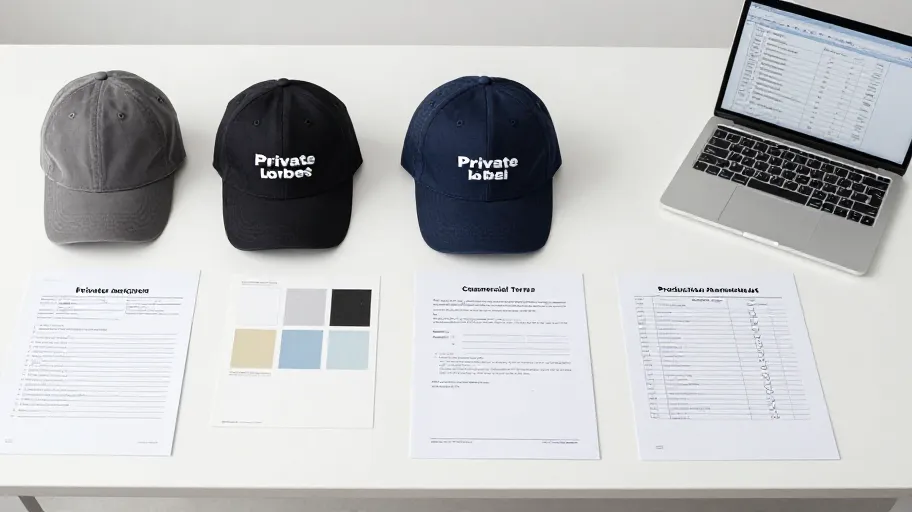
Choosing a private label hats manufacturer is not the decision that determines your outcome — releasing the bulk order is. Before you approve production, resolve five gates in sequence: Specification, Sample, Materials & Compliance, Commercial Terms, and Production Readiness. Anything left verbal at that point becomes a dispute later.
Why bulk approval is the highest-risk moment
Most sourcing problems in custom headwear do not originate on the production floor. They originate at the moment of release: a specification that existed only in an email thread, a sample that was "close enough," a compliance document that was promised but never requested, or a commercial term that changed once the deposit was paid.
The discipline is simple and demanding: treat bulk approval as a gated decision, not a gut feeling. A capable supplier will welcome structured questions — they answer them every week. A supplier who resists documentation is giving you information about how the rest of the project will run.
The Five Gates to Bulk Approval
Use this table as your decision map. Each gate must close before the next one opens. Nothing here assumes any particular supplier policy — every row ends in something you confirm directly, in writing, with the manufacturer you are evaluating.
| Gate | What must be resolved | What you must NOT assume | Question to put in writing |
|---|---|---|---|
| 1. Specification | Full tech pack: profile, construction, panels, closure, embroidery/print placement, labelling, packaging | That "same as the sample" is a specification | "Please confirm the specification sheet this quotation references." |
| 3. Materials & Compliance | Fabric, trims, dyes and any documentation you require for your market | That materials meet any standard unless evidenced | "Please provide the material documentation you can supply, and confirm what you cannot." |
| 4. Commercial Terms | Price basis, quantity breaks, payment schedule, Incoterms basis, validity of the quotation | That quoted terms hold unchanged past your approval date | "Please confirm the quotation's validity period and the payment and delivery terms in the contract." |
| 5. Production Readiness | Inspection criteria, in-process checkpoints, what happens if output deviates, and the defined release conditions | That quality controls are in place because they sound plausible | "What inspection checkpoints do you propose, and what are the acceptance criteria we both sign?" |
Gate 1: Specification — turn your idea into a document
A private label order lives or dies on the specification sheet. Before approval, your document should state the cap profile and construction, fabric and trim details, decoration method and placement, internal labels and hangtags, and packaging format. If any of these exist only as photos or descriptions, ask the manufacturer to transcribe them into a spec sheet and confirm it back to you.
Two questions to resolve now:
- "Who owns the specification document, and which version number governs the bulk order?"
- "What is the agreed process if we need to revise the spec after approval — and how are cost and timing re-confirmed?"
Gate 2: Sample — define what "approved" actually means
- State explicitly which sample version (dated, photographed, retained by both parties) is the approval standard.
- Ask how the manufacturer proposes to handle deviations between the approved sample and bulk output — and record the answer.
- Confirm every colourway and size variant is represented or accounted for, not only the hero sample.
- Ask what any sample-related policy is, including whether any fee applies — then confirm the current policy directly with the supplier. Do not rely on second-hand accounts or assumptions.
Gate 3: Materials and compliance — request evidence, not reassurance
For any market you sell into, your compliance obligations are yours, not your supplier's. Before approval, request in writing the material and documentation support the manufacturer can actually provide, and treat a clear "we cannot supply that" as useful information rather than a deal-breaker. What matters is that you know the boundary before, not after, the deposit.
Verify what you receive; do not accept a claim as a substitute for a document.
Gate 4: Commercial terms — freeze the numbers before you freeze the order
Approval is the moment your negotiating position changes. Resolve before releasing:
- The price basis: what the unit price includes, and what it excludes (packaging, labelling, decoration set-ups — confirm each explicitly).
- Quantity structure: how the price moves at different order quantities, and what happens if actual output quantity differs from the planned quantity.
- Payment schedule and the exact conditions attached to each payment milestone.
- Delivery basis (the Incoterm and named point) and which party arranges freight.
- The quotation's validity period, and whether approved terms are contractually fixed.
Gate 5: Production readiness — agree the release conditions
The last gate converts good intentions into criteria. Ask the manufacturer to propose:
- In-process inspection checkpoints and who signs off at each.
- The acceptance criteria bulk output will be measured against — ideally referencing the retained approval sample.
- The agreed procedure if output fails inspection: rework, replacement or other remedy, defined before production begins.
- Pre-shipment inspection arrangements: who inspects, to what criteria, and what document results.
A supplier confident in its process will engage with this conversation constructively.
Pre-approval checklist
Before you release bulk production, confirm you can tick every line:
- Numbered specification sheet confirmed by both parties
- Approval sample dated, photographed and retained by both sides
- Material and documentation requirements requested and answered in writing
- Price basis, quantity breaks and payment schedule stated in the contract
- Incoterms basis and freight responsibility confirmed
- Inspection checkpoints and acceptance criteria agreed
- Deviation and remedy procedure defined before production starts
- All verbal assurances converted into written terms
If any box is unticked, pause the release. Use the checklist as your go/no-go filter on every project.
Want this structured for your project? Request the development Brief — we'll send a working document covering specification, sampling, compliance and commercial questions tailored to your headwear programme.
FAQ
How many sample rounds should I plan before approving bulk production? There is no fixed number — it depends on design complexity, decoration methods and how quickly revisions are agreed. Plan the rounds you need to close Gates 1 and 2 completely, and ask each shortlisted supplier to describe its own sampling process and what each round covers. Confirm all sample policies directly with the supplier.
What should I do if a supplier's quotation changes after I approve the sample? Treat it as a Gate 4 failure: the commercial terms were not fixed in writing. Going forward, require quotation validity periods and contractually stated pricing before any approval. If this happens mid-project, request the revised quotation in writing with a stated basis for each change before proceeding.
Do I need third-party inspection, or is the manufacturer's own QC enough? This is your decision, not a default. Ask each supplier to describe its inspection checkpoints and acceptance criteria, then decide whether an independent pre-shipment inspection adds value for your risk level and market. Whatever you choose, document the criteria both parties will measure against.
How do I compare several private label hats manufacturers fairly? Score each candidate against the same Five Gates: quality of specification handling, transparency of the sampling process, willingness to provide material documentation in writing, clarity of commercial terms, and specificity of proposed quality controls. A supplier that answers slowly or vaguely at Gate 1 will not improve at Gate 5.
What single document matters most before release? The one that merges your specification, approval sample reference, agreed commercial terms and inspection criteria into a signed production order. If those elements are scattered across emails and calls, consolidate them before approval — not after a dispute.
Before bulk production, lock five gates: an agreed specification, a retained approval sample, documented material support, contractually fixed commercial terms, and written inspection criteria. Resolve them in order and your private label programme starts on evidence, not assumptions.
Request the development Brief to turn this framework into a project-ready document for your custom headwear order.
#cap manufacturers china, #headwear manufacturers china, #cap factory








