


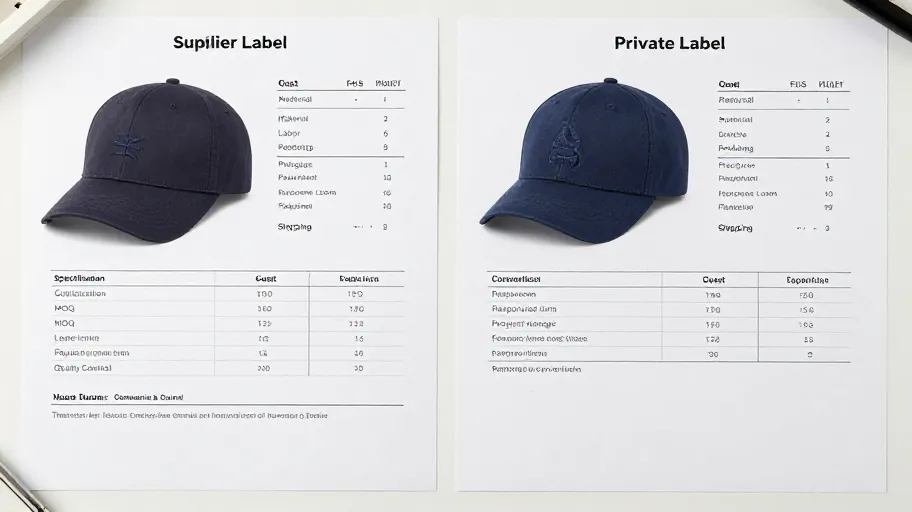
When you compare quotes from two potential suppliers, read each one through four lines — specification, cost construction, commercial terms, and communication & control — and score them separately. A quote that looks cheaper is only cheaper if it covers the same scope; the Four-Line Quote Comparison shows you exactly where the scope differs before you commit.
Why two quotes for the same cap can differ so much
If you have requested quotes from two factories for what you believe is the same cap, you may have received two documents that look nothing alike. One might be a single line with a unit price and an estimated delivery date. The other might run several pages, breaking out fabric, embroidery digitising, tooling, packaging and freight separately.
Neither document is wrong. They are simply answering different questions. The detailed quote answers "what does this project include?" The thin quote answers "what is the headline number?" A buyer who compares only the headline numbers is not comparing suppliers; they are comparing formatting habits.
The fix is to stop reading quotes as offers and start reading them as scope declarations. That is what the framework below is for.
The Four-Line Quote Comparison
Line 1 — Specification. Does each quote reference the same, fully specified product? Before any meaningful comparison, you need a spec sheet: crown construction, fabric composition and weight, closure type, embroidery or patch placement, sweatband, labelling, packaging. If a quote does not reference your spec sheet — or if you never sent one — the two suppliers may be quoting two different hats. This is the single largest source of "surprises" later, and it is entirely preventable at the quote stage.
Line 2 — Cost construction. What is included in the unit price, and what is billed separately? Ask each supplier to confirm, in writing: whether tooling or mould charges apply, whether digitising or sample-making is a separate line, whether packaging and labelling are included, whether the quoted unit price is tied to a stated order quantity, and what happens to the price if your quantity changes. You are not asking about any policy here; you are asking what the document in front of you says. Confirm the current policy directly with each supplier for anything the document does not state.
Line 3 — Commercial terms. Do the two quotes use the same trade terms? Incoterms, payment structure, and who arranges inspection and freight can shift the real cost of a project substantially without changing the unit price. A quote on FOB terms and a quote on EXW terms are not comparable until you normalise them. Note the trade term on each quote explicitly, and if either document is silent, ask.
Line 4 — Communication & control. How does each supplier behave during the quoting process itself? Response clarity, willingness to answer scope questions in writing, and precision of language are your only pre-order evidence of how the project will be managed. A supplier who answers "it depends" with a clarifying question is giving you more usable information than one who answers vaguely to keep the conversation moving. Document this impression — it is legitimate comparison data, not a soft factor.
Decision table: scoring the two quotes
| Comparison line | What to score | Red flag to watch | Question that resolves it |
|---|---|---|---|
| Specification | Does the quote reference your full spec sheet? | Quote describes a "similar" cap in its own words | "Please confirm the quote matches the attached spec, item by item." |
| Cost construction | Unit price plus every separately billed line | Any charge that appears in one quote but not the other | "Which charges are included in the unit price at the stated quantity?" |
| Commercial terms | Trade term, payment structure, inspection arrangement | Silent or ambiguous trade terms | "Which Incoterm does this quote assume?" |
| Communication & control | Clarity, written confirmations, precision | Answers that change between emails | "Please confirm your answer in writing so we can reference it." |
Score each line for each supplier. If one supplier wins on cost construction but loses on specification, you have learned something actionable: the cheaper headline number may reflect a thinner scope, and the comparison is not finished until the scopes match.
Approval questions to put to both suppliers
Send the identical question set to both suppliers and compare the answers side by side. Recommended set:
- Attach your current spec sheet and ask: "Does your quote cover this specification exactly? If anything differs, list the differences."
- "List every charge in this project that is billed separately from the unit price."
- "Which Incoterm does your quote assume, and is freight included or excluded?"
- "At what order quantity is this unit price valid, and how does the price change at other quantities?"
- "What is the approval sequence between sample submission and mass production, and at which points do we sign off?" Confirm the current policy directly for anything the answer leaves open.
- "Who is our single point of contact during production, and how are issues documented?"
Question 5 is deliberately about process rather than any stated duration or outcome. You are comparing how each supplier describes its own approval sequence — which tells you how traceable the project will be if something goes wrong.
A worked comparison walkthrough
Imagine two quotes for the same six-panel embroidered cap. Quote A shows a lower unit price but is silent on tooling and references no spec sheet. Quote B shows a higher unit price, references your spec sheet, and lists digitising as a separate line with the tooling status stated clearly.
Under the Four-Line framework: Quote A fails Line 1 (no spec reference), which makes Line 2 unreadable — you cannot know what its price includes. Quote B passes Line 1 and gives you a readable Line 2, even though its number is higher. That does not mean Quote B wins; it means Quote B is comparable and Quote A is not yet. Your next step is to send Quote A's supplier the same spec sheet and scope questions, then re-run the comparison. The cheapest comparable quote is the only one worth choosing from.
This is also where a structured document earns its keep. A development brief that fixes your specification, target quantities, labelling requirements and approval sequence forces both suppliers to quote against the same baseline — which is precisely what makes the four lines comparable.
[Checklist — before you sign anything]
- Both quotes reference the identical spec sheet
- Every separately billed charge is listed in both quotes
- The Incoterm on each quote is stated in writing
- The quantity each unit price is valid at is stated
- The approval sequence between sample and production is documented
- One named contact per supplier is confirmed
Request the Development Brief from New Generation and we will structure your specification, quantities and approval requirements so every quote you receive is directly comparable.
FAQ
Should I always choose the lower quote? Only after the scopes match. A lower number against an unclear scope is not a price advantage; it is an unanswered question. Normalise both quotes to the same specification and terms first, then compare.
What if one supplier refuses to itemise charges? Treat the refusal itself as comparison data. You are not demanding any particular arrangement — only a written list of what the quote covers. A supplier unwilling to describe its own document's scope leaves you with nothing to verify later.
Can I compare quotes written on different Incoterms? Not directly. Note the trade term on each document, ask each supplier to restate the quote on the term you prefer, and confirm the current policy directly with each one. Only then are the numbers reading the same language.
How many quotes should I compare before deciding? Two structured quotes beat four unstructured ones. The goal is comparability, not volume. Once your brief fixes the specification and terms, two suppliers quoting against it will give you a genuine choice.
What makes a quote "readable" for comparison? Four things: it references your spec, it separates included and billed-separately items, it states its trade term, and it states the quantity it is valid at. Everything else is commentary.
New Generation is a Shenzhen-based OEM/ODM manufacturer of custom caps and headwear working with overseas brands, importers, wholesalers and corporate buyers. We will not tell you which quote to pick — but we will give you a document that makes your comparison honest.
#cap manufacturers china, #headwear manufacturers china, #cap factory








