


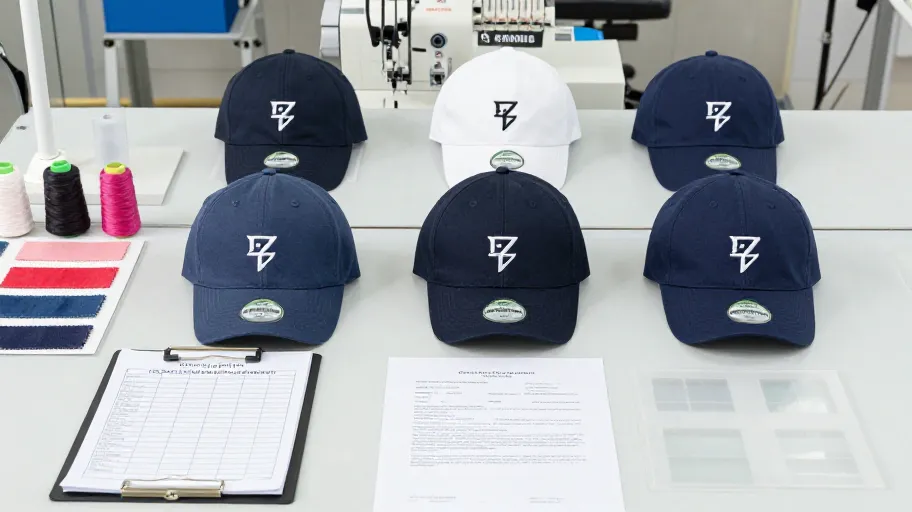
The best cap manufacturers in China are the ones you can verify against your own project: confirmed production capability for your cap construction, documented sampling and approval control, transparent processes for materials and inspection, and commercial terms you have confirmed in writing. "Best" is project-specific — evaluate evidence, not rankings.
Why "best" depends on your project, not a league table
A private-label programme for structured six-panel caps with embroidered logos has different requirements from an unstructured washed-caps line or a corporate-gifting order. Any list that names "the best" factories without knowing your construction, quantities, decoration method and compliance requirements is answering a different question.
A more productive approach: define your evaluation criteria before you contact anyone, then run every candidate through the same framework so comparisons are like-for-like. That is what the C.A.P. Framework below is designed to do.
The C.A.P. Evaluation Framework
Use three lenses, in order:
C — Capability evidence. Can the supplier demonstrate, with verifiable material — not just claims — that it produces your construction, decoration method and spec range? Ask for references you can contact, photos of comparable past production (not renders), and the names of subcontracted steps, if any, such as embroidery or washing. Whether a factory subcontracts is not itself a problem; nondisclosure of it is.
A — Approval control. How does the supplier control what you approve versus what ships? Look for a defined sampling stage, a pre-production sample you sign off, and a written rule that bulk production matches the approved sample. Ask what happens when bulk deviates — this question alone separates process-driven manufacturers from order-takers.
P — Process transparency. Can the supplier explain, step by step, how an order moves from tech pack to shipment, who inspects what and when, and how documentation is handled? Transparency about what the supplier cannot do is also a positive signal; factories that claim to do everything perfectly deserve more scrutiny, not less.
Decision table: scoring competing suppliers
Score each candidate 1–5 per row (5 = documented and confirmed, 1 = claim only). Weight rows to fit your programme.
| Evaluation dimension | What to demand | Score (1–5) | Notes |
|---|---|---|---|
| Construction match | Confirmed experience with your exact cap construction and spec | ||
| Decoration capability | In-house or disclosed subcontracting for embroidery/printing | ||
| Sampling process | Written sampling stage with defined approval gate | ||
| Pre-production approval | Signed pre-production sample before bulk | ||
| Quality control | Named inspection points and how results are reported to you | ||
| Documentation | Ability to provide compliance documents relevant to your market | ||
| Communication | Responsive, precise, willing to answer hard questions in writing | ||
| Commercial terms | MOQ, pricing structure, tooling, payment terms — confirmed in writing | ||
| Traceability | Named subcontractors, material sources on request | ||
| Capacity fit | Confirmed ability to handle your volume in your window |
Add candidates as columns and compare totals — but read the low rows, not just the sums. A supplier scoring high overall with an opaque approval process is a riskier choice than a lower-scoring supplier with tight approval control.
Concrete approval questions to send every shortlisted factory
Send these verbatim and compare the quality of the answers, not just their content:
- What is your current MOQ for our specific construction and decoration method, and how is it calculated?
- What is your sampling process, what does it cost, and what is the current policy on sample fees and shipping? Please confirm the current terms in writing.
- At which points can we inspect or approve before bulk production begins?
- What is the current lead time for sampling and for bulk at our target quantity, and what factors could change it?
- Which production steps happen in-house and which are subcontracted? Will subcontractors be disclosed?
- What inspection checkpoints exist, and how are inspection results documented and shared?
- What compliance documentation can you provide for materials relevant to our destination market, and can you confirm current validity?
- What are your payment terms, and what protections apply at each stage?
- How are defects in bulk handled — what is your current policy on rework, replacement or credit?
- Which two or three past projects most resemble ours, and can we contact those buyers?
Vague or evasive answers to questions 3, 5, 9 and 10 should carry the most weight in your decision.
Verification habits that protect private-label buyers
- Keep a golden sample. Retain a signed, dated copy of every approved sample and reference it in the purchase contract.
- Put deviations in writing. If bulk differs from the approved sample, the remedy should already be defined in your agreement.
- Confirm every policy directly. Sampling fees, shipping responsibility, refunds and rework policies change over time and vary by supplier; confirm current terms in writing for each project rather than relying on any general description.
- Document, then decide. Keep a written record of every claim a supplier makes during evaluation. If it is not in writing, treat it as unverified.
How New Generation fits an evaluation like this
New Generation is a Shenzhen-based OEM/ODM manufacturer of custom caps and headwear working with overseas brands, importers and corporate buyers. We do not ask you to take capability on trust — we invite you to run us through the same C.A.P. evaluation you apply to every other candidate: request evidence of comparable production, question our sampling and approval gates, and ask us to document our inspection process. Specific MOQ, pricing, sampling terms, lead times and documentation for your project should be confirmed directly with our team, since these depend on your construction, quantities and destination market.
FAQ
How many cap manufacturers should I shortlist before deciding? A workable shortlist is three to five candidates run through an identical evaluation. Fewer limits your negotiating position; more spreads your verification effort too thin to do it properly.
Should I visit the factory in China before ordering? A visit is the strongest verification step when feasible, because you can observe processes directly. If a visit is not practical, third-party inspection during sampling and production, plus the written evidence described above, provides an alternative layer of control. Confirm with each supplier what access they permit.
Is in-house production better than subcontracting? Neither is automatically better. What matters is disclosure and control: a supplier that names its embroidery subcontractor and documents inspection is safer than one that claims everything in-house without evidence.
What documents should a cap manufacturer provide for an overseas private-label order? Ask each supplier to confirm the current documentation they can provide for your destination market — for example, material composition information, relevant test reports and social-compliance audit scope. Availability and validity vary; verify each document's currency directly rather than assuming it from a brochure.
How do I compare quotes fairly? Compare like-for-like specifications: same construction, materials, decoration, packaging and Incoterms. A quote that looks low may exclude tooling, sampling or packaging. Ask each supplier to itemise, then compare the itemised totals.
Before you shortlist anyone, download the Supplier Scorecard — a ready-to-use comparison sheet built on the C.A.P. Framework, with all the approval questions above formatted for you to send verbatim. Run every candidate through it and let the evidence decide.
Prefer to start smaller? Use the ten approval questions in this article as your pre-contact checklist. Copy them into your next supplier email and compare the answers — that single step filters out more unsuitable factories than any ranking list.
#cap manufacturers china, #headwear manufacturers china, #cap factory








