


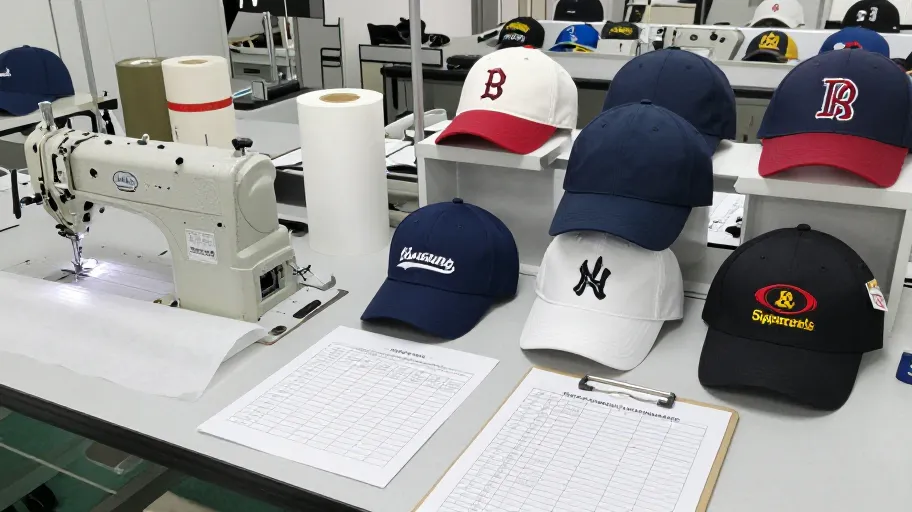
The best baseball cap manufacturers for a private-label project are the factories you can verify against your specific requirements — construction capability, accountability for your brand assets, and documented process control — not the ones with the loudest claims. "Best" is a project-relative judgement. Evaluate candidates with a weighted scorecard, confirm every policy in writing, and approve a supplier only after evidence passes your threshold.
Why "best" has no universal answer
A buyer sourcing unbranded promo caps, a fashion label launching embroidered six-panel caps, and a corporate buyer needing structured flat-bills all have different definitions of the best manufacturer. The ranking criteria change with your construction types, decoration methods, target market compliance needs and order cadence.
So the productive question is not "who tops a list" but "which manufacturer can document the capability my project requires?" That reframing turns a vague comparison into an auditable process.
The CAP-Verify framework
Use three lenses, each with evidence you can request before placing a bulk order:
C — Capability. Can the factory produce your specific construction and decoration? Ask for photos or samples of the exact panel count, closure type, sweatband style, and decoration method (embroidery, printing, patches, laser appliqué) your project needs. A factory that excels at one method may not run another in-house — confirm what is made on-site versus outsourced.
A — Accountability. Who answers when something goes wrong? Confirm the contract manufacturer of record, IP protection terms for your designs and logos, defect-resolution procedures, and the named contact responsible for your account. Ask whether tooling, digitized embroidery files and patterns are held exclusively for you.
P — Process control. How does the factory prevent drift between sample and bulk? Ask about inline inspection points, a golden-sample retention process, pre-shipment inspection acceptance, and how deviations are documented and corrected.
Decision table: weighted supplier comparison
Score each candidate 1–5 per criterion, multiply by the weight, and total. Adjust weights to your project.
| Criterion | What to verify | Suggested weight | Evidence to request |
|---|---|---|---|
| Construction & decoration match | Exact cap style and methods produced in-house | 20% | Physical counter-samples of your spec |
| Sample-to-bulk consistency | Documented process for approving and retaining golden samples | 20% | Sample approval procedure in writing |
| Quality control system | Inline and final inspection stages, defect handling | 15% | Inspection checklist, QC report format |
| Communication & responsiveness | One accountable English-speaking contact, clear response cycle | 10% | Track actual reply behaviour during RFQ |
| IP & design protection | Contract terms covering your artwork, patterns and tooling | 15% | Written IP clause for review |
| Market compliance awareness | Understanding of your destination market's requirements | 10% | Ask what documentation they can provide — confirm scope yourself |
| Commercial terms transparency | MOQ, pricing structure, payment milestones, lead time — all project-specific | 10% | Written quotation; confirm every current policy directly |
No candidate should advance on claims alone. Documented answers, counter-samples and written procedures are what the scorecard measures.
Approval questions to send every candidate
Send the same list to each factory so answers are comparable:
- Which parts of my cap's construction and decoration will you produce in-house, and which will you outsource?
- What is your current MOQ, unit pricing structure and lead time for my exact specification? (These are project-specific — request a written quotation.)
- What is your current sample policy, including any fees, shipping responsibility and turnaround? Confirm the policy directly before relying on it.
- How do you lock the approved sample before bulk production, and who retains the golden sample?
- At which production stages do inspections occur, and can I or a third party inspect before shipment?
- What contractual IP protection applies to my designs, embroidery files and tooling?
- What compliance documentation can you provide for my destination market, and what must I obtain independently?
- Who is the named person accountable for my order, and how are production issues escalated and resolved?
- What is your procedure if a delivered batch deviates from the approved sample?
- Which markets do you currently export to, and can you describe comparable project types you have produced? (Ask for verifiable references rather than brand names.)
Red flags that justify pausing
- Refusal to put MOQ, pricing, lead time or sample policy in writing
- No documented inspection stages between sample approval and shipment
- Vague answers on IP ownership of your artwork and tooling
- Inability to say what is outsourced
- Pressure to skip counter-sampling or third-party inspection
None of these proves a factory is bad — but each removes the evidence you need to approve them.
How New Generation fits an evaluation process
New Generation is a Shenzhen-based B2B OEM/ODM manufacturer of custom caps and headwear serving overseas brands, importers, wholesalers and corporate buyers. We support the evaluation process above: submit your specification and receive written answers to the approval questions, then verify through counter-samples before any bulk commitment. Every MOQ, price, lead time and sample-policy detail is confirmed per project, in writing, because those terms depend on your specification.
FAQ
Should I choose an OEM or an ODM partner? OEM means you supply the design and the factory produces it; ODM means the factory contributes or owns the design. Choose OEM if brand control over the design is critical, ODM if speed to market matters more. Confirm in either case who owns the patterns, tooling and design files.
How many manufacturers should I compare before deciding? Compare at least three with the same questionnaire and scorecard. Comparing identical written answers — not marketing pages — is what makes the ranking meaningful.
Do I need a third-party inspection even if the factory has QC? Buyer-side inspection protects your interest independently of the factory's internal process. Confirm pre-shipment inspection access in writing before ordering, and verify who bears any associated costs.
What documentation should I keep from the evaluation? Keep every written answer, quotation, approved sample reference, and version of your tech pack. If a dispute arises later, your documented approval trail is your reference point.
Is a lower-priced quotation automatically better value? Not necessarily. Price differences can reflect construction details, decoration method, inspection depth or materials you haven't specified precisely. Compare quotations only against an identical, fully specified tech pack.
Primary CTA: Ready to run a structured comparison? 下载 Supplier Scorecard — the weighted evaluation template used in this article, ready to send to every candidate factory.
Low-friction checklist CTA: Or start smaller: reply with your cap specification and we'll answer the ten approval questions above in writing for your project.
#cap manufacturers china, #headwear manufacturers china, #cap factory








