


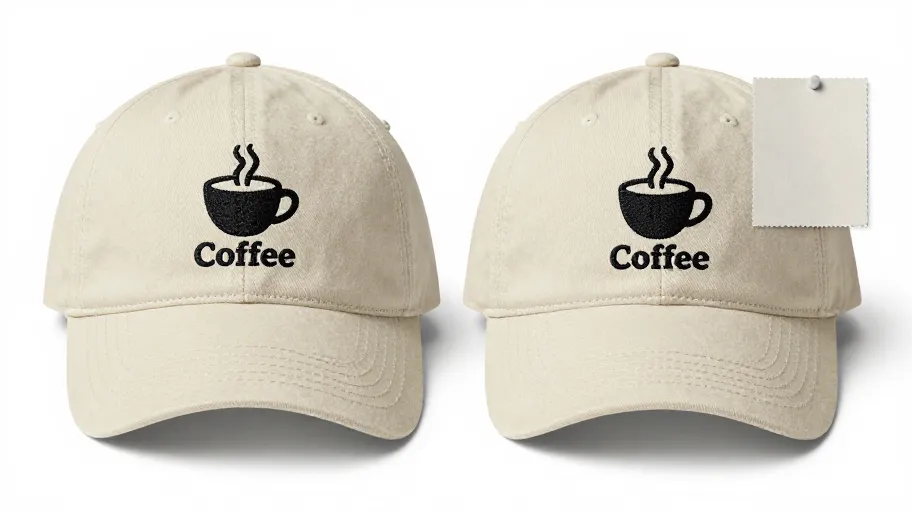
Custom hats for coffee shops become straightforward to order when you work through three decisions in sequence: choose the silhouette that matches the brand's look, confirm the logo method and placement on paper, and approve a physical sample before committing to anything further. This article gives you the framework, the tables and the questions to run that process.
Why a coffee shop brief differs from a generic cap order
A café or coffee brand is buying headwear as part of an identity, not as a one-off giveaway. Staff may wear the same cap style daily behind the counter, a merchandising drop may sit alongside retail packaging, and a wholesale buyer may be ordering for several locations whose interiors differ. That means the decisions that matter most are not production statistics but specification clarity: the exact crown shape, panel construction, front structure and visor shape — and a logo treatment that reproduces the brand mark faithfully at small scale.
When several people in your chain of command — brand manager, merchandiser, importer — each imagine a different cap, the resulting sample disappoints everyone. The fix is a written brief agreed before sampling.
Step 1: Plan style and silhouette
| Attribute | Options to compare | What it changes for a coffee brand | Approval question to answer in writing |
|---|---|---|---|
| Crown profile | High / middle / low | A high crown reads bold and streetwear-leaning; a low crown reads understated and uniform-like | Which profile best matches our counter and retail imagery? |
| Panel construction | Structured vs unstructured front panels | Structured fronts hold a flat or 3D logo crisply; unstructured crowns suit a relaxed café aesthetic | Do we want the logo to stand off the cap or sit into it? |
| Front structure | Buckram/fused support vs soft | Determines how the brand mark appears from across a shop | Will the front keep its shape after daily wear and cleaning? |
| Visor shape | Curved, flat, or intermediate | Flat visors skew contemporary; curved visors skew classic workwear | Which visor shape appears in our brand reference imagery? |
If your team cannot answer all four questions from existing imagery, that is the first gap to close — send reference images to your supplier and ask them to name each attribute before a sample is made.
Step 2: Plan the logo and its placement
| Decoration route | Best suited to | What to verify with your supplier |
|---|---|---|
| Embroidery | Wordmarks and simple icons; staff uniforms needing durability | Can my artwork's smallest detail survive at the intended stitch scale? |
| 3D embroidery (puff) | Bold single-word marks | Does my typeface suit a raised finish? |
| Woven label or patch | Detailed multi-colour logos | Where is the label attached, and how is it finished? |
| Screen / digital print | Full-colour artwork on unstructured caps | Which substrates and placements are compatible with my artwork? |
| Woven side or back labels | Retail-grade finishing detail | Can multiple placements be combined in one order? |
Approval questions to settle before sampling:
- Where exactly will the logo sit — front centre, front-left, side, back, or a combination?
- What size will the logo be on the cap, measured on a physical sample?
- Will the artwork need to be adapted (simplified, resized, colour-matched) to suit the chosen decoration method?
- How will we document the approved placement and size so production follows the same spec?
Ask your supplier how each of these will be recorded and confirmed. Do not rely on a conversation.
Step 3: Approve a sample before any commitment
Sampling is where a written brief pays for itself. Before requesting or approving any sample for a coffee shop headwear order, walk this checklist:
Sample approval checklist
- Brief in writing: profile, panels, front structure, visor shape, decoration method, placement, artwork version.
- Reference images attached and labelled with the attributes they illustrate.
- Confirm the current sample policy with the supplier directly — including whether a sample fee applies, who arranges shipping, and the applicable terms — before sending artwork.
- Sample received: check silhouette against your reference, not against memory.
- Check logo size, position and finish under shop-style lighting.
- Photograph and archive the approved sample as the production standard.
- Document any change requests in writing and confirm the revised spec before further sampling.
Questions to put to any supplier you are comparing:
- Which decoration methods do you offer for my specific artwork, and which do you recommend — and why?
- How will you confirm profile, panel construction and visor shape before sampling?
- What is your current sample policy, including any fees and shipping arrangements?
- How do you document an approved sample so it governs production?
- What information do you need from us to quote this order accurately?
Choosing between suppliers on equal terms
Because quotes for custom hats for coffee shops can differ in scope, compare vendors using the identical brief. Send the same written spec, the same artwork and the same reference images to each supplier, then compare their responses on: how precisely they read the spec, how they propose to handle the decoration details, and how their sampling process is documented. A supplier that returns a precise reading of your brief is easier to hold to standard than one that promises outcomes it has not evidenced.
FAQ
Can we order several cap styles under one coffee brand brief? Yes — many brands mix a structured front cap for staff and an unstructured cap for retail. Confirm with your supplier how multiple styles within one brief are handled, and keep the written attributes (profile, panels, visor) separate for each style.
What artwork should we prepare before contacting a supplier? Prepare vector artwork where possible, plus photographs showing the intended placement and scale. Note in the brief which attributes from Step 1 you intend to order.
How many samples should we approve? Approve whatever is needed to lock every variable in the checklist — one sample may cover silhouette and decoration, or you may need iterations. Document each round's changes in writing.
Can we combine a hat order with other café merchandise? Some buyers coordinate headwear with aprons or apparel as one identity programme. Ask the supplier what they manufacture themselves and what would be handled differently, and confirm the scope of any combined order in writing.
What happens after the sample is approved? Once a sample is documented as the standard, the next step is confirming the current quotation and production arrangements with your supplier directly. Ask for the approved sample specification to be referenced in the order documents.
Primary CTA — submit your brief for review. Send New Generation your cap brief, a reference image or your logo, and receive a project-specific review covering silhouette, decoration and the sampling steps your order needs. Confirm every term directly with the team before committing.
Low-friction checklist CTA. Not ready for a full brief? Copy the Sample approval checklist above into your procurement notes, fill in the four silhouette attributes from Step 1, and use it to brief any supplier you compare.
#cap manufacturers china, #headwear manufacturers china, #cap factory








