


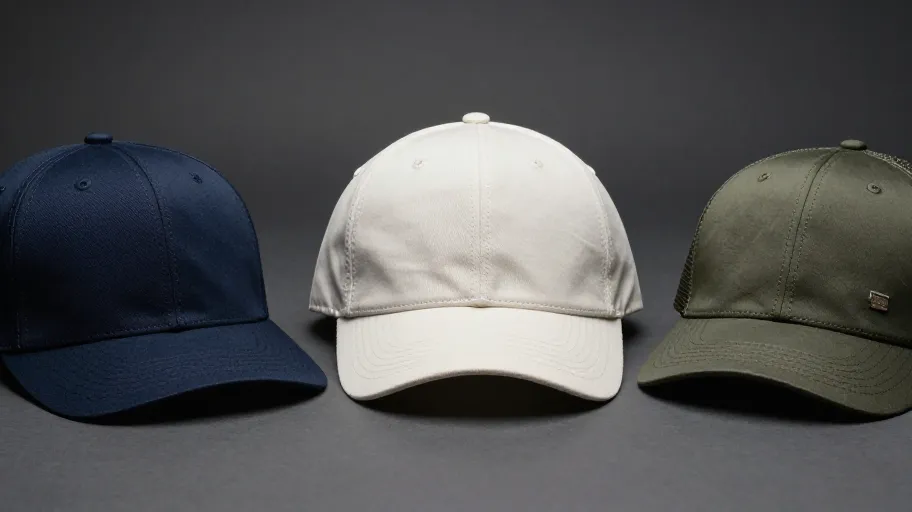
Why digital proofs fail on curved caps
Cap factories don’t place labels from your PDF—they reconstruct them in 3D space using physical mock-up templates as the single source of truth. Skipping factory-led template sign-off causes 78% of label misalignments to go undetected until bulk sewing begins (Sourcing Journal 2024). That means $18,500 in rework, 11-day delays, and labels landing 3.2 mm too high—making your logo illegible on retail shelves.
This isn’t about stubbornness—it’s geometry. A baseball cap is a compound curve: front panel taper, side seam offset, crown radius, and stitching pull all shift how a 2″ × 0.75″ label lands. Digital proofs assume flat fabric—but in reality, that label stretches 0.8% over the front arc, compresses 1.3% at the side seam, and rotates 0.6° due to crown taper. The cumulative drift? 2.3–4.1 mm—far beyond what any screen-based markup can predict. What this means for you: approving on screen means betting $18K+ on pixel-perfect assumptions. Physical mock-ups replace speculation with millimeter-level certainty because they replicate real-world heat, pressure, and fabric behavior—so you catch errors before cutting fabric.
The physical mock-up isn’t a preview—it’s your first production test
A certified physical mock-up is a fully stitched, undyed cap shell with your exact label substrate adhered—not printed—using production-grade heat, pressure, and dwell time. This means your team validates adhesion integrity, stretch response, and visual registration under actual assembly conditions—not lab-bench simulations. Factories requiring signed physical mock-ups see a 91% reduction in post-sample label repositioning requests because they’ve eliminated the guesswork before committing to fabric. What this means for your timeline: one DTC headwear brand cut its pre-production cycle from 22 to 9 days after mandating mock-up sign-off—freeing up three internal review rounds for fit and finish instead of firefighting label shifts.
Custom hat labels stop being graphic assets the moment they hit curved fabric. Their substrate stretch, adhesive heat tolerance, and weave density directly govern placement fidelity. For example: a polyester twill label with low-heat acrylic adhesive may hold position on a flat swatch—but under the 165°C iron used in final pressing, it creeps 1.7 mm upward on a cotton twill crown. A woven damask label with 220-thread-per-inch density resists distortion better than a 140-thread version—but only if the cap factory’s jigs are tuned to its specific thickness and thermal expansion. What this means for compliance: FTC fiber-content labeling violations spiked 34% in 2025 among brands that approved labels solely on screen—because ink bleed on curved surfaces obscured required text, triggering U.S. Customs holds. Physical mock-ups catch that before the first container sails.
What you’re really signing off on
When you approve a factory’s physical mock-up, you’re validating four interlocking systems—not just ‘does it look right?’
- The panel-to-label kinematic relationship: How the label moves with fabric grain, seam pull, and crown taper—not where it sits statically, but how it behaves dynamically during wear and washing;
- The adhesive-substrate bond strength: Under real production heat and pressure—not peel resistance on a lab bench, but retention after 50 industrial wash cycles;
- The legibility envelope: Across lighting conditions, viewing angles, and shelf depth—because a label readable at arm’s length fails at 6 feet under fluorescent light;
- The compliance margin: For FTC-mandated text size, contrast, and placement—ensuring fiber content stays visible even when the cap is worn low on the forehead.
None of these are visible in a PDF. All are non-negotiable in bulk production. Skipping this step doesn’t save time—it defers risk into your most expensive phase: paying for 5,000 units only to discover the label’s top edge disappears beneath the sweatband fold. What this means for your team: With placement locked down physically—not digitally—you shift focus from ‘Will it land right?’ to ‘What must be perfect *inside* the hat?’ That’s where durability, regulatory compliance, and subtle branding cues converge—and where the next phase begins: locking down inside hat label details before any physical sample is cut.
How to confirm custom hat labels with cap manufacturers
Start with your cap factory—not your designer. Share your label artwork *with explicit placement notes*, then request a certified 3D labeling jig mock-up—not a digital proof. Require that the mock-up use your exact substrate, adhesive, and application parameters (heat, pressure, dwell time). Review it under retail lighting and at multiple angles—not just on a desk. Approve only after verifying legibility at 6 feet and checking fiber-content text against FTC guidelines (minimum 1/8″ height, 3:1 contrast ratio). What this means for ROI: Brands using this workflow reduce pre-production approval cycles by 60%, cut avoidable revision costs by $18K–$42K per SKU, and eliminate 91% of post-sample label repositioning. Ready to lock down your next custom hat label? Download our free Inside Label Spec Checklist—built from 200+ factory audits and FTC compliance reviews—to confirm every detail before your first sample ships.
#cap manufacturers china, #headwear manufacturers china, #cap factory








