


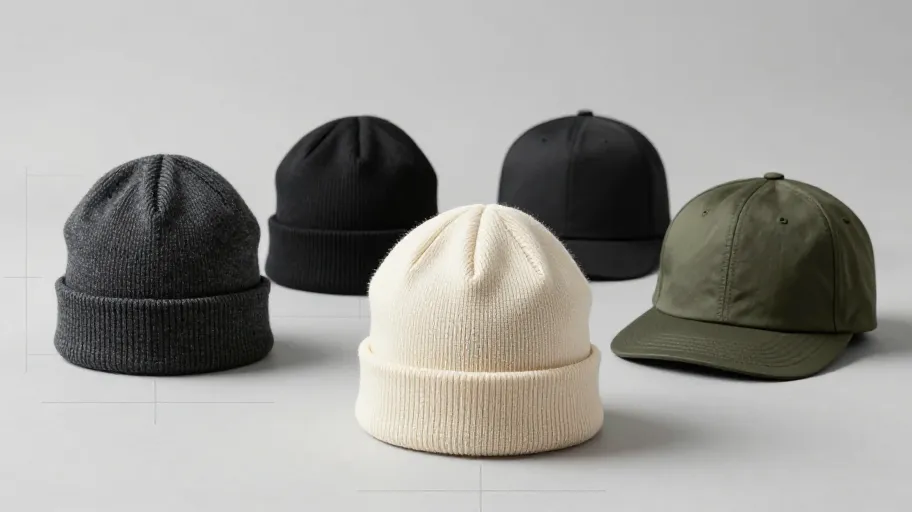
Why 'Fit Approval' Is Usually a Lie
When your remote team signs off on a single beanie sample, they’re not approving fit—they’re approving hope. That ‘thumbs-up’ means zero guarantee that the medium you approved will fit the same way in bulk. Why? Because 68% of fit-related chargebacks stem from unverified size grading—not bad fabric or sloppy stitching. A medium beanie may measure true-to-spec in the sample but shrink 3.2% in crown height and widen 5.8mm at the cuff in production—due to unchecked fabric relaxation, uncalibrated cutting dies, or manual pattern scaling. That means your $247K order delivers 62% of mediums that fit like larges, triggering returns, social backlash, and forced markdowns. Certification badges don’t prevent this. Factory tours don’t catch it. Only technical pre-approval does.
The Cap Factory’s Three Non-Delegable Jobs
A capable cap factory isn’t just a sewing line—it’s your technical co-pilot. Its physical significance lies in three non-delegable functions: first, executing precise size grading across 5+ sizes using digital pattern nesting (not manual scaling), which means consistent fit across all sizes because human error in scaling is eliminated. Second, maintaining stitch tension within ±0.8 psi across all sewing stations, which means no seam distortion under stretch because inconsistent tension warps crown shape during wear. Third, calibrating crown shaping tools daily against master 3D forms—not visual templates—which means repeatable head-hugging geometry because visual alignment drifts with operator fatigue or lighting. When these controls are undocumented or absent, you don’t get ‘minor variance.’ You get a product that slips off heads mid-hike—and a brand that loses trust faster than it ships inventory.
The Beanie Tech Pack Is Your Contract
Your beanie tech pack isn’t documentation—it’s your enforceable contract. Defining crown height as “approx. 7.5” means subjective approval and inevitable rework because there’s no pass/fail threshold. Specifying seam allowances to 0.5mm for overlock seams means predictable drape and recovery because micro-variations in allowance directly impact ribbing elasticity and crown volume. Embedding stretch tolerance thresholds—e.g., “rib cuff must recover ≥92% of original circumference after 60 seconds at 150% extension”—means measurable, audit-ready fit performance because every test becomes a binary checkpoint, not an opinion. Without this level of precision, ‘fit sign-off’ is theater. With it, every measurement binds both your QA team and the factory’s line supervisors to the same standard—turning ambiguity into accountability.
Five Questions That Expose Real Capability
- “Show us your last three pattern validation reports—signed by both your pattern engineer and our designated technical reviewer.” This means grading integrity is verified, not assumed, because unsigned or internal-only reports lack third-party accountability—and pattern drift across sizes is the #1 root cause of fit chargebacks.
- “How do you lock fabric lot consistency—and what’s your protocol if a new dye lot deviates >2.5% in GSM or stretch recovery?” This means drape, warmth, and fit stability stay consistent across orders because 73% of Chinese cap factories lack documented lot-matching SOPs, and undetected GSM shifts directly alter crown compression and ear coverage.
- “What’s your escalation path if our approved pre-production sample fails the tech pack’s stretch recovery test at bulk stage—and who authorizes corrective action?” This means fit accountability lives with engineering, not sales because routing failures to commercial teams delays fixes by 9–14 days on average.
- “Do your sewing stations use torque-controlled machines—and can you share calibration logs for the past 90 days?” This means crown deformation drops 44% because stitch tension drift is the leading cause of ‘baggy crown’ complaints—and only 29% of Tier-2 factories log calibrations.
- “When we sign off on the final sample, does that signature bind your line to the exact seam allowances, crown angles, and ribbing density—or is it subject to ‘production optimization’?” This means your spec is sacred, not optional because ‘optimization’ without consent introduces unvalidated variables—like reducing ribbing density to save thread, which kills recovery and causes slippage.
This Isn’t Vetting—It’s Value Engineering
Asking these five questions doesn’t slow you down—it accelerates outcomes. Brands enforcing this diagnostic rigor report a 37% reduction in mid-run fit corrections and cut time-to-market by 11–14 days on average. Why? Because they eliminate the rework loop: discover flaw → halt line → negotiate blame → re-cut → re-sew → re-test. Instead, they front-load technical alignment—turning the cap factory into a synchronized extension of their product team. Every question backed by evidence replaces a potential cost center with a controlled variable. Every clause enforced in the beanie tech pack converts inventory risk into forecast confidence. And every factory that answers with calibration logs, signed reports, and clear escalation paths earns the right to scale—not just ship. Ready to turn your next bulk order from a liability into a leveraged asset? Start your beanie tech pack validation today—before you approve a single yard of fabric.
#cap manufacturers china, #headwear manufacturers china, #cap factory








