


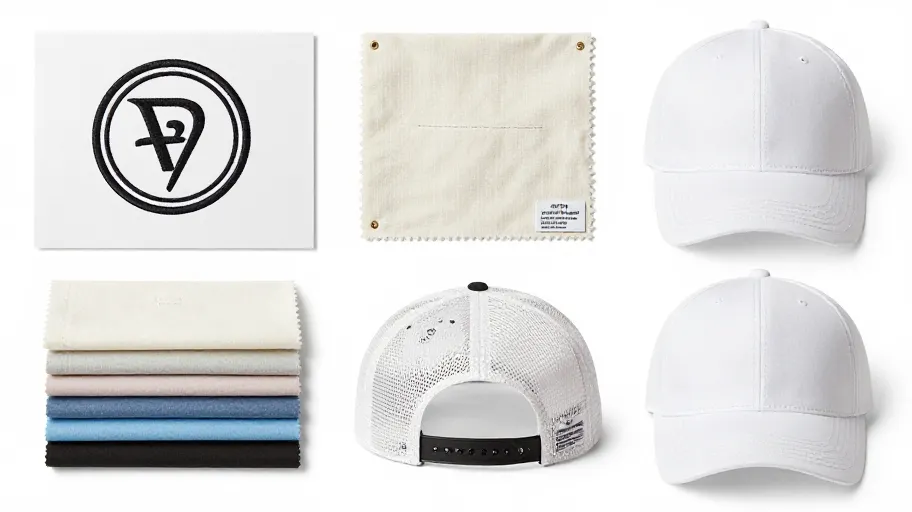
Most rework on private label headwear does not start on the production line — it starts in the specification. Before you choose a private label hats manufacturer, close five specification layers in writing: artwork, materials, construction, sizing and fit, and finish. Whatever you leave open, someone downstream will fill in for you.
Why specification gaps, not workmanship alone, drive rework
When a private label brand receives a cap that does not match expectations, the instinct is to blame the factory. In practice, the root cause can be traced back much earlier: a phrase like "premium cotton cap" left on a spec sheet, an embroidery file sent as a flat JPG, a colour described as "our brand blue" without a code, or a closure type that was never explicitly confirmed.
A capable manufacturer will ask clarifying questions. But an overloaded one will make assumptions instead — and those assumptions get baked into samples, and sometimes into bulk. The buyer then pays for the gap twice: once in revised samples, and again in schedule slip.
The remedy is not distrust. It is a disciplined specification process, agreed with your private label hats manufacturer before any sample is cut. The framework below gives you a structure for that conversation.
The Specification Lock Framework: five layers to close before production
We call it the Specification Lock Framework: five layers of detail, each of which should be locked in writing before bulk sign-off.
Layer 1 — Artwork and branding. Lock the vector files, thread counts, stitch direction, embroidery or print placement, logo dimensions relative to the panel, and how the artwork behaves on curved surfaces. A logo that looks fine flat can distort badly over a structured crown.
Layer 2 — Materials. Specify fabric composition and weight, colour codes (Pantone or equivalent), lining, sweatband material, and hardware such as buckles, eyelets and snaps by reference, not by adjective. "Heavy brushed cotton" is not a specification; a named fabric with a stated composition is.
Layer 3 — Construction. Confirm crown structure (structured or unstructured), panel count, closure type, stitching method at seams, and whether the visor is pre-curved and how it is reinforced. These choices change both the look and the cost, so they should be deliberate rather than inherited from a previous order.
Layer 4 — Sizing and fit. Lock the size system (fitted, adjustable, or a stated size run), head circumference measurements per size, and crown height and brim dimensions. For corporate and wholesale buyers, fit consistency across a size run matters more than any single sample's look.
Layer 5 — Finish and packaging. Confirm labelling (main label, care label, hangtag), folding method, polybag or box packaging, carton packing ratio, and any retail-ready requirements. Packaging gaps are a frequent source of last-minute rework at the warehouse stage, not the factory stage.
Once each layer is locked, the specification document becomes your shared reference. Every later disagreement is resolved against a document, not against memory.
Decision table: comparing manufacturers on specification clarity
When comparing candidates, look past the quote and compare how each one handles specification discipline. Use a table like this in your internal evaluation:
| Evaluation point | What strong looks like | What weak looks like |
|---|---|---|
| Spec intake | Requests vector files, colour codes and measurements before sampling | Starts sampling from a logo image and a short description |
| Sampling loop | Ties each sample revision to specific spec line items | Sends "improved" samples with no documented change list |
| Communication | Puts material and construction confirmations in writing | Confirms key choices verbally or in chat fragments |
| Change management | Flags any spec change with a documented impact on cost and schedule | Accepts changes silently and surfaces issues later |
| Bulk sign-off | Requires your written approval against the final locked spec | Proceeds once the deposit is paid |
No single row is decisive on its own; the pattern across all five is what tells you whether a manufacturer will protect you from rework or absorb you into it.
Concrete approval questions to put in writing
Bring these questions into your next development conversation, and require written answers, not summaries:
- Which specific fabric composition and weight will you use, and can you confirm it against a physical swatch reference before bulk?
- What colour-matching method do you apply, and how will you document the approved colour reference for bulk production?
- For this embroidery file, what stitch density and backing will you use, and can I approve a digitised sample before bulk?
- What exactly does your bulk production approval include, and at which point are changes no longer possible without rework?
- How do you document a spec change, and who on your side signs off against the revised document?
- What is your current policy on samples, including any fees and shipping arrangements, for a project like mine? Please state it directly, as I will confirm it in writing.
- What is your current minimum order quantity for this construction and material combination?
Question 7 is deliberately phrased as a question. Minimum order quantities vary by construction, material and decoration method, so ask for the figure that applies to your specific project rather than accepting a general statement.
Worked scenario: how a gap becomes a dispute
Consider a private label brand ordering embroidered caps. The spec sheet says "black cap, our logo, adjustable". No fabric reference, no colour code, no stitch specification.
The sample arrives. The black is a matte finish; the brand expected a slight sheen. The logo is legible but finer detail is lost. Both parties did reasonable work — but the specification never defined finish or stitch density. The brand requests a revision; the factory revises; the schedule slips; trust erodes. Nobody was dishonest. The gap was simply left open.
Contrast that with the same project under the Specification Lock Framework: fabric reference confirmed by swatch, colour locked to a code, digitised logo approved at a stated stitch density, closure type named. The sample either matches the document or it does not. Rework, where it happens, is targeted and quick — and, crucially, responsibility is traceable.
FAQ
How detailed does my spec sheet need to be for a first enquiry? Detailed enough to avoid wrong assumptions on the highest-risk items: fabric reference, colour codes, logo artwork files, closure type and size system. You can refine construction and packaging details during sampling, but the first four layers of the framework should be in your initial brief.
Who decides the stitch count and digitising for my logo? You approve it. Ask the manufacturer to provide a digitised embroidery file and a sewn-out sample at the production setting, then approve that reference in writing before bulk. Treat the approved sew-out as part of your locked specification.
Should I rely on the sample as my quality reference? A sample is a physical reference, but it works best alongside a written spec. Documents define what was agreed; samples show how it looks and feels. Use both, and reference the locked spec whenever you comment on a sample revision.
What if I want to change the design mid-development? Changes are normal in development; undocumented changes are not. Ask the manufacturer to state the impact of any change on cost and schedule before you approve it, and update the spec document so the bulk reference stays accurate.
How do I compare two manufacturers offering similar quotes? Compare specification discipline, not just price. Ask both to respond to the approval questions above. The one that answers with precise, documented commitments is the one more likely to deliver what you approved.
Request the development brief
If you are preparing a private label headwear programme, the fastest way to start on the right footing is a structured brief. New Generation, a Shenzhen-based OEM/ODM manufacturer of custom caps and headwear, has prepared a development brief template that walks you through all five specification layers — artwork, materials, construction, sizing and finish — so nothing is left open for assumption.
Request the development brief today, send us your brand requirements, and we will come back with specific questions and written confirmations on every layer that matters for your project.
Low-friction checklist: ready to send a brief?
Before you request it, tick off what you already have:
- Vector artwork files for logos and branding
- Colour codes (Pantone or equivalent) for fabric and stitching
- Preferred closure type and size system
- Fabric preference or reference swatch
- Labelling and packaging requirements
- Your target quantities and markets
If you can tick even half of these, you have enough to start a productive specification conversation. Send what you have — we will help you close the gaps.
#cap manufacturers china, #headwear manufacturers china, #cap factory








