


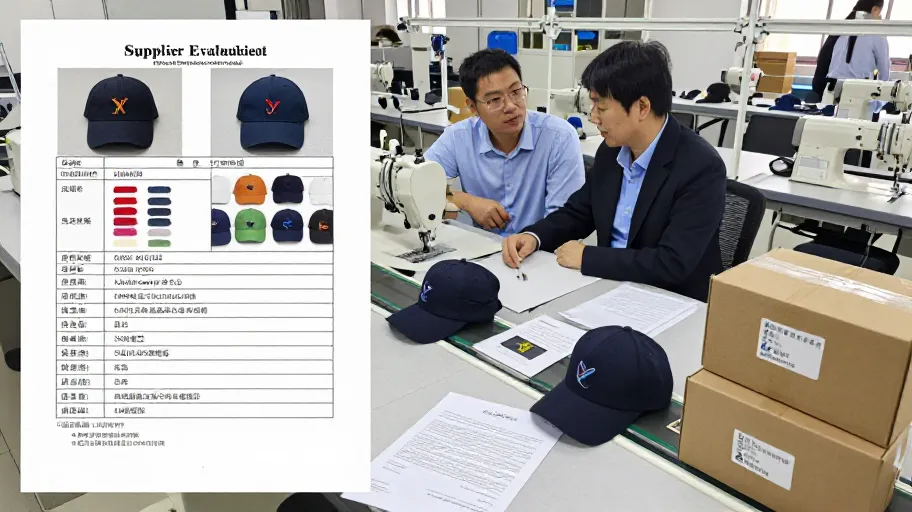
When buyers search "who are some caps manufacturers in china?", the real question underneath is not a list of names — it is how to tell which of those names can actually deliver a private-label cap programme to standard. The fastest reliable route is to evaluate every candidate against the Six-Gate Supplier Evaluation — Documents, Capability, Communication, Quality Control, Commercial Terms, and a Pilot Order — and to eliminate any manufacturer who cannot pass each gate with evidence you can verify and file. This article walks through each gate, the exact questions to ask, and how to compare candidates side by side before you commit a deposit.
Why the question itself needs reframing
A list of manufacturer names costs nothing. Search results, directories and trade platforms will hand you dozens of candidates within minutes, and every profile will look polished. That is precisely the problem: presentation is not evidence.
For a private-label project, the variables that determine whether the partnership works — sample policy, pricing basis, minimum order quantities, production scheduling, quality control methods and communication responsiveness — are all project-specific and must be confirmed directly with each supplier in writing. No listicle can answer those questions for your product, and a sourcing adviser who pretends otherwise is doing you a disservice.
So treat the search results as a candidate pool, not an answer. Your job is to run each candidate through a structured evaluation and let evidence, not marketing copy, decide.
The Six-Gate Supplier Evaluation
Gate 1: Documents
Before any conversation about price or design, ask each candidate for verifiable business documentation: registered legal entity name, business licence details, export experience relevant to your destination market, and the factory's physical address. Then verify what you receive independently — cross-check the registered name against the name on quotations and contracts, and confirm the address matches what the company publishes.
One distinction matters more than almost anything else at this stage: whether you are dealing with the manufacturer itself or a trading intermediary acting between you and a factory. Neither is automatically wrong, but they behave differently on accountability, communication and pricing. Ask each candidate directly: "Are you the manufacturer, or do you work with partner factories? If a partner, who is contractually responsible to me for quality and delivery?" Get the answer in writing.
Gate 2: Capability
Capability questions are product-specific and must be answered per project. Do not accept a brochure. Ask each candidate:
- Which headwear product categories do you produce in-house versus outsource?
- What construction methods — structured, unstructured, embroidered, printed, woven label — are handled on your own floor?
- Which decoration techniques do you run internally, and which go to subcontractors?
- Can you produce to a tech pack I supply, and who on your team reviews it before sampling?
Match the answers against your project's actual requirements. A supplier strong in one cap category may rely on subcontracting for another, and that changes where quality risk sits.
Gate 3: Communication
Communication failures are the most common cause of private-label disappointment, and they are detectable before any money changes hands. Score each candidate on:
- Who is your single point of contact, and who covers when they are unavailable?
- In what language and channels do you confirm specification changes?
- How do you document approvals — email, signed samples, a formal approval sheet?
- If a problem arises mid-production, what is the escalation path and who has authority to resolve it?
A supplier who answers these questions precisely is signalling how they will behave when something goes wrong. A supplier who dodges them is signalling that too.
Gate 4: Quality control
Ask each candidate to describe, in their own words, how they control quality for a custom cap order: at which stages inspections occur, who performs them, what records are produced, and how defects found at inspection are handled. Then ask the question that separates process from promise: "May I appoint a third-party inspection before shipment, and will you accommodate that?" A manufacturer confident in its process will say yes without hesitation.
Also request, for your own project, the definitions they use for acceptable quality levels, tolerance on construction and colour matching, and what documentation accompanies a shipment. Every answer here is a commitment to be written into your contract — not a verbal assurance.
Gate 5: Commercial terms
This gate collects the variables every buyer must confirm directly, per supplier and per project, because they vary by product, quantity, decoration and destination. Put these questions to each candidate and record the answers in a comparison sheet:
- What is the minimum order quantity for my specific design, fabric and decoration?
- On what basis is pricing calculated — and what would change the price: quantity tiers, materials, decoration method, packaging?
- What are your payment terms and schedule for a first order?
- What is the current sample policy for my project — who arranges samples, on what terms, and at what cost?
- What is the quoted production schedule for my confirmed quantity, and how is it documented?
- What shipping terms and incoterms do you quote, and what does each option include?
Never generalise from one quote to another project, and never assume one supplier's terms apply to the next. Confirm each point in writing against your current specification.
Gate 6: Pilot order
However strong a candidate looks on paper, structure a first engagement that limits your exposure. A pilot order — deliberately smaller than your intended programme — lets you verify how the supplier actually performs: whether the pre-production sample matches the approved one, whether communication holds up under production pressure, and whether the goods you receive match what you approved.
Before releasing a pilot, agree in writing:
- An approved sealed sample as the quality reference.
- A documented specification sheet covering materials, construction, decoration and packaging.
- The inspection method and timing before shipment.
- What happens — and who decides — if the delivered goods deviate from the approved sample.
Only after a pilot meets every documented expectation should you scale the programme.
Comparing candidates: a decision table
Use this structure to compare your shortlist objectively. Score each row per supplier, and weight the rows according to what your project values most.
| Evaluation dimension | What strong evidence looks like | What weak signals look like | Weight for your project (set your own) |
|---|---|---|---|
| Legal identity & role | Verifiable registration; clear manufacturer-vs-intermediary answer in writing | Vague entity names; mismatch between quote and licence details | ___ |
| Product capability match | Specific in-house processes matching your design requirements | Generic "we make everything" answers | ___ |
| Communication quality | Named contact; documented approval processes | Slow, shifting or unconfirmed answers | ___ |
| Quality control | Defined inspection stages; accepts third-party inspection | No records offered; resists external inspection | ___ |
| Commercial terms | Written, project-specific answers to every MOQ, price and policy question | Refuses to put terms in writing; "we'll discuss later" | ___ |
| Pilot willingness | Agrees to documented pilot conditions | Pushes for large first order with no approvals defined | ___ |
Any supplier who fails two or more weighted dimensions should move down your shortlist, whatever their presentation looks like.
Approval questions to put to every candidate
Before signing anything, require written answers to:
- Are you the manufacturer for my specific product, and who is contractually responsible for quality and delivery?
- What is your current sample policy for this project, including who arranges and what it costs? (Confirm — do not assume.)
- What is the minimum order quantity for my exact specification?
- What is the quoted production schedule, and how is a confirmed schedule documented?
- May I appoint a third-party inspection before shipment?
- What documentation accompanies each shipment?
- Which incoterms do you quote, and what does each include?
- Who signs off specification changes, and how are changes recorded?
A candidate's willingness to answer these in writing is itself one of the strongest evaluation signals you will get.
Your pre-commitment checklist
Before you pay any deposit to any caps manufacturer in China, confirm you have:
- Verified the supplier's registered legal entity and physical address independently
- A written answer on manufacturer vs. trading role
- Capability answers matched against your specific design, not generic claims
- A named contact and documented communication/approval process
- Written, project-specific answers on MOQ, pricing basis, payment terms and schedule
- Confirmed the current sample policy directly with the supplier
- An approved sealed sample and a signed specification sheet
- Agreement on pre-shipment inspection rights
- Pilot-order conditions documented before scaling
FAQ
Is a lower quote automatically a red flag? Not on its own. Prices differ legitimately with materials, construction, decoration, quantity and shipping basis. What matters is whether each quote is itemised and project-specific. Ask every candidate what drives their price and what would change it — then compare like with like on identical specifications.
Should I only work with factories, never trading companies? Judge behaviour, not labels. Some intermediaries manage programmes well; some factories subcontract processes you assumed were in-house. What matters is written clarity on who is contractually responsible to you for quality, delivery and communication. Insist on that clarity at Gate 1.
How do I verify a factory is real without visiting? Combine independent document checks (registration, address consistency), a video walk-through arranged by the supplier, third-party inspection options, and a pilot order with documented approval conditions. No single check is sufficient alone; the combination is what protects you.
What if the sample is perfect but bulk goods differ? This is why Gate 6 exists. A sealed approved sample plus a signed specification sheet gives you the reference standard for any dispute. If a supplier resists documenting approvals before production, treat that resistance as a major evaluation signal.
How many candidates should I evaluate seriously?
Download the Supplier Scorecard
Put this whole process into one working document. The Supplier Scorecard turns the Six-Gate Evaluation into a scoring sheet you can use across every candidate — with the exact questions, comparison table and approval checklist built in.
[Download the Supplier Scorecard] — free, and ready to use on your next sourcing round.
A closing note from your sourcing adviser
The query "who are some caps manufacturers in china?" will keep returning new names, and names alone will never de-risk a private-label project. Process will. Evaluate every candidate — New Generation included — against the same six gates, demand written answers to the same questions, and confirm every commercial policy directly against your current specification before you commit. Suppliers who welcome that scrutiny are the ones worth shortlisting; that is the standard we hold ourselves to, and it is the standard we recommend you hold every manufacturer to.
#cap manufacturers china, #headwear manufacturers china, #cap factory








