


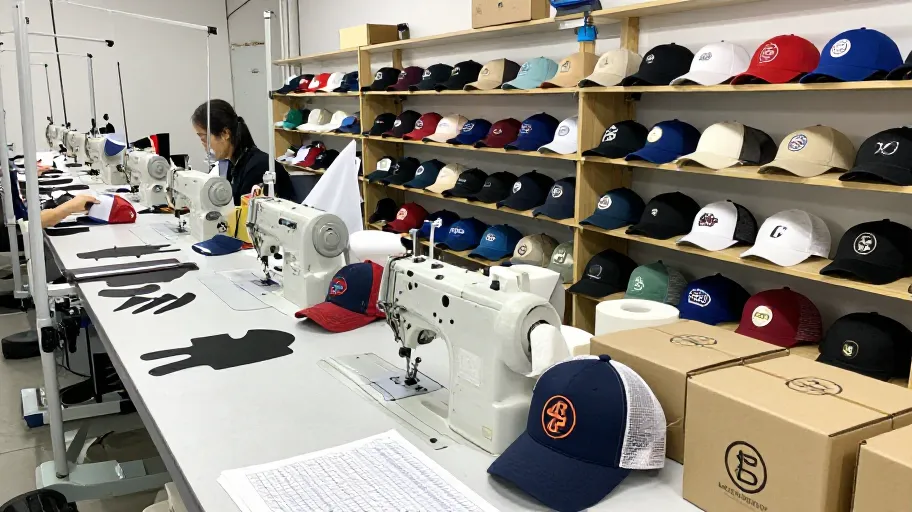
The most reliable way to evaluate private label hat manufacturers usa — and to compare them against overseas OEM/ODM partners — is to score each candidate against the same eight-lens framework: Specification, Asset control, MOQ & scale, Pricing transparency, Lead-time discipline, Sampling & approval, Innovation fit, and Governance. Collecting written answers on each lens turns a stack of confusing quotations into a single, comparable scorecard — and exposes the supplier who cannot document what it claims.
Why a structured evaluation beats a price-only comparison
If you are a brand owner, importer, wholesaler or corporate buyer, the temptation is to shortlist by unit price. The problem is that two quotations rarely describe the same thing: one may include decoration, labels and packaging; another may not. Without a shared evaluation structure, you are comparing documents, not capabilities.
A structured evaluation does three things for you:
- It forces written commitments. Verbal assurances about quality or timing are worthless once a dispute begins. A scorecard makes every claim a documented answer you can reference.
- It equalises comparison. When every supplier answers the same questions, differences in honesty become visible — the supplier who dodges a question is telling you something.
- It de-risks the first order. Your first purchase order is where trust is built or broken. A documented evaluation gives you checkpoints to hold the supplier to.
Whether you are assessing a domestic manufacturer or an overseas OEM/ODM partner such as a Shenzhen headwear factory, the framework is identical. Only the logistics questions differ — and those, too, should be asked in writing.
The SAMPLING framework: eight lenses for scoring any hat supplier
S — Specification capability
Start with your own tech pack: crown structure, panels, closure type, fabric composition, decoration method, label and packaging requirements. Then ask each supplier one question: Can you produce to this exact spec, and can you show evidence? Evidence means photographs of comparable work you have seen in person or via video call, a clear statement of which decoration methods are done in-house versus subcontracted, and a named contact who owns your spec. Do not accept "yes, no problem" without documentation.
A — Asset control
For a private-label project, the assets are yours: artwork, embroidered logos, tooling, dies and brand marks. Ask who owns each asset after production, where those assets are stored, and whether the supplier will confirm in writing that they will not be used for other clients. This question costs nothing to ask and tells you a great deal about how the supplier treats client IP.
M — MOQ and scale fit
Minimum order quantities and production capacity vary by supplier, style and decoration method. Rather than guessing, turn MOQ into a project-specific question: What is your confirmed minimum order quantity for my specific cap style, with my decoration method and my label requirements? Get the answer per style, not as a general claim. Then ask how the supplier handles reorders at smaller or larger volumes, so your second order does not surprise you.
P — Pricing transparency
Request a line-item quotation: base cap, decoration per method, labels and tags, packaging, tooling or setup where applicable, and the incoterms used. Ask which elements could change after sampling and under what conditions. A quote you can read is a quote you can defend; a single blended number is a quote you cannot audit.
L — Lead-time discipline
Do not ask "how long does production take" in the abstract. Ask: For my confirmed quantity and spec, what is the stated sampling timeline and production timeline, and what are the documented checkpoints within it? Then ask what happens if a checkpoint slips. A supplier who has an answer for slippage is a supplier who plans; one who only quotes a headline number is a supplier you will be chasing.
I — Sampling and approval
N — Innovation fit
For brands building a range, ask what the supplier can offer beyond the standard cap: new silhouettes, fabrications, closures or decoration techniques. This is not about hype; it is about whether the supplier can grow with your next collection. Ask to see options relevant to your category, and note which suppliers bring ideas versus which only take orders.
G — Governance
Finally, cover the unglamorous items: who signs your contract, how quality issues are raised after delivery, what the written process is for handling defects in a shipped order, and what communication cadence you can expect during production. Put each answer into your scorecard. After-sales handling is best agreed before the purchase order, not negotiated during a crisis.
Decision table: comparing suppliers on an equal footing
Score each candidate supplier on a simple 1–5 scale per row, and keep the evidence next to each score.
| Evaluation row | What "5" looks like | What "1" looks like | Evidence to attach |
|---|---|---|---|
| Spec confirmation | Written confirmation per line of your tech pack, with open questions flagged | Vague "yes" with no reference to your spec | Annotated tech pack with supplier responses |
| Asset control | Written confirmation of client IP ownership and non-reuse | No answer or refusal to put it in writing | Signed IP/asset statement or email confirmation |
| MOQ & scale | MOQ quoted for your exact style and decoration | MOQ given as a sweeping general figure | Quotation per style |
| Pricing transparency | Fully itemised quote with incoterms stated | Single blended price with no breakdown | Line-item quotation |
| Lead-time discipline | Timeline with named checkpoints and slippage plan | One headline date, no detail | Documented production schedule |
| Sampling & approval | Clear approval chain with sign-off criteria | Sample promised, process undefined | Sample policy in writing + approval plan |
| Innovation fit | Relevant style and decoration options presented | Catalogue only | Options sheet or range proposal |
| Governance | Named contacts, cadence, written after-sales process | "Contact your sales rep" | Communication and after-sales summary |
A supplier scoring well on price but poorly on sampling, governance and asset control is not a bargain — it is a deferred risk.
Approval questions to put in writing before any purchase order
Bring these questions to every shortlisted supplier. The answers themselves are the evaluation.
- Can you confirm, in writing, your minimum order quantity for my specific cap style, fabric and decoration method?
- Which decoration and finishing steps are completed in-house, and which are subcontracted?
- What is the documented sampling and production timeline for my confirmed quantity, including each approval checkpoint?
- Who owns the artwork, embroidery files, tooling and brand assets once production is complete, and will you confirm this in writing?
- What is your written process for raising and resolving quality issues found after delivery?
- Which incoterms does your quotation use, and what is included at each term?
- Who is my named contact during production, and what reporting cadence can I expect?
Pre-purchase-order checklist
Before you sign anything, confirm every line below is ticked:
- Tech pack reviewed and confirmed line-by-line by the supplier
- MOQ confirmed in writing for each exact style and decoration method
- Itemised quotation received with incoterms stated
- Sample terms confirmed directly with the supplier in their current written policy
- Approval chain agreed: pre-production sample, sign-off criteria, bulk reference sample
- Asset and IP ownership confirmed in writing
- After-sales and defect-handling process documented
- Named production contact and communication cadence agreed
- Scores completed on your supplier scorecard with evidence attached
Frequently asked questions
Should I choose a domestic manufacturer or an overseas OEM/ODM partner? Judge both on the same SAMPLING framework. The capability questions are identical; what differs are freight terms, communication timezone and the logistics clauses in your contract. Ask both types of supplier the same approval questions above and compare documented answers, not assumptions.
Can I evaluate a supplier without visiting the factory? Yes, with discipline. Request a live video walkthrough of the relevant production and decoration areas, keep every commercial answer in writing, and require a pre-production sample you approve against written criteria. If a supplier resists all three forms of evidence, treat that as data.
How many suppliers should I shortlist? Three is a workable number for most private-label headwear projects: enough to see real differences in responsiveness and transparency, few enough to give each one a complete spec and a fair chance to quote properly.
What is the single biggest warning sign during evaluation? Reluctance to document. A supplier can be friendly, fast and well-priced, but if it will not confirm MOQ, timeline, asset ownership or sample terms in writing, you have no basis for recourse if the project drifts.
What should my sample stage achieve? The sample stage should end with a pre-production sample you approve in writing, and a bulk reference sample that future production must match. Confirm the current sample policy — inclusions, shipping and fees — directly with each supplier, since these terms are set by the supplier and can change.
Ready to run this evaluation yourself? [Download the Supplier Scorecard] — the same eight-lens framework above, formatted for side-by-side supplier comparison with space to attach evidence for every score.
Or start lighter: print the pre-PO checklist above and use it in your next supplier call — eight questions, no sign-up needed.
New Generation is a Shenzhen-based OEM/ODM manufacturer of custom caps and headwear for overseas brands, importers, wholesalers and corporate buyers. We publish this framework so buyers can evaluate any supplier — including us — against documented evidence rather than assurances.
#cap manufacturers china, #headwear manufacturers china, #cap factory








