


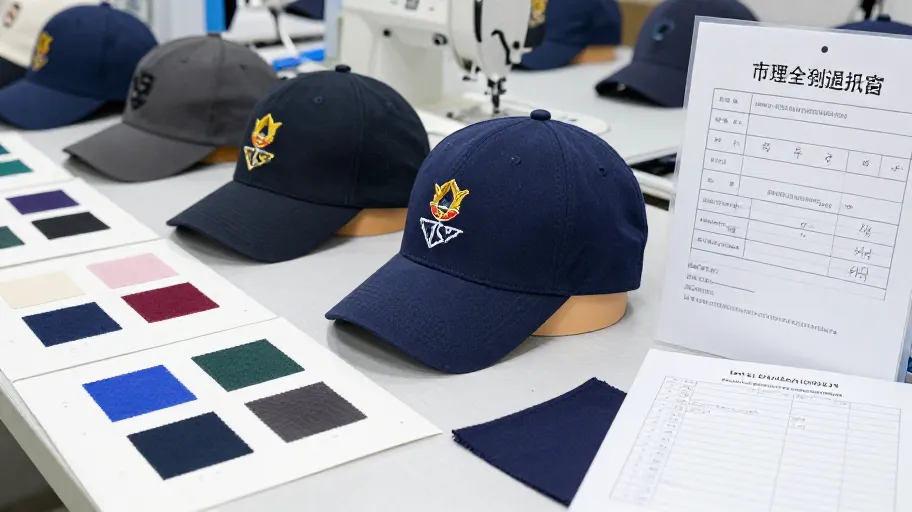
Evaluating a men team cap manufacturer in China for a private-label project comes down to five verifiable gates: design capability, sample quality, production control, compliance readiness and partnership terms. Score every candidate supplier on the same written questions, document each answer, and approve a gate only when the evidence — not the sales pitch — supports it.
Why searches for "men team cap manufacturer china" produce uneven results
A search for a men team cap manufacturer china partner returns hundreds of listings: trading companies presenting themselves as factories, factories without in-house decoration capability, and capable producers whose websites tell you almost nothing useful. The profiles look similar. The reality behind them does not.
The core problem is not finding suppliers. It is comparing them on evidence you can trust. Most buyers rely on a quick sample, a friendly email exchange and a competitive-looking quotation — and discover later that the assumptions behind each were never aligned. A structured evaluation method fixes this before money moves.
This article gives you one: the 5-Gate Supplier Verification Framework, applied specifically to men's team caps — structured crown, adjustable or fitted closures, decorated front panels, and branding that must survive real use by teams, clubs and corporate groups.
The 5-Gate Supplier Verification Framework
| Gate | What you are verifying | Evidence to request | Approve when |
|---|---|---|---|
| 1. Design Gate | The supplier can translate your artwork into a manufacturable cap specification | Tech pack review, construction drawings, decoration method options | The supplier returns your design as a written spec, not just a yes |
| 3. Production Gate | Process control exists between approval and shipment | In-line inspection plan, final inspection method, defect definitions you both agree on | Inspection criteria are documented and agreed in writing |
| 4. Compliance Gate | Materials and documentation meet your market's requirements | Confirmation of which tests and certifications the supplier can support, and which you must arrange | You know exactly who is responsible for what, in writing |
| 5. Partnership Gate | Terms, communication and problem-handling are workable | Written quotation assumptions, revision policy, communication cadence | Every commercial term you care about is confirmed, not inferred |
The framework is deliberately supplier-neutral. It does not tell you which men team cap manufacturer china candidate is better; it tells you how to find out for yourself.
Decision table: spec areas and the approval questions to put in writing
For a men's team cap, these are the specification areas where verbal agreement breaks down. Convert each into a written question before you approve anything.
| Spec area | Written approval question for the supplier |
|---|---|
| Crown construction | Which panel count and buckram/front-interlining construction will be used in bulk, and is it identical to the approved sample? |
| Closure type | Is the closure (snapback, strapback, fitted or other) produced in-house or sourced externally, and how is consistency verified between orders? |
| Fabric and colour | Which exact fabric reference and colour standard will bulk follow, and how will dye variation between production runs be measured? |
| Embroidery / logo | What is the agreed stitch method, thread reference and placement tolerance language — described in words and marked on a diagram? |
| Sizing | Which head-size range and adjustment mechanism applies, and how is it checked during final inspection? |
| Labelling and packaging | Who supplies labels, hangtags and polybags, and what happens if supplied components are defective on arrival? |
| Quantities and sizes mix | What is the confirmed order quantity structure and size breakdown, and what are the conditions if that mix changes? |
Two notes on the table. First, do not accept a reference to a sample alone as an answer — ask how bulk will be checked against that sample. Second, any term involving quantity, cost or schedule is a project-specific question. No article can tell you what a given supplier's minimums, pricing or turnaround will be; you must confirm each directly and record the answer.
Gate-by-gate guidance
Design Gate: make the supplier prove translation, not agreement
Many buyers send artwork and receive an enthusiastic "no problem." That is agreement, not translation. A capable manufacturer will respond with questions: which logo elements need embroidery versus woven labels, how small details will render on curved surfaces, what construction changes your design implies. Treat the quality of those questions as your first quality signal.
Ask:
- "Please return our design as a written tech pack summary — what would you change, and why?"
- "Which decoration method would you propose for each element, and what are the trade-offs?"
- "What information is missing from our brief before you could quote accurately?"
A supplier who answers with documentation is a candidate. A supplier who answers with reassurance is a risk.
Sample Gate: interrogate the sample-to-bulk gap
The sample you hold and the bulk you receive are two different production events. Your job at this gate is to close that gap in advance:
- "Will the bulk run use the same fabric lot reference, thread reference and closure source as this sample?"
- "If any component must change between sample and bulk, what is your notification process?"
- "May we keep sealed reference samples for comparison at final inspection?"
Also confirm the sample's commercial terms directly with the supplier — what the sample involves, what it costs, who arranges and pays for shipping, and the current policy. These terms vary by supplier and project, and you should never assume them from an article, a colleague's past order or a sales conversation. Get the current position in writing.
Production Gate: agree on inspection before production starts
Defect disputes arise when buyer and supplier define "acceptable" differently after shipment. Prevent this by agreeing definitions before the run:
- "What inspection method will be applied during production, and at which stages?"
- "Can we agree a written defect classification before mass production begins?"
- "How are inspection results communicated, and what is the corrective process if results fall short?"
If a supplier resists documenting inspection criteria, that resistance is itself a data point for your scorecard.
Compliance Gate: allocate responsibility precisely
Different markets impose different documentation and testing expectations. Rather than guessing what applies, ask:
- "For our destination market, which tests and certifications can you support, and which remain our responsibility?"
- "Will you provide component and material declarations we can pass to our own testing provider?"
- "Can you name the documentation you would supply with the shipment?"
Record the answers as allocations of responsibility. Then verify independently anything material to your market entry. Do not treat a supplier's assurance as a substitute for your own compliance process.
Partnership Gate: test the working relationship before it is tested for you
The final gate is less glamorous and arguably most predictive:
- "What is our agreed communication cadence during production, and who is our single point of contact?"
- "How are revisions handled after sample approval, and what does each revision involve?"
- "If a shipment issue arises, what is the escalation process and the expected response flow?"
A quotation is a snapshot; a partnership is a process. Score suppliers on how they handle these questions, not just on what the quotation says.
Signals to weigh — and why to weigh them as questions, not verdicts
Fast, fluent replies are encouraging but prove little. Slow but precise replies that include documents are worth more. References, workshop photos and certificates can all be part of your file, but each should prompt a follow-up question rather than a tick: verified against what, current as of when, applicable to which process? Keep every answer on your scorecard with a date and the name of the person who gave it. Evidence ages; your file should show when each item was collected.
FAQ
How do I compare several men team cap manufacturers in China fairly? Use the same scorecard and the same written questions for every candidate. Score each gate on documented evidence — written specs, sealed samples, agreed inspection criteria — rather than on quotation attractiveness or responsiveness. Identical inputs are the only way comparisons mean anything.
What should I confirm before requesting a sample?
How can I make sure bulk production matches my approved sample? Agree in advance that bulk must follow the same material references as the approved sample, keep sealed reference samples from both parties, and require inspection against those references before shipment. Put all three points in the purchase documents, not in email threads.
Should I work with a trading company or a factory? Neither answer is universally better; both can deliver well or poorly. What matters is that the party you contract with is transparent about its role and accountable for every gate in this framework. Ask directly: "Who performs each production step, and who is contractually responsible if a gate fails?" Then verify the answer holds up across your correspondence.
How many gates should I complete before committing to a first order?
Download the Supplier Scorecard
Put the 5-Gate Framework to work on your own shortlist. Download the Supplier Scorecard — a ready-to-use evaluation sheet covering all five gates, with fields for written evidence, answer dates and gate approvals. Score every candidate men team cap manufacturer china option on identical criteria, and shortlist with confidence.
[Download the Supplier Scorecard]
Before your next supplier call — quick checklist
- Shortlist written, with a scorecard row per supplier
- Artwork brief complete, including decoration methods per element
- Sample terms confirmed in writing with each supplier
- Sealed reference samples agreed for both parties
- Inspection criteria and defect definitions documented
- Compliance responsibilities allocated and recorded
- Communication cadence and escalation process agreed
#cap manufacturers china, #headwear manufacturers china, #cap factory








