
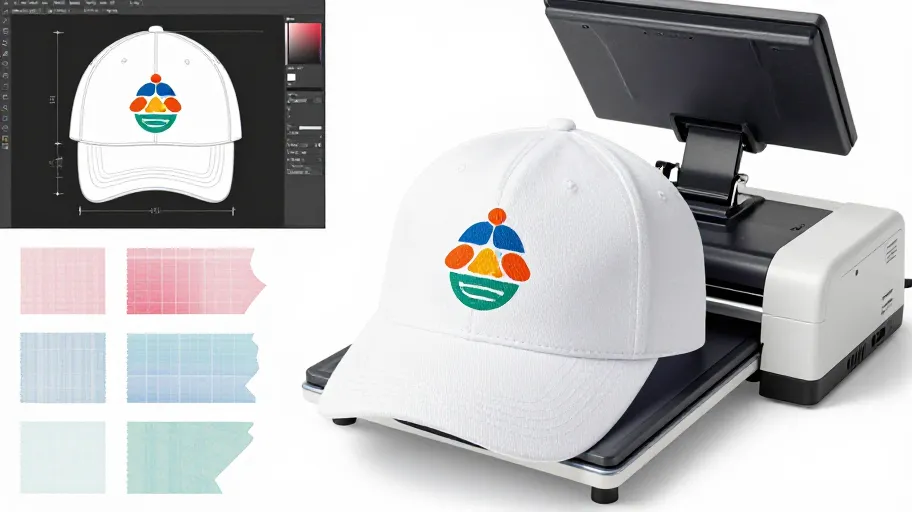
Heat transfer hats succeed or fail at the briefing stage, not on the press. Before you request samples, you need three things settled: vector artwork with stated dimensions and placement, a fabric and construction combination confirmed as suitable for the decoration, and written approval criteria so both sides judge the sample against the same standard.
Why heat transfer raises questions other methods don't
New Generation lists screen printing, sublimation and an all-over transfer print combined with embroidery among its decoration examples. That list tells you which methods exist; it does not tell you how heat transfer will behave on your specific cap. Unlike embroidery, which is stitched into the panel, a transfer sits on the surface, so its appearance and durability depend on the artwork, the fabric surface and the construction of the cap.
The published list does not state transfer temperatures, pressure, dwell time, wash life or substrate suitability. Those are not details you should guess at. They are questions to put to the factory with your artwork attached, and the answers you get back are exactly what you should compare when evaluating suppliers.
The Artwork–Fabric–Approval (AFA) checklist
Use this three-part framework before any sample is made:
A — Artwork. What you send determines what the factory can quote and sample. New Generation's tech-pack guidance asks for vector artwork plus logo dimensions and placement. That is the structure of a usable brief — not a description of a confirmed heat-transfer process. If all you have is a JPEG pulled from a website, say so honestly and ask what the factory can do with it.
F — Fabric. The transfer must bond to the actual cap surface: brushed cotton twill, performance polyester, mesh, a curved seam crossing the logo area — each combination behaves differently. New Generation does not publish substrate suitability guidance, so fabric fit is a question, not an assumption.
A — Approval. Agree in writing what the sample must demonstrate: colour match against a reference, edge definition of fine details, hand feel, adhesion after handling, and how the decoration interacts with seams or panels. Without agreed criteria, a sample review becomes a matter of taste.
Decision table: is your artwork ready for a heat transfer quote?
| Artwork situation | Risk if sent as-is | Question to resolve with the supplier | Ready to brief? |
|---|---|---|---|
| Vector file (AI, EPS, PDF) with Pantone references | Colour interpretation still possible | Confirm how spot colours are handled in the transfer process | Yes |
| High-resolution raster file only | Redraw may be needed; detail may soften | Ask whether redraw is offered and what input the factory needs | Not yet |
| Logo with fine lines, gradients or halftones | Fine detail may not survive transfer | Ask what minimum detail the process supports on your fabric | Not yet |
| Logo must cross a seam or panel join | Distortion at the press | Ask whether placement can be adjusted or the artwork modified | Not yet |
| Full-coverage or all-over artwork | Listed as an all-over transfer print combined with embroidery | Confirm how the transfer and embroidery elements are combined and approved | Discuss first |
Fabric and construction questions to settle before sampling
Because published guidance does not cover substrate behaviour, put these directly to New Generation with your brief:
- Which of my candidate fabrics does the factory consider suitable for heat transfer, and which would it steer toward embroidery or screen printing instead?
- If the cap uses performance or coated fabrics, does the transfer process require any special handling, and are there fabric choices to avoid?
- How does decoration placement interact with structured versus unstructured crowns, and with panels where the logo area is interrupted by a seam?
- If I intend an all-over transfer combined with embroidery, how are the two elements registered and approved together?
Treat the answers as project-specific evidence for comparison — not as general rules that apply to every cap in every factory.
Approval questions: what the sample must prove
Before the first sample is produced, document the criteria:
- Colour. Will the sample be checked against a Pantone reference, a printed proof or a physical swatch you supply?
- Detail fidelity. Which elements of the artwork — small text, thin strokes, gradients — must appear sharp for the sample to pass?
- Hand feel and edge quality. Is a soft, flexible transfer required, and what does a rejected edge or halo look like in practice?
- Adhesion after handling. What simple check (flexing the panel, light abrasion) will both sides use to flag adhesion problems, pending any formal testing you commission separately?
- Placement tolerance. What placement deviation is acceptable, measured how?
Note the boundary here: no published wash-life figures, test results or performance outcomes are available for New Generation's heat transfer process. If durability testing matters to your program, raise it as a requirement to confirm, not as an expectation to assume.
FAQ
Is heat transfer better than embroidery for caps? Neither is universally better. Embroidery is a raised, stitched decoration; a transfer is a surface graphic. The right choice depends on your artwork's detail level, your fabric and the look you want. New Generation lists screen printing, sublimation and an all-over transfer print combined with embroidery, so the practical step is to send your artwork and ask which listed method the factory recommends for your specific brief — then verify that recommendation with a sample.
What artwork files should I prepare for heat transfer hats? Follow the tech-pack structure: vector artwork, logo dimensions and placement. If you only have a raster file, include it anyway and ask whether redraw is needed. The published requirements define the brief structure; they are not a statement of what any specific transfer process can reproduce.
Will the print fade or crack after washing? Wash life depends on the transfer process, the fabric and the care instructions — none of which are published by New Generation. Put wash-life expectations in your brief and ask the factory what evidence it can provide for your chosen fabric and construction, and what testing would be required to verify it.
Can heat transfer be combined with embroidery on the same cap? New Generation lists an all-over transfer print combined with embroidery among its decoration examples, so combined decoration is within the published scope. How the two elements are planned, registered and approved is a project-specific question to resolve in your brief and confirm on the sample.
Primary CTA
Ready to put the AFA checklist to work? Submit your cap brief, reference image or logo to New Generation for project-specific review — include your fabric candidates, placement intent and the approval questions above, and the factory response will tell you far more about the fit of heat transfer hats for your program than any specification sheet.
Low-friction checklist CTA
Not ready to commit? Run this five-line check first:
- Vector artwork prepared (or raster file flagged for redraw)
- Logo dimensions and placement defined
- Candidate fabrics listed
- Approval criteria drafted (colour, detail, feel, adhesion, placement)
- Open questions listed explicitly (process parameters, substrate suitability, wash life)
Attach the completed list to your brief when you submit — it shortens the review and makes supplier responses comparable.
#cap manufacturers china, #headwear manufacturers china, #cap factory