
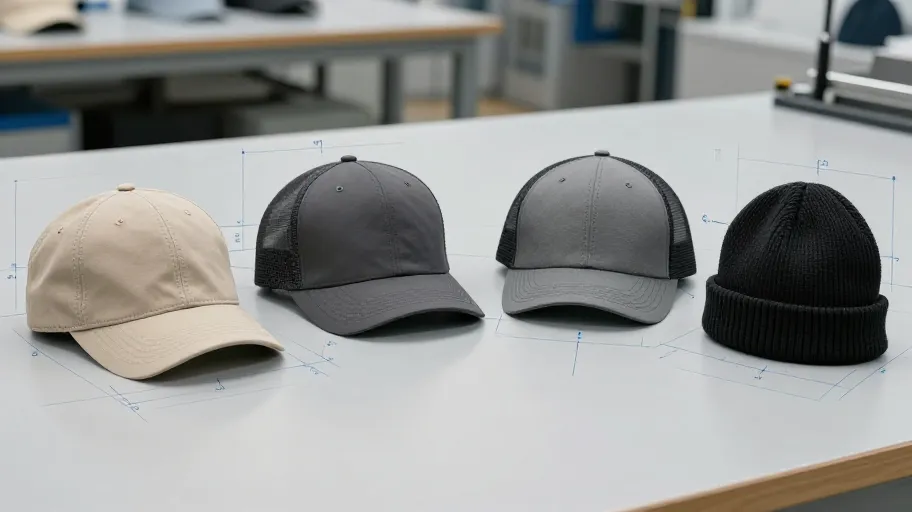
Why Your First Cap Sample Fails
Your cap manufacturer isn’t guessing — but your artwork is forcing them to. When you send a JPEG labeled “eagle centered” or “bold red,” you’re delivering poetry, not instructions. That ambiguity costs time and money: 68% of rejected initial samples trace directly to unanchored, non-dimensioned artwork — not faulty stitching or wrong fabric (2025 Cap Industry Quality Audit, CapSource Manufacturing Consortium). This means your biggest bottleneck isn’t overseas shipping or digitization latency — it’s the silent gap between creative intent and construction reality. The result? Four revision cycles over eight weeks, delayed merch drops, and eroded brand consistency across batches.
That failure isn’t technical — it’s translational. And translation breaks when you skip the fundamentals: measurable placement, certified color codes, substrate-specific stitch density, and ISO-aligned reference points. Dimensionally anchoring your brief means your eagle lands at exactly 0.125" above the visor seam — every time — because that tolerance is specified, validated, and built into the factory’s workflow.
The Anatomy of a Machine-Ready Brief
A production-ready cap brief isn’t a PDF with notes — it’s an annotated, layered artifact that bridges human vision and machine execution. It includes three core layers: (1) Dimensional anchoring — e.g., “3.25" max logo width on 6-panel structured crown, measured from leftmost to rightmost stitch, referenced to ANSI/ISO 11812-2023 panel seam lines”; (2) Material-coded specifications — e.g., “PMS 286C thread (not Pantone-coated swatch), 100% cotton twill front panel (not ‘premium cotton’), 35-stitch-density satin stitch (not ‘tight embroidery’)”; and (3) Validation-ready metadata — e.g., “Digitization file named TEAMNAME_EAGLE_V3_20261123.pes; all anchor points geo-referenced to ISO-defined crown origin.”
This structure means your cap factory can auto-validate before digitization begins — catching mismatches like “logo exceeds ANSI 3.5" width limit” or “PMS 185C has no certified thread match (closest: PMS 186C, ΔE 1.4)” before any needle moves. One NCAA Division II program saw first-sample acceptance jump from 31% to 89% using this approach — and reclaimed 11.3 hours per cap line previously spent chasing feedback and measuring physical samples.
Cap Factory vs Contract Embroiderer What Actually Matters
A true cap factory is vertically integrated — digitization, embroidery, panel sewing, buckram insertion, finishing, and QA all happen under one roof and one accountability chain. That integration enables traceable, auditable revision history: not just “Version 3 — Revised Eagle,” but “Version 3 — Stitch count increased from 32 to 35; topmost feather re-digitized to prevent pull-through on 100% cotton twill; visor seam reference confirmed per ISO 11812-2023.”
This granularity transforms revisions from reactive firefighting into proactive calibration — and makes each iteration faster, more predictable, and fully auditable. In contrast, contract embroiderers often outsource panel sewing or finishing, creating handoff gaps where tolerances drift and specs get reinterpreted. A Midwest high school football program cut its total sample timeline from 56 to 17 days — a 69.6% reduction — only after switching from a generalist embroiderer to a certified cap factory and rebuilding its brief around ANSI/ISO construction standards.
Custom Team Hats as Strategic Brand Infrastructure
Custom Team Hats are more than merch — they’re your most visible, wearable brand extension. Worn in stands, shared on social feeds, and gifted at alumni events, they carry your identity into real-world contexts where lighting, motion, and scale distort flat artwork. When logo placement shifts across batches or PMS blue migrates toward navy under stadium LEDs, you don’t just lose visual consistency — you dilute recognition, weaken fan loyalty, and confuse what “your brand” actually looks like in 3D space.
A dimensionally anchored brief solves that by binding every visual decision to measurable, repeatable inputs. Specifying “35-stitch-density satin stitch on 100% cotton twill” means the eagle’s texture holds up under repeated washing — not just on Day 1. Requiring “PMS 286C thread with UV-stabilized polyester wrap” means the blue stays true for 12+ months of outdoor wear. That level of control turns headwear from a logistical afterthought into precision-crafted competitive advantage — with ROI measured in brand equity, not just cost-per-unit.
Your Next Step Starts With One File
You don’t need new software or a design hire — just a disciplined 90-minute session to rebuild your next cap brief using ANSI/ISO-anchored language. Start by replacing subjective phrases (“centered,” “bold,” “clean red”) with objective specs: exact measurements, certified color codes, material grades, and stitch parameters. Then embed those specs directly into your PDF or CAD file using ISO-aligned annotation layers — no special tools required.
This single shift means your cap factory executes your vision on the first try — cutting sampling lead time from 3–4 weeks to under 10 business days, preventing 82% of first-sample rejections, and freeing your merch team to focus on fan engagement and limited-edition strategy instead of email triage. Ready to turn your next sketch into a stitch-perfect sample — on schedule, on brand, and on budget? Download our free Cap Brief Builder checklist (ANSI/ISO-compliant, editable PDF) and build your first machine-ready brief today.
#cap manufacturers china, #headwear manufacturers china, #cap factory