
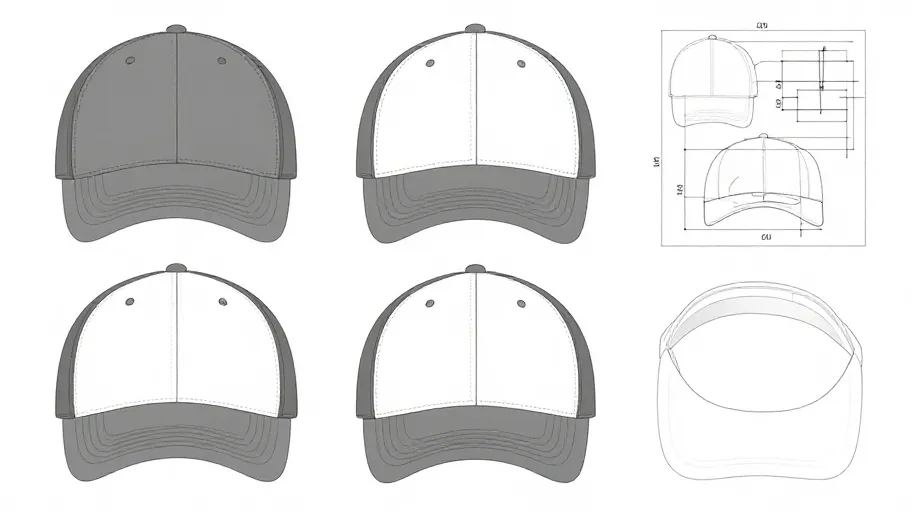
Custom team hats succeed or fail long before production — at the moment a team's artwork is translated into a written sample brief. The most useful way to do this is the 4-Point Cap Brief: define the crown profile, panel construction, front structure and visor shape in the tech pack before any sampling begins. A brief built on these four points gives your manufacturer something concrete to quote, prototype and revise against, and gives you a document to hold every comparison to.
Why artwork alone is not a specification
A logo file answers one question: what goes on the cap. It says nothing about the cap itself. When a buyer sends only artwork — a crest, a mascot, a sponsor lock-up — the factory has to guess the silhouette, the number of panels, whether the front is structured or unstructured, and how the visor curves. Every one of those guesses is an opportunity for the first sample to miss the mark, and each missed mark costs a revision round you did not plan for.
This is not a small detail for team orders specifically. Team and club work tends to involve variants — home and away colourways, coach and player versions, sponsor editions — and variants amplify whatever ambiguity exists in the original brief. A specification gap that causes one revision on a single-style order can cause five on a five-variant order.
The remedy is procedural, not creative: before anyone discusses pricing or timelines, write down the cap. The New Generation customization shape guidance asks buyers to record crown profile, panel construction, front structure and visor shape in the tech pack before sampling — which is exactly the discipline this article walks through.
The 4-Point Cap Brief
Use this framework to convert artwork into a sample-ready brief. For each point, the table below states what to decide and what to record.
| Point | What it covers | Decision to make | What to write in the tech pack |
|---|---|---|---|
| 1. Crown profile | The overall silhouette and height of the crown | Low, mid or high profile; structured or relaxed feel | Named profile choice plus a reference image of a cap whose crown matches the intent |
| 2. Panel construction | How many panels form the crown and how seams run | Six-panel, five-panel or another construction | Panel count, seam positions, and whether the top is a button or closed construction |
| 3. Front structure | Stiffness and build of the front two panels | Buckram-backed structured front vs soft unstructured front | Structure type, since this determines how the team crest presents when worn |
| 4. Visor shape | Curvature and profile of the brim | Flat, pre-curved or adjustable curvature | Visor type; note if the visor carries decoration or contrast colour |
Two practical notes on using the table. First, a reference image alongside each written decision removes most interpretation risk — factories read photos faster than prose. Second, if you cannot make a call on one of the four points, say so explicitly in the brief and ask the manufacturer to propose options with mock-ups; an open question in the tech pack is far safer than a silent assumption.
From artwork to tech pack: what to document
Beyond the four structural points, a complete team-hat brief should capture the decoration itself. Work through the following with your designer before submission:
- Artwork files. Provide vector files where available. State the placement of each element — front, side, rear, visor — and the approximate size relative to the panel, using positional descriptions rather than measurements, since exact sizing is a sampling question to resolve with the factory.
- Colour references. Give a thread or fabric colour reference for each element if you have one. If you do not, flag colour matching as an open item for the supplier to confirm how they handle it.
- Decoration method preference. If you have a view — embroidery versus woven patch, for example — state it and your reasoning. If you do not, ask the manufacturer to recommend a method for your artwork's level of detail and note that you want the rationale documented.
- Variant map. List every team variant in one table: which elements change between versions and which stay fixed. A variant map is the single most effective document for preventing a "we assumed the away version matched the home version" conversation.
Approval questions to settle before sampling
Before you authorise a sample, put these questions in writing and get answers into the document trail:
- Which of the four structural points, if any, does the factory recommend changing based on the artwork or intended use — and why?
- How will colour matching be verified, and what reference will both sides check the sample against?
- What does the first sample round include — one style or every variant — and who bears the cost of that round? Confirm the current sample policy directly with the supplier; do not assume it.
- What documentation accompanies each sample revision, so you can track what changed between rounds?
- Which decoration method does the factory propose for fine artwork detail, and what are the trade-offs versus your stated preference?
The answers convert a sample from a hopeful artefact into a checkpoint. If the sample arrives and something is off, you compare it against the brief and the answers, not against memory.
Comparing suppliers with the same brief
If you are evaluating more than one manufacturer — and for team orders at importer or wholesaler scale, you should — send the identical 4-Point brief to each. Comparability is the whole point of a standardised document:
- Quotes become interpretable, because each is priced against the same specification rather than each supplier's interpretation of a logo file.
- Samples become comparable, because each was built from the same four structural decisions.
- Gaps surface early: a supplier who cannot answer the approval questions above, or who returns a sample that ignores a recorded point, has told you something useful.
When you review proposals, ask each candidate to confirm in writing how they handle the open items in your brief, and treat vagueness on structural points as a signal worth weighing alongside everything else.
FAQ
Can I start with just a logo and a reference photo? You can start a conversation that way, but do not authorise sampling on it. Add your decisions on crown profile, panels, front structure and visor shape — or explicitly mark them as open questions for the factory to propose. A reference photo plus four recorded decisions is a workable brief; a logo alone is not.
What if my team wants a hat style I cannot name? That is precisely what a reference image is for. Send a photo of a cap whose silhouette matches what the team envisions, and ask the manufacturer to map it to the four points and confirm the mapping in the tech pack before sampling.
Should every team variant get its own tech pack? Keep one master brief with a variant table appended. The four structural points are fixed across the family; the variant table records what changes — colours, placements, decoration methods — for each version. Separate unlinked documents invite drift.
How many sample rounds should I expect for a team programme? This depends entirely on your artwork complexity, the number of variants, and the manufacturer's process. Ask each supplier to state their sample process for your specific brief, and get the round structure and cost responsibility confirmed in writing before you approve the first sample.
Does the brief affect pricing conversations? A complete brief is what makes a quotation meaningful. Without one, any price you receive is a price for an unspecified product. Settle the specification first, then compare quotes on a like-for-like basis — and confirm all current pricing, MOQ and lead-time terms directly with each supplier, since these are project-specific and not something any article can state for you.
Submit your brief for review
Turn your team artwork into a structured sample brief before you commit to sampling. Send New Generation your cap brief, reference image or team logo for a project-specific review of crown profile, panel construction, front structure and visor shape — and get the specification questions answered before the first sample is made.
[Submit your cap brief, reference image or logo for project-specific review]
Or start smaller — run through this checklist and attach it to your enquiry:
- Vector artwork for each decoration element, with placement noted
- Crown profile decision (or marked as open)
- Panel count and seam notes (or marked as open)
- Front structure: structured or unstructured (or marked as open)
- Visor shape: flat, pre-curved or adjustable (or marked as open)
- Variant table covering every team version
- Colour references, or colour matching flagged as an open item
- Written list of your five pre-sampling approval questions
#cap manufacturers china, #headwear manufacturers china, #cap factory