
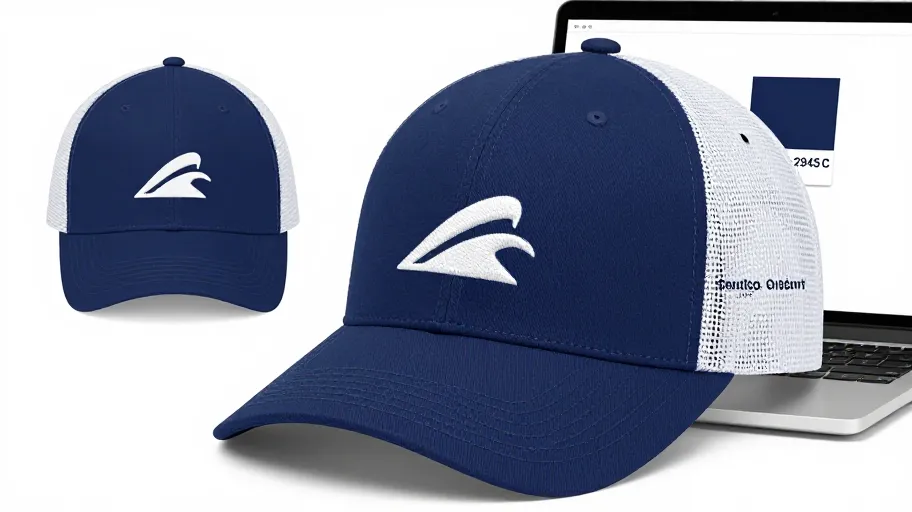
Sourcing custom fishing hats from a Chinese manufacturer goes more smoothly when your brief fixes three specification areas before you request quotes: fabric, closure and logo details. Manufacturers can respond faster and more accurately when a brief states the cap style, panel construction, fabric, Pantone reference, and the logo's size, position and embellishment type — the same fields New Generation requests in its tech pack process, alongside original vector Illustrator artwork.
The Fabric–Closure–Logo (FCL) specification check
The FCL check is a simple discipline for commercial comparison: define the fabric, closure and logo inputs yourself, then ask each prospective supplier to respond against the same fixed inputs. This turns supplier responses into comparable documents rather than a mix of assumptions.
Each area answers a different question:
- Fabric answers: what is the hat made of, and how should it look and feel?
- Closure answers: how does the hat adjust on the wearer's head?
- Logo answers: where does the brand appear, at what size, and by what technique?
A brief that covers all three reduces back-and-forth and makes it easier to spot which supplier has understood your intent.
Fabric specification: document before you compare
Fabric drives cost, appearance and user experience, so it belongs at the front of your brief. Before contacting suppliers, document:
- Fabric type. Name the material family you want — for example cotton twill, polyester, or a blend — even if you are not yet sure of the exact weight or construction. Precision here can be settled during sampling.
- Colour reference. Provide a Pantone reference for each colourway. "Ocean blue" means different things to different readers; a Pantone code does not.
- Panel construction. State the number of panels and whether you want a structured or unstructured crown, since this affects both the pattern and the fabric behaviour.
- Reference sample or image. A photo of a hat whose fabric you like gives the supplier a shared starting point.
Note what fabric alone does not settle. Terms such as UV protection, waterproofing or salt resistance are performance claims that require defined test standards — you should not assume they are included, and any supplier claiming them should be asked to state the standard and provide verification for your approval.
Closure selection: a decision table
The closure is a small component with an outsized effect on how a fishing hat is positioned. Use this table to fix a provisional choice per style before you request quotes.
| Closure type | Best suited when… | Questions to raise with the supplier |
|---|---|---|
| Snapback | You want one-size adjustability with a visible branded element | Can the snap be colour-matched? Metal or plastic? |
| Strapback | You prefer a softer, lower-profile look | Webbing material and buckle options available? |
| Buckle (metal or plastic) | You want a premium feel on a technical-looking hat | Which buckle finishes can be matched to the Pantone palette? |
| Elastic/fitted | You target a clean, closure-free silhouette | How will sizing be managed across the order? |
| No closure (fixed size range) | You sell to end consumers who select size | What size breakdown do you want to specify? |
One caution: these entries describe positioning intent, not verified supplier capability. Confirm with each manufacturer which closures they can actually produce for your style, and ask them to show that capability in a sample rather than take it on trust.
Logo specification: size, position and embellishment type
Prepare the following for each logo placement:
- Artwork file. Provide original vector Illustrator artwork (for example .ai), not a screenshot or a raster image pulled from a website. Vector files let the manufacturer assess which embellishment techniques are feasible for your design.
- Size. State the intended logo dimensions for each placement rather than sending artwork alone.
- Position. Name each placement — front panel, side, rear, brim, closure area — separately.
- Embellishment type. Indicate your preferred technique, such as embroidery or a woven patch, and note where you are open to the manufacturer's recommendation.
If your fishing brand uses multiple colourways, specify how the logo changes (or stays identical) across them.
Approval questions to send every prospective supplier
Before you commit to a comparison shortlist, send each candidate the same set of questions and compare the answers directly:
- Can you confirm the fabric, closure and embellishment options available for my specified style and panel construction?
- What artwork file format and resolution do you require, and will you review my vector file before quoting?
- How will colour accuracy against my Pantone references be checked and approved during sampling?
- What does your tech pack requirement include, and what must I supply versus what you will document?
- Which of my logo placements do you consider feasible at the stated sizes, and would you recommend any changes?
- What is your current MOQ, pricing basis, sample arrangement and lead time for this specific brief?
Question 6 matters because none of those terms can be assumed from a website or a conversation about another product. Record the answers in writing and attach them to your comparison file.
FAQ
How much detail does a manufacturer need before quoting a custom fishing hat? At minimum: cap style, panel construction, fabric type, Pantone reference, and the logo's size, position and embellishment type, plus vector artwork. New Generation asks for precisely these fields in its tech pack process, and supplying them upfront makes supplier responses comparable.
Do I need to provide my own tech pack, or can the manufacturer help create one? Ask each supplier directly. New Generation's design tech pack service is described on its website, but the division of work — what you supply and what the manufacturer documents — should be confirmed for your specific project before you rely on it.
What artwork should I send for a fishing hat logo? Original vector Illustrator artwork. Avoid compressed website images or flattened raster files, which cannot be assessed reliably for embroidery or patch production at a stated size.
Should I request UV protection or waterproof fabric for a fishing hat? You can specify such requirements, but treat them as claims to be verified: ask the supplier to name the applicable standard, how it will be tested, and what documentation you will receive for approval. Do not assume any requirement is met until it is tested and approved.
How do I compare quotes from different manufacturers fairly? Fix your inputs first with the FCL check — identical fabric, closure and logo specification sent to every supplier — then compare responses on the same terms, including the answers to the approval questions above.
Ready to move from brief to review? Send New Generation your cap brief, reference image or logo artwork, and the team will review it against the fabric, closure and logo details discussed here — with feedback specific to your project rather than a generic catalogue response.
Or start with the checklist. Before contacting any supplier, confirm you have: cap style and panel construction · fabric type and Pantone reference · closure choice per style · logo size, position and embellishment type · original vector artwork. Tick all five and your quote requests will be comparable from day one.
#cap manufacturers china, #headwear manufacturers china, #cap factory