


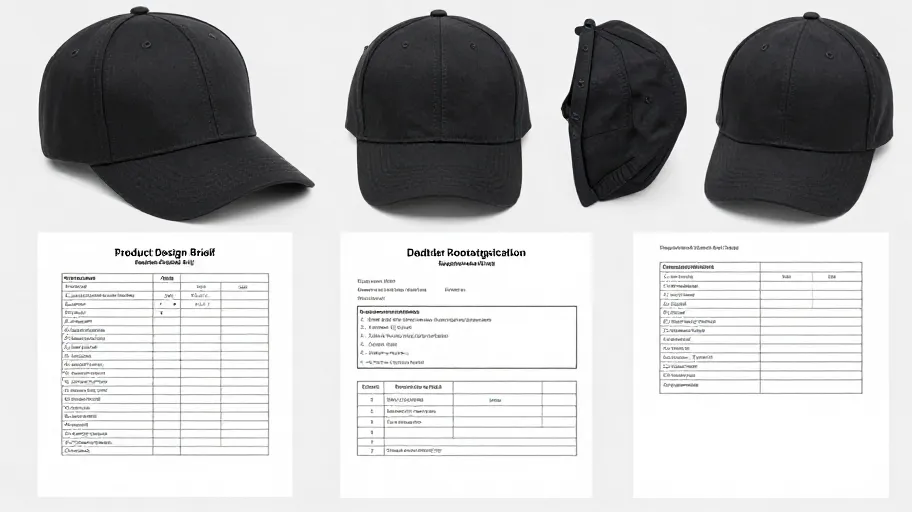
Sourcing custom caps from China goes smoothly when buyers move through four controlled stages: Define the product, Brief the supplier, Approve every artefact in writing, and Audit each confirmation. The custom caps china process that fails is the one that skips written approval. This article gives you a brief template, a decision table and an approval checklist you can apply to any headwear project with any supplier, including New Generation in Shenzhen.
The D-B-A-A loop: a four-stage sourcing framework
Most sourcing friction in custom headwear comes from verbal agreements and untracked changes. The D-B-A-A loop — Define, Brief, Approve, Audit — keeps each decision documented so both buyer and supplier work from the same record.
- Define. Write down the product concept, target market, decoration method and constraints before contacting any manufacturer. A defined project can be quoted; an undefined one can only be guessed at.
- Brief. Convert the definition into a written design brief the supplier can respond to line by line, with space for them to state what they confirm versus what they propose.
- Approve. Require written sign-off on each artefact — tech pack, physical sample, colour standard, packaging spec — before the next stage begins. Approvals create the audit trail.
- Audit. Revisit each approval before production and before shipment. Anything changed verbally must be re-documented and re-approved.
The loop is supplier-agnostic. Whether you work with New Generation or any other manufacturer in Shenzhen or elsewhere, the framework forces claims to become confirmations, and confirmations to become records.
Writing a design brief suppliers can quote against
A useful brief separates what you have decided from what you are asking the supplier to confirm. Cover these blocks:
- Product definition: cap style, closure type, panel count if relevant, and intended use (retail, uniform, promotion, sport).
- Materials and construction: shell fabric, lining, sweatband, visor structure, stitching expectations — described as requirements, not assumptions about what the factory holds in stock.
- Decoration: embroidery, printing, woven labels, patches, metal trims; artwork files and colour references in a named colour system.
- Branding and packaging: labels, hangtags, inner cartons and outer cartons, with artwork supplied separately.
- Compliance and documentation: what certificates, test reports or declarations you require for your destination market — phrased as a request for evidence, not an assumption that any specific credential exists.
- Commercial questions: minimum order quantity, unit pricing structure, sample procedure, sampling and production timing, and shipping terms. Confirm the current policy directly for each of these, in writing, before you commit.
For every line, ask the supplier to respond in one of three ways: "confirmed as written", "confirmed with this amendment", or "cannot confirm — here is our alternative". That three-way response format is what turns a brochure into a quotable document.
Decision table: specifying your custom caps project
| Decision point | Option A | Option B | What to weigh |
|---|---|---|---|
| Design origin | OEM: you supply full design and tech pack | ODM: you adapt the manufacturer's existing base | OEM gives control and longer development; ODM can reduce development effort but limits design ownership — confirm what can be modified |
| Decoration | Embroidery for logos and defined shapes | Printing or patches for gradients and fine detail | Compare durability, artwork suitability and how each affects the approval sample |
| Colour control | Named colour system reference in the brief | Physical colour standard approved by mail | A physical swatch removes screen variance; agree in writing which governs if they disagree |
| Sampling stages | Single pre-production sample | Progressive samples (proto, revised, pre-production) | More gates catch changes earlier; confirm the sampling procedure and costs directly |
| Spec documentation | Email threads | Versioned tech pack with sign-off log | Versioned documents prevent "which file was final?" disputes |
| Quality verification | Supplier self-inspection report | Third-party or buyer inspection before shipment | Decide the audit gate in the brief, not after production |
The approval checklist: sign off before production starts
Use this checklist at every approval gate. Do not tick an item based on a verbal assurance — request the document, sample or written confirmation first.
Design and specification approvals
- Written brief issued, and every line answered with confirmed / amended / alternative
- Tech pack version number recorded and agreed
- Colour standard (named system or physical swatch) approved in writing
- Artwork files approved, including label and packaging artwork
- Any OEM/ODM design-ownership terms documented
Sample and pre-production approvals
- Sample received, compared against the brief line by line
- Sample feedback given in writing; revisions re-sampled and re-approved
- Pre-production sample signed off as the binding reference for the production run
- Material and construction on the sample match the approved tech pack version
Commercial and compliance approvals
- MOQ, pricing structure and payment terms confirmed in writing — confirm the current policy directly
- Sample policy, fees and shipping terms confirmed in writing — confirm the current policy directly
- Production and delivery schedule confirmed as a written schedule — confirm the current policy directly
- Required certificates or test reports for your market requested and evidence reviewed
- Inspection arrangements and acceptance criteria agreed before production
- Packaging, labelling and shipping marks approved
Final audit
- Any verbal change since the last sign-off re-documented and re-approved
- All approvals compiled into one project file before the production release
This is where the D-B-A-A loop pays for itself: when a dispute or a surprise arises, the project file — not memory — settles it.
Practical questions to put to any supplier
Beyond the checklist, these questions reveal how a manufacturer handles structure and evidence:
- Can you respond to our brief line by line, marking each item confirmed, amended or alternative?
- Who is the named contact for approvals, and how are sign-offs recorded?
- What documentation accompanies the pre-production sample?
- What evidence can you provide for the certifications we require for our destination market?
- How do you handle a change request after pre-production approval?
A supplier's willingness to answer in writing, with named responsibilities, tells you more about the working relationship than any catalogue.
FAQ
How detailed does a design brief need to be for custom caps sourced from China? Detailed enough that the supplier can quote against it without guessing: style, materials, decoration method, colour reference, artwork files, packaging and every commercial question. Every item you leave undefined becomes an assumption someone else makes for you.
What should I physically approve before production begins? At minimum, a pre-production sample that both sides treat as the binding reference, plus written confirmation of the tech pack version, colour standard and packaging spec. Confirm the current sampling policy directly with the supplier before planning your schedule.
Should I use OEM or ODM for my headwear project? Choose OEM when you own the design and need full control over specification. Choose ODM when adapting an existing base is acceptable and development speed matters more than design exclusivity. Ask what can and cannot be modified under ODM, and get the answer in writing.
How do I verify a Chinese cap manufacturer's claims? Convert each claim into a request for evidence: certificates, test reports, sample records, inspection arrangements and written responses to your brief. If a claim cannot be evidenced, treat it as unverified and decide accordingly.
What causes the most disputes in custom headwear sourcing? Undocumented changes. A verbal tweak after sample approval, an unagreed colour reference, an unversioned artwork file — each one is a dispute waiting for a production run. The D-B-A-A loop exists to prevent exactly this.
Start your project the structured way
[获取项目 Brief → Get the Project Brief] — request the project brief template and begin your custom caps sourcing conversation with a document the supplier can answer line by line.
Or, if you are not ready to enquire, take the low-friction first step: copy the approval checklist above into your next supplier email and see who answers in writing.
#cap manufacturers china, #headwear manufacturers china, #cap factory








