
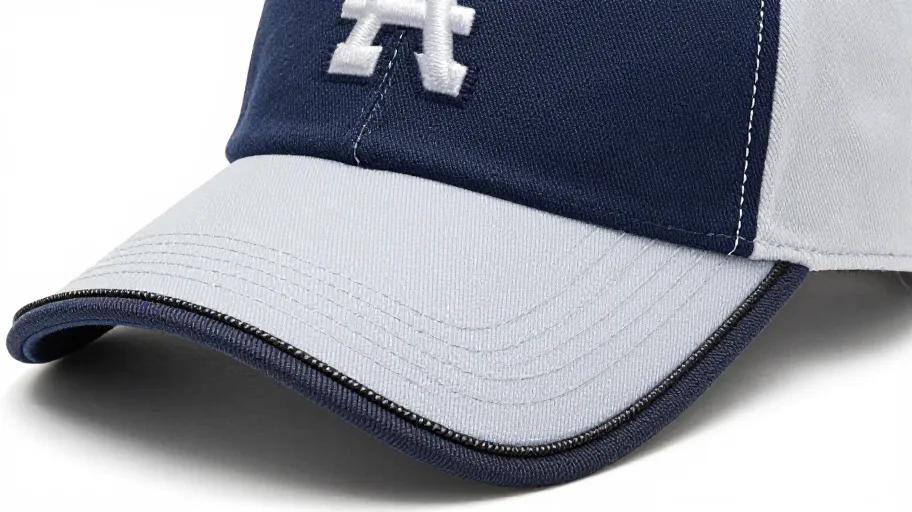
When specifying custom caps, treat the visor as four separate decision layers: the edge treatment, the top surface, the undervisor surface, and the transition details where brim meets crown. Naming each layer — sandwich, piping, binding, print or flat embroidery on the undervisor — in writing is the single most effective way to make sure the cap your factory produces matches the cap you approved.
Why visor vocabulary decides whether your cap matches your sample
Most disputes between buyers and headwear manufacturers do not come from exotic features. They come from vague words. "Add a bit of contrast to the brim" can be built at least four ways, and each one looks different on a finished cap.
The New Generation visor customisation page lists 21 named visor options, including Sandwich Visor, Print On Undervisor, Flat Emb. On Undervisor, Binding Effect and Piping Effect. Those names are useful precisely because they give both sides a shared vocabulary. The page, however, provides no comparative price, durability or lead-time evidence — so treat this article as a specification checklist, not a ranking. Whatever terms you adopt, confirm cost and feasibility for your specific project directly with your supplier.
The Four-Layer Visor Spec framework
Work through the visor in four layers, and write one line for each on your spec sheet.
| Layer | What you are deciding | Options to name | Spec-sheet question |
|---|---|---|---|
| 1. Edge treatment | How the visor's outer edge is finished | Binding Effect, Piping Effect, plain stitched edge | "Is the edge bound, piped, or a standard stitched edge? Show on the sample photo." |
| 2. Top surface | What the top of the brim looks like | Sandwich Visor (contrast layers within the brim edge), solid colour, patterned fabric | "How many sandwich layers, and which colours sit where in the stack?" |
| 3. Undervisor surface | What is printed, embroidered or left plain underneath | Print On Undervisor, Flat Emb. On Undervisor, tonal or plain undervisor | "Is the undervisor artwork a print or flat embroidery, and where does it sit?" |
| 4. Transition details | How brim meets crown and how the visor curves | Pre-curve vs flat profile, stitch lines, trim continuation | "How does the crown trim carry into the visor, and what is the intended curve?" |
You do not need to answer all four layers for every cap — a clean corporate cap may only need one decision. The point is that an unaddressed layer will be decided by someone else.
Option family one: sandwich visors
A Sandwich Visor builds contrast into the thickness of the brim edge, so you see distinct coloured bands when the visor is viewed from the side or slightly below. It is a popular way to add brand colours without adding surface artwork.
What to confirm in writing:
- How many colour bands the sandwich should contain, and their order.
- Whether the bands should match existing crown trim, piping or embroidery thread colours — supply thread or Pantone references if you have them.
Ask to see a physical sample or detailed photographs of a sandwich construction with your colour count before approving artwork, because a two-band and a three-band sandwich photograph very differently.
Option family two: piping and binding
Piping Effect and Binding Effect are separate named options, and they are not interchangeable in appearance:
- Piping introduces a raised or tubular line along the visor edge, giving a defined ridge of contrast.
- Binding wraps the edge with a strip of fabric, producing a flat band of contrast along the perimeter.
Both can echo a sandwich layer, and both change how the visor edge catches light. Rather than debate which is "better" — that depends entirely on your design and budget — document the question: "Should the visor edge be piped (raised line) or bound (flat band)? Please show both constructions in the sample stage if we are undecided."
Option family three: undervisor prints and flat embroidery
The underside of the visor is where brands can add something most passers-by never see on the street but the wearer sees every time they look up — which is exactly why it carries emotional value for merchandise and corporate gift programmes.
The New Generation visor page names two distinct undervisor treatments:
- Print On Undervisor — artwork applied as a print across the under-surface, suitable for larger graphic coverage.
- Flat Emb. On Undervisor — flat embroidery on the under-surface, producing a stitched texture rather than a printed field.
Key questions to resolve before you approve either:
- Is my logo better served as an all-over print or a discrete flat embroidery on this surface?
- Where should the artwork sit — centred, rear-positioned, or repeated?
- How does the undervisor treatment interact with the top-surface and edge choices in my spec?
- What artwork file format and resolution does the factory need from me?
Do not assume an answer to cost or process compatibility for any of these. Confirm them per project with the factory — this is exactly the kind of detail a project-specific review of your logo will resolve faster than guesswork.
Write it down: approval questions for your spec sheet
Before any sample round, put these questions in writing to the supplier:
- Which named visor options apply to this style? (Use the factory's own names, e.g. Sandwich Visor, Piping Effect.)
- Edge treatment: piped, bound, or standard stitched edge?
- Sandwich: how many bands, which colours, in what order?
- Undervisor: print, flat embroidery, or plain — and where does the artwork sit?
- Which artwork files and colour references are required, and in what format?
- Can we see the visor treatment on a physical sample or close-up photographs before bulk approval?
- Are all visor choices reflected on the tech pack, not just discussed verbally?
This checklist is deliberately free of commercial terms. MOQ, pricing, lead time and sample policy were not assessed for this article, and you should confirm each of them directly with the supplier for your specific project.
Frequently asked questions
Can I combine a sandwich visor with an undervisor print? Both are named options on the visor customisation page, so they can be specified together — but whether the combination works for your design, and what it involves commercially, should be confirmed with the factory against your artwork. Submit both elements in one brief rather than deciding them separately.
What is the difference between Piping Effect and Binding Effect? Piping gives a raised contrast line at the visor edge; binding wraps the edge with a flat fabric band. The distinction is visual and tactile, which is why we recommend asking for close-up photographs or a sample that shows the construction before you approve one.
Is a print on the undervisor more durable than flat embroidery? We do not make that comparison, and neither does the source material — the visor page provides no durability evidence for any option. Durability depends on materials, artwork and use conditions, so raise it as a project-specific question rather than assuming an answer.
Do I need to choose a visor option at all? No. A clean, undecorated visor is a legitimate specification — but state it explicitly ("plain undervisor, standard edge") so the factory does not default to a treatment you did not intend.
How do I get feedback on my specific visor idea? The fastest route is to submit your cap brief, a reference image or your logo together with your colourway, and ask for a project-specific review of the visor options against it.
Ready to specify your visor? Submit a cap brief, reference image or logo for project-specific review. Send your colourway and any reference photos of visor treatments you like, and the options above can be assessed against your actual design rather than in the abstract.
Low-friction first step: copy the approval checklist above into your next RFQ. Even without artwork ready, it will surface the four visor layers in a single email.
#cap manufacturers china, #headwear manufacturers china, #cap factory