


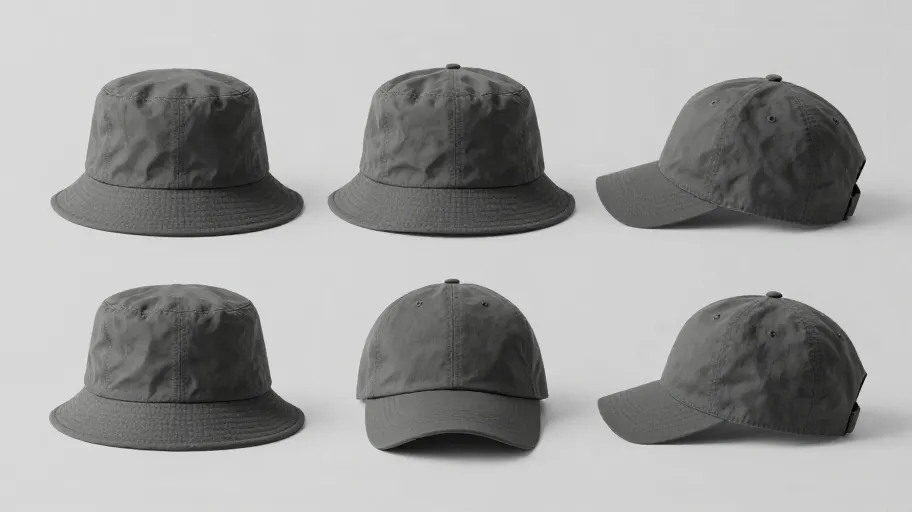
What goes where—and why it costs you money
Putting the wrong detail in the wrong place doesn’t just delay sign-off—it triggers cascading rework. A ±1/8″ crown height tolerance buried in approval notes instead of the Drawing BOM means your factory measures against vague intent, not hard specs. That means ±1/8″ becomes ±1/4″—and that single misinterpretation means $12,000 in re-sampling and 17 days lost before first-article approval. Why? Because the Drawing BOM is your dimensional and material contract: it holds only what can be measured (crown height, brim width, seam allowance, shell weight, interlining composition). When those live exclusively there, QA knows exactly what to accept—and factories know exactly what to build. That single-layer clarity cuts first-sample rejection by over 40%, per internal data from three U.S.-based cap manufacturers serving premium headwear brands.
Meanwhile, Approval Notes are your process execution playbook—not an afterthought, but the contextual layer that governs how verified parts behave together. 'Centered ±3mm, no visible shift after steam pressing' isn’t geometry—it’s a performance standard tied to fabric memory and heat response. 'Fold-and-stitch alignment must match front panel grainline, verified via layup photo' enforces structural integrity on curved surfaces. And 'no more than one isolated thread pull per seam, inspected under 10x magnification' sets an objective pass/fail bar for human judgment. These aren’t soft notes—they’re deterministic instructions that prevent batch-level misalignment before the sewing line starts.
Why cap factories got this right first
Cap factories didn’t invent rigor—they evolved it under fire. Stitching 50,000 baseball caps per week with 12-point embroidery registration leaves zero margin for ambiguity: a misplaced millimeter in the BOM forces tooling recalibration, machine downtime, and scrap. So they hardened the Drawing BOM into a single source of truth for what is built, while pushing all conditional, contextual, and judgment-dependent rules into Approval Notes—where they’re reviewed, signed off, and referenced during execution, not inspection. Bucket hats face even tighter tolerances: a 3° variance in brim roll angle changes silhouette perception; a 0.5mm interlining shift alters crown drape. Yet most apparel tech packs treat them like flat-panel garments—dumping grainline logic, steam-set tolerances, and trim anchoring rules into generic 'notes' alongside care labels and packaging specs. That’s why 68% of sampling delays in headwear programs (per 2024 Sourcing Edge benchmark data) trace back to 'unresolved interpretation of non-dimensioned directives'—not missing specs, but misplaced ones.
This dual-layer discipline delivers compounding ROI: faster sign-off (average 3.1 days vs. 8.7), fewer physical samples (down 42%), and seamless integration with Tier-1 cap manufacturers who require deterministic inputs to activate their leanest production lanes. One activewear brand reduced its pre-production cycle from 11 weeks to 6.5 weeks—and captured Q2 wholesale orders 19 days earlier—by enforcing this split across its entire bucket hat portfolio. Their secret? They stopped asking 'What do we need to say?' and started asking 'Where does this need to be verified—and by whom?'
The operating system for predictable headwear
The bottom line isn’t about compliance—it’s about control. When your Drawing BOM holds only what can be measured, and your Approval Notes hold only what must be judged, every handoff—from designer to factory to QC to audit—operates from shared, unambiguous logic. That means no more chasing samples, no more explaining intent, and no more port holds for 'aesthetic deviation' instead of defect. It means your team spends less time reconciling interpretations and more time scaling production. For engineers: this structure eliminates subjective review loops and enables automated CAD-to-QA validation. For managers: it reduces average sampling rounds from 4.2 to 2.3 per style and cuts miscommunication costs by up to $18K per SKU. For executives: it shortens time-to-revenue by up to 19 days per launch and unlocks access to Tier-1 cap manufacturers’ fastest, highest-yield production lanes—because they only accept deterministic inputs. This isn’t documentation hygiene. It’s the operating system for predictable, scalable, premium headwear execution.
Ready to cut sampling rounds by 42% and ship your next bucket hat collection with engineering-grade confidence? Download our free Bucket Hat Tech Pack Split Checklist—built from real cap-factory SOPs and validated across 62 headwear programs.
#cap manufacturers china, #headwear manufacturers china, #cap factory








