


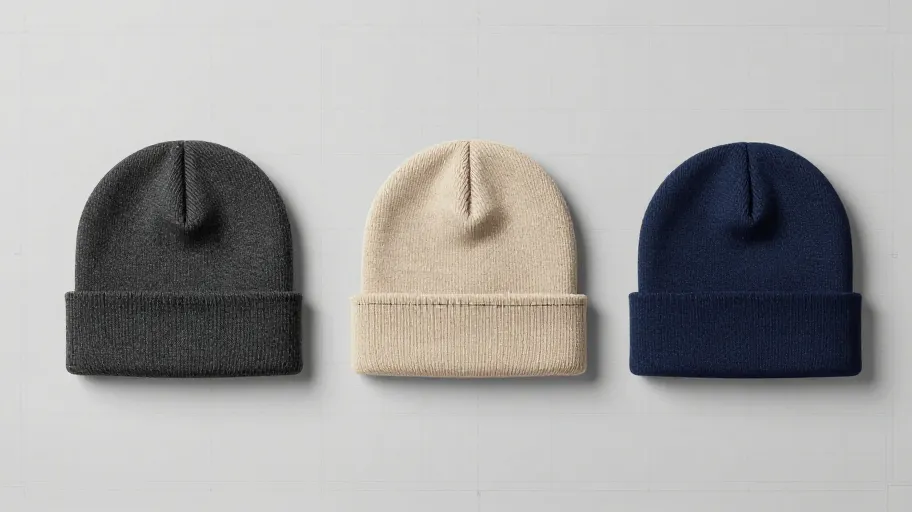
Why Your RFQ Is Really a Rorschach Test
Without a beanie tech pack, your RFQ doesn’t ask for a quote—it invites interpretation. When you write “slouchy fit,” one cap factory builds in 1.5" of crown ease; another uses 0.75". That 0.75" gap means $2,800 in wasted labor, air freight, and delayed launch windows per sampling round—because the first sample fails fit validation. This ambiguity means 73% of RFQ bottlenecks aren’t about price or capacity—they’re about misaligned definitions. A beanie tech pack means your team stops chasing clarifications and starts comparing real cost drivers—because every variable that affects lead time, yield, or compliance is defined upfront. That’s why brands using it reduce RFQ-to-quote time from 11 days to 4.2 days—not by emailing faster, but by eliminating the need to email at all.
From Mood Board to Measurable Reality
A beanie tech pack converts creative language into factory engineering language—and that translation delivers concrete value. Crown height isn’t “medium”—it’s 6.25" ±1/8", meaning your fit team can validate samples with a tape measure, not a gut feeling. Brim curvature isn’t “rounded”—it’s a 3.5" radius measured at the front seam junction, so a bucket hat factory in Vietnam knows instantly whether its laser jigs meet tolerance—or if retooling is needed. Seam allowance isn’t “standard”—it’s ⅜" flat-felled with 10-needle topstitching, specified by stitch density (12 spi), thread class (Tkt 40), and tension range (25–30 psi). This precision means factories quote accurately on the first pass—because they know exactly what you’ll measure, audit, and accept. One mid-tier activewear brand cut sampling iterations by 68% across three seasons—not by demanding perfection, but by making perfection measurable.
Free Hat Samples Only Work When They’re Auditable
Free hat samples are powerful—but only when anchored to a tech pack. Without one, a sample is just an artifact: Is the brim curl caused by fiber content, blocking technique, or inconsistent stitch tension? With a tech pack, the sample becomes evidence. Your team measures against documented tolerances—and when crown height, brim radius, and seam allowance all land within spec, you’re not approving fabric and stitching. You’re validating process control, documentation rigor, and engineering discipline. That’s why brands using structured tech packs see a 41% higher first-sample acceptance rate (2025 Apparel Sourcing Benchmark Report)—and why their ‘free’ samples de-risk bulk production instead of triggering new revision loops. It shifts validation from subjective (“feels right”) to objective (“meets spec”).
The Real ROI: Velocity with Certainty
The value of a beanie tech pack compounds downstream. Every hour saved in RFQ clarification translates directly into tighter capacity booking, earlier bulk material commitments, and more runway for pre-season wear testing. Shortening RFQ cycles by 60% means a DTC outerwear brand secures factory slots 17 days earlier—locking in Q1 capacity before competitors even finalize sketches. It means procurement teams stop comparing vague quotes and start evaluating true differentiators: material yield efficiency (up to 9% higher with precise grainline specs), labor cost variance (±$0.32/unit when seam allowances are fixed), and QC pass rates (22% higher when trim attachment tolerances are documented). This isn’t about cleaner documents—it’s about compressing decision risk while accelerating time-to-market. You shift from hoping your cap factory understood you… to knowing exactly how—and where—they executed.
#cap manufacturers china, #headwear manufacturers china, #cap factory








