


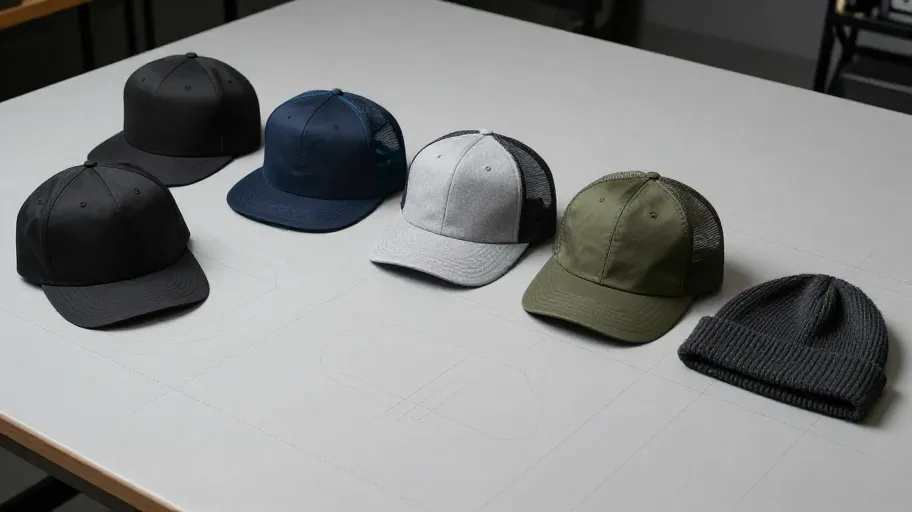
Why Your First Hat Run Fails Before It Starts
Your band’s first production run of custom hats fails—not because your logo is weak, but because your cap factory never got a real chance to say “this won’t hold up” before stitching began. That means 3–5 week delays, $1,200–$4,800 in air freight surcharges, and scrambled pre-sale timelines—all preventable. Vector artwork with layered construction notes means your designer and factory speak the same technical language, because unannotated files force assumptions that break on curved crowns. PMS color matching under garment-dye lighting means your neon blue reads true on washed cotton twill—not washed out on stage lights—because lighting shifts hue perception by up to 18% in real-world conditions (CPPA 2024 Color Consistency Report). And treating your cap factory as a structural partner—not just a production node—means they catch crown seam tension drops *before* embroidery, not after. That’s how you avoid puckering on 200 units at festival gate.
The Three Non Negotiables Before You Hit Send
Submit these together—or risk cascading misalignment:
- Layered vector files mean zero ambiguity in stitch execution, because separating base fill, outline, and gradient overlays lets factories simulate thread density (e.g., “8,200–8,700 stitches; max 12 st/mm²”) and flag over-embroidery risks before needle hits fabric.
- A crown tolerance map means consistent logo scaling across variants, because Flexfit 6212 truckers and New Era 59FIFTY snapbacks have ±1.5mm crown height variance and different front-panel curvature radii—so a logo centered on one will distort on the other without clearance notes (e.g., “Minimum 8mm from front seam to logo edge”).
- A physical pre-production blank means verified structural integrity, because factories like Apex Headwear test seam tension under simulated embroidery load—and catching a 2mm crown warp now saves $3,200 in bulk rework later, per their 2025 internal ops audit.
When Portland indie band Neon Ghost ran this sequence, they shipped full production in 11 days—not 29—with zero fan complaints about inconsistent sizing. That’s not luck—it’s engineered alignment.
How This Loop Pays for Itself—Fast
Each validated sample round cuts average time-to-fan by 42%, according to CPPA’s 2025 Merch Ops Benchmark—meaning limited drops sell out before soundcheck, not sit while fans pivot to unofficial resellers. Vector discipline means your merch team spends 70% less time fielding ‘why does the trucker look stretched?’ DMs, because the answer is already embedded in the file layers. Crown tolerance mapping means your tour manager stops cross-checking cap specs mid-van ride—because the PDF lives in one shared folder with factory-confirmed numbers. And physical blank validation means your label avoids $1,200+ air freight surcharges on urgent corrections, because the problem surfaces when it’s cheap to fix—not when 500 units are stitched and boxed. Most quietly: every time fans see identical logo fidelity across online, merch table, and stage left, they don’t just buy a hat—they buy into consistency, credibility, and care. That’s the first stitch in a loyalty loop no revision cycle can replicate.
#cap manufacturers china, #headwear manufacturers china, #cap factory








