


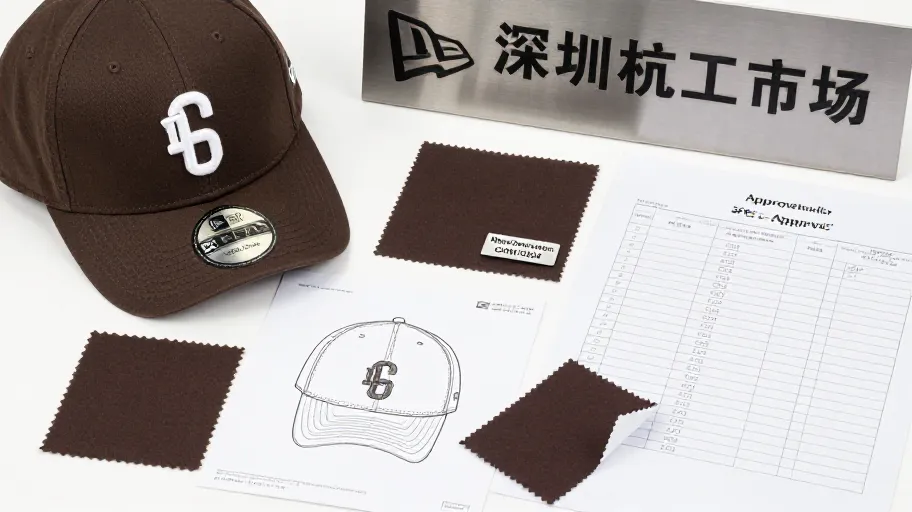
For B2B buyers, "new era cap brown" is less a colour choice and more a specification challenge: you must define the exact brown, confirm the construction, and lock an approval gate before production starts. This guide gives you a named framework (SPEC-Approve™), a comparison table, and written approval questions you can send to any supplier, including New Generation, a Shenzhen OEM/ODM manufacturer of custom caps and headwear.
Why brown is a specification problem, not a style problem
Brown fails silently in mass production. Unlike black or navy, where small shade deviations are hard to notice, brown sits in a narrow perceptual band where a slight shift toward red or yellow changes the entire product impression. For a wholesaler or brand, this means two things: your brown must be anchored to a documented reference, and your supplier must agree in writing to match that reference at the bulk stage, not just at the sample stage.
The second issue is material interaction. The same dye or pigment can render differently on cotton twill, brushed cotton, wool blends, suede finishes and synthetic sweatbands. If your brown cap combines a crown fabric, a brim, eyelets, a button and a closure in different materials, each component needs its own colour-matching instruction. A supplier who confirms only "brown" on paper has confirmed almost nothing.
This is why comparison questions — not marketing claims — should drive your sourcing decision. The rest of this article gives you those questions inside a repeatable framework.
The SPEC-Approve™ framework
SPEC-Approve™ breaks a brown cap program into five verifiable stages:
- S — Specify. Fix the brown with a named reference (for example, a Pantone code you own or a physical swatch), and list every material component that must match it.
- E — Evaluate. Ask each supplier to state, in writing, how they hold colour consistency across components and production batches, and what references they will return to you for sign-off.
- P — Prototype. Request a sample that includes all brown components together — crown, brim, closure, button, eyelets, sweatband — so you evaluate the colour as a whole product.
- C — Confirm. Compare the sample against your reference under controlled lighting, document deviations, and request corrections in writing.
- Approve. Authorise production only against the approved physical sample, retained by both parties, with any changes after approval requiring a new written sign-off.
The framework works with any supplier. Its value is that it converts vague colour conversations into documented checkpoints you can compare across quotes.
Decision table: comparing brown cap programs across suppliers
| Evaluation question | Strong answer looks like | Weak answer looks like | Action if weak |
|---|---|---|---|
| Is brown anchored to a named reference? | Supplier accepts your Pantone code or swatch and records it on the spec sheet | "We have many brown colours in stock" | Provide your reference; require it on paper |
| How is cross-component matching handled? | Written matching plan for brim, closure, button, eyelets, sweatband | Only the crown fabric is discussed | Ask for a component-by-component colour map |
| What is the sample approval route? | Clear route from sample to written sign-off before production | Sample and bulk treated as one continuous step | Insert an approval gate in writing |
| How are batch deviations handled? | Documented reference retained by both parties for dispute comparison | Verbal assurance only | Request a retained approval sample clause |
| What is documented on the spec sheet? | Fabric, construction, closure type, logo method, colour references per component | Price and quantity only | Send your own spec sheet template |
| Who signs off? | A named person on your side and a named contact on the supplier side | No named approver | Assign approval responsibility before quoting |
Use this table identically with every supplier you are comparing. The differences in answers — not the differences in catalogues — will tell you which partner to develop.
Spec sheet essentials before you request a quote
Before asking New Generation or any supplier to quote, document the following for each brown cap SKU:
- Product reference: a name or code that stays stable across all correspondence
- Colour reference: the exact brown code or swatch ID, plus tolerance language you define
- Fabric and composition: per component, not just the crown
- Construction: panel count, brim style, closure type, eyelet style
- Decoration method: embroidery, printing, patch, woven label — and how the brown interacts with each
- Labelling and packaging: care labels, hangtags, inner packing, per your destination market's requirements
- Approval chain: who signs off, on what document, before which milestone
None of these items requires you to know the supplier's internal numbers. They require you to state your requirements precisely, which is the only reliable basis for comparison.
Sample and approval workflow: questions to ask in writing
Send these questions to your supplier contact and keep the written answers on file:
- "Please confirm which brown references you can match, and whether you will record our Pantone code or swatch on the spec sheet."
- "Please describe how you will colour-match the brim, closure, button, eyelets and sweatband to the crown fabric."
- "Please confirm your current sample policy, including any costs, shipping arrangements and terms, so we can plan our budget." (Do not assume what the policy includes — ask for the current written version.)
- "Please confirm what happens if the first sample does not match the reference: what is the correction route and the associated terms?"
- "Please confirm that a physical approval sample will be retained by both parties and that bulk production starts only after our written approval."
- "Please confirm what documentation you provide with the bulk order so we can verify consistency on receipt."
- "Please confirm any minimum order, lead time and capacity considerations relevant to our quantities." (These are project-specific and must come from the supplier, not from assumptions.)
The pattern matters: every question asks the supplier to confirm, in writing, something that affects your risk. Suppliers who answer precisely and promptly are demonstrating a working process; suppliers who answer vaguely are showing you what production communication may look like later.
Approval checklist before authorising production
Run this checklist before you sign any production authorisation:
- Brown reference (code or swatch ID) recorded on the spec sheet
- All components listed with their colour-matching instruction
- Physical sample inspected under controlled lighting against the reference
- Deviations documented and corrections confirmed in writing
- Corrected sample approved by the named approver on your side
- Approval sample retained by both parties
- Production terms (quantity, schedule, packaging, labelling) confirmed in the same written thread
- Any post-approval change routed through a new sign-off
- Incoming inspection plan agreed, referencing the retained approval sample
A completed checklist is not bureaucracy. It is the cheapest dispute-prevention tool available in cross-border sourcing, because it removes the phrase "but we thought…" from both sides of the conversation.
FAQ
1. How do I specify "brown" so a Chinese manufacturer matches it correctly? Anchor it to a reference you control: a Pantone code or a physical swatch you send and have recorded on the spec sheet. Never approve a brown from a screen image, because displays render brown inconsistently and your approval must survive comparison to a physical product.
Every component. A crown panel in isolation tells you nothing about whether the brim, closure, button and sweatband will sit in the same brown family. Evaluate the sample as the whole product your customer will receive.
3. How many suppliers should I compare before choosing? Enough to see a spread of answers — for many buyers, two to three shortlisted manufacturers compared with the same decision table. What you are comparing is the precision of their written answers, not their catalogues.
4. What documentation should I keep after approval? The spec sheet, the written Q&A thread, the approval sign-off, and a retained physical sample from both sides. Together these form your reference set for the incoming inspection of the bulk order.
5. Can New Generation produce a matched-brown custom cap program? New Generation is a Shenzhen-based OEM/ODM manufacturer of custom caps and headwear serving overseas brands, importers, wholesalers and corporate buyers. Whether a specific brown, construction and decoration combination fits a current program is project-specific — confirm your colour reference, sample requirements and order terms directly with the supplier before quoting.
获取采购 Brief — download the sourcing brief to get the spec-sheet template, the written question list and the approval checklist in one working document you can send to any supplier today.
Low-friction option: if you are not ready to download, start with the approval checklist above — copy it, complete one line per supplier you are comparing, and you will already have a defensible comparison record after three enquiries.
#cap manufacturers china, #headwear manufacturers china, #cap factory








