


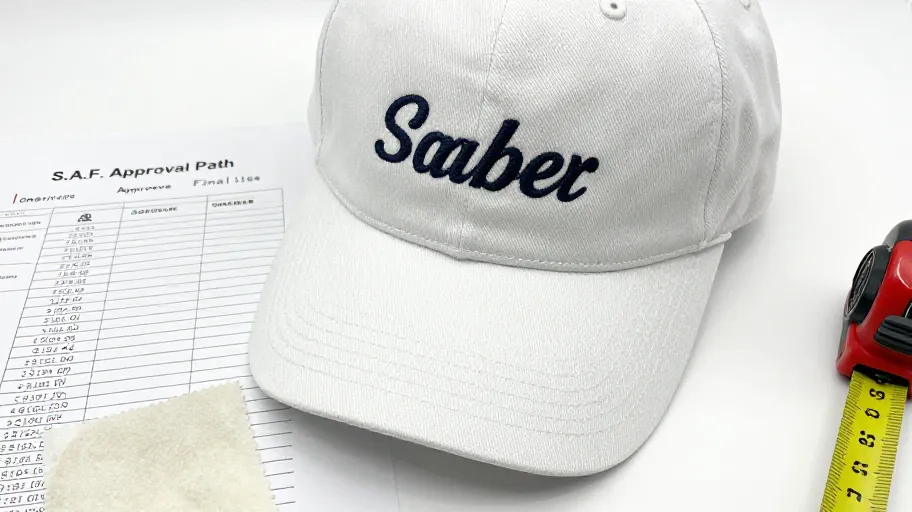
Custom fitted hats with a name on them succeed or fail on paperwork, not promises: you get the result you specified, sampled and approved in writing, and nothing else. The fastest way to keep control is the S.A.F. Approval Path — Specify every detail of the hat and the lettering, Approve a physical sample against that spec, and Finalise the production terms that bind the run to the approved sample. This guide walks you through all three steps so you can compare Chinese OEM/ODM suppliers on evidence rather than quotations alone.
Why a personalised fitted cap is a harder brief than a plain logo hat
- Placement tolerance matters more. A name that sits a few millimetres off-centre is far more visible than a generic emblem slightly askew.
- Legibility depends on technique and size. Fine lettering on a curved, textured panel can lose definition depending on the decoration method chosen.
- Sizing is a real decision. Because fitted caps come in specific sizes, you must decide on a size run and confirm how each size affects your order structure.
None of these are reasons to avoid personalisation. They are reasons to be more rigorous about your spec sheet.
Step 1 — Specify: the brief you hand every supplier
Before contacting manufacturers, write a one-page spec sheet. Sending the same document to every supplier makes their replies comparable and exposes who answers precisely and who answers vaguely.
Hat specification questions
- Crown structure: structured or unstructured; panel count; profile height.
- Closure: closed back with fitted sizing — confirm which size run applies and whether mixed-size packs are possible.
- Material: main fabric, sweatband, undervisor and eyelet types you want compared.
- Brim: pre-curved or flat; brim stiffening; undervisor colour.
- Decoration: technique for the name (embroidery, print, woven label or other), thread or ink colours by reference code, placement measured from defined reference points, letter height, font file supplied as vector artwork.
Name and lettering specifics
- Minimum letter height you consider legible for your chosen technique, and the smallest text the supplier says they can execute cleanly.
- Whether each hat carries a different name (per-unit personalisation) or one shared name (team or brand lettering) — this changes how the run must be organised, so confirm how each supplier handles it.
Commercial questions (confirm directly — no answer can be assumed)
- What is your MOQ for this configuration, and does it differ for per-unit personalisation?
- What is your current production lead time from sample approval?
- Which quality checks do you perform before packing, and may we define an approved sample as the reference standard?
Step 2 — Approve: comparing samples and suppliers
Once replies arrive, compare suppliers on the same criteria. Use this decision table to score each candidate consistently:
| Criterion | What to check | Red flag |
|---|---|---|
| Spec responsiveness | Did the supplier answer each line of your spec sheet with specifics? | Generic replies that ignore named parameters |
| Lettering feasibility | Can they execute your font, size and placement, and do they explain limits honestly? | "No problem" with no technical detail |
| Sample match | Does the physical sample match the spec on placement, colour reference, letter height and fit? | Sample that differs from the spec "slightly" without written explanation |
| Communication cadence | Are updates proactive and dated? | Long silences followed by a finished sample |
| Documentation | Will they agree the approved sample is the production standard in writing? | Reluctance to put terms in writing |
Two approval questions worth asking every supplier verbatim:
- "If a bulk hat differs from the approved sample in lettering position or size, what is the agreed remedy — and can we state that in the order terms?"
- "Will you photograph the first pieces off the line against the approved sample and send them for my sign-off before packing?"
Neither question implies a given policy; both force the supplier to state theirs.
Step 3 — Finalise: terms to get in writing before production starts
The final step converts your approval into a production standard. Confirm in writing:
- The approved sample ID or photo reference designated as the quality standard for the run.
- The decoration data file — per-unit name list in a locked format, with a change-freeze date after which name lists cannot be edited.
- The inspection arrangement you agree on: what gets checked, by whom, and against what reference.
- Packaging and labelling per unit: size tags, hangtags, and any care or composition labels you require — confirm which labels the supplier can supply and which you provide.
- The revision rule: any change to lettering, colours or materials after approval requires a new written confirmation from both sides.
Buyers who skip this step rarely lose money dramatically — they lose it quietly, in shipments that are "almost right." A short written standard prevents that.
Checklist — before you send an enquiry
- One-page spec sheet completed, with vector artwork attached
- Name list format decided (per-unit vs. shared lettering) and spelled correctly
- Size run decided for the fitted construction
- Same spec sheet ready to send to every shortlisted supplier
- Approval questions drafted from Step 2
- Written-terms list from Step 3 ready to attach to the purchase terms
FAQ
Can I order fitted hats with a different name on every unit? Per-unit personalisation is a different production workflow from a shared logo, so confirm directly with each supplier how they handle individual name lists, what data format they need, and how it affects their MOQ and lead time. Never assume one supplier's answer applies to another.
How do I make sure the lettering matches my brand's font? Supply the font as vector artwork, specify letter height and placement against defined reference points on the crown, and require the sample to be judged against that spec. If a supplier says your lettering size is too small for clean embroidery, ask what alternative technique or size they can execute and evaluate the trade-off yourself.
What should a sample approval include?
What information do suppliers need from me to quote accurately? At minimum: crown structure, fabric, decoration technique and colours, size run, per-unit vs. shared lettering, and estimated quantity. The vaguer the enquiry, the wider the eventual gap between quotation and invoice.
How do I keep the bulk run consistent with the sample? Designate the approved sample as the written production standard, agree an inspection arrangement, and ask for first-off production pieces to be photographed against the sample before packing. Confirm each supplier's willingness to do this before you order, not after.
Ready to put this into practice? Request the sourcing brief — send New Generation your spec sheet and name list, and we will respond with a structured, itemised answer you can compare line by line against any other supplier.
Prefer to prepare first? Use the pre-enquiry checklist above with any manufacturer on your shortlist — including us. We would rather quote against a complete brief than win an order on vague terms.
#cap manufacturers china, #headwear manufacturers china, #cap factory








