


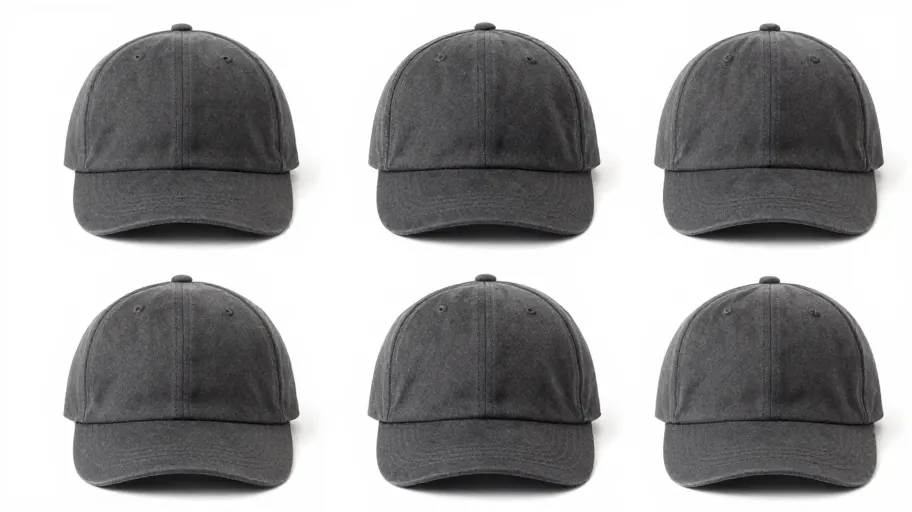
5 panel vs 6 panel cap men's comes down to one trade-off: a 5 panel cap offers a single, uninterrupted front panel ideal for large or edge-to-edge prints, while a 6 panel cap offers a centre-seamed, more traditional structured crown suited to embroidered logos and classic positioning. Choose by artwork first, then confirm construction, closure and fit through documented samples and written approval.
Why panel count is a sourcing decision, not a style preference
When an importer or brand buyer specifies a men's cap, the panel count changes three things that matter long before style does:
- The printable surface. A 5 panel cap front is one continuous piece of fabric with no centre seam. A 6 panel cap front is split by a seam running from the button to the brim. That seam affects whether certain print methods, large logos or heat transfers can sit cleanly across the front.
- The crown shape. Six panel construction, with structured buckram or similar interfacing, supports a defined, dome-like crown. Five panel construction tends toward a flatter, more angular front profile that suits streetwear and bold graphic placements.
- The artwork and decoration method. Embroidery, screen printing, heat transfer, patches and woven labels each interact differently with seams and panel curvature. Deciding the artwork before the construction — not after — prevents re-sampling.
This is why the Panel–Print–Approval (PPA) Framework starts with artwork, not with the cap itself.
The decision table: 5 panel vs 6 panel at a glance
| Decision factor | 5 panel cap | 6 panel cap | What the buyer should verify with the supplier |
|---|---|---|---|
| Front surface | Single uninterrupted front panel | Two front panels joined by a centre seam | Request close-up sample photos of the seam line |
| Print suitability | Suits large, continuous or edge-to-edge graphics | Suits centred logos, embroidery, patches | Confirm which decoration methods the factory supports per construction |
| Crown profile | Flatter, angular front profile | Structured, dome-like crown | Ask for profile shots or a physical sample of both |
| Style positioning | Streetwear, skate, cycling, promotional runs | Classic sport, corporate, uniform, retail basics | Match construction to your brand's line plan before quoting |
| Visor options | Confirm availability of flat or curved visor per style | Confirm availability of flat or curved visor per style | Verify visor options and stitching styles in writing |
| Closure options | Confirm per style (snapback, strapback, fitted, elastic) | Confirm per style (snapback, strapback, fitted, elastic) | Ask which closures are available for your chosen panel construction |
| Sampling implications | Print placement must be tested on the actual panel geometry | Seam clearance for embroidery/print must be tested | Request pre-production samples with your artwork applied |
Note: nothing in this table asserts what a supplier will charge, how long sampling takes, or what the MOQ is. Those are project-specific facts you must confirm in writing for your order.
The PPA Framework: three steps to the right specification
Step 1 — Panel: choose construction from your artwork. Lay out your largest logo or graphic at final size. If it crosses the centre of the cap front where a seam would sit, a 5 panel construction protects the artwork. If your logo sits centred and small — an embroidered mark, a woven patch — a 6 panel construction matches classic retail expectations. Decide this before requesting quotes, so you compare like with like.
Step 2 — Print: confirm decoration method against construction. Ask the factory, in writing, which decoration methods they can execute on your chosen construction: flat embroidery, 3D embroidery, screen print, heat transfer, silicone patch, woven label. Request photo evidence of past work on the same construction — and, where possible, a physical sample with your own artwork before committing to production.
Step 3 — Approval: lock the gates before mass production. Never approve a cap from photos alone if you can avoid it. Approval should cover, at minimum: panel alignment, seam quality, crown structure, visor shape, closure function, sweatband attachment, sizing, and decoration accuracy against your artwork file. Document each point with a signed or emailed approval so both parties hold the same reference.
Sampling: what to request and how to document it
Because no sample policy, cost, timeline or shipping arrangement can be assumed, treat sampling as a negotiation you document. Request the following from your supplier in writing:
- Whether physical samples are available for both 5 panel and 6 panel constructions in your target fabric.
- Whether the sample can carry your own artwork, and which file formats the factory needs.
- What happens if the first sample fails your approval: is a second sample round available, and under what terms?
- Whether a pre-production sample (from the actual production line and materials) will be provided before mass production begins.
Keep every answer in your RFQ file. When quotes, samples and approvals live in one document, disputes shrink and revision rounds become traceable.
Approval questions to ask before sign-off
Use this question set in your final approval email to the factory:
- Does the sample match the agreed tech pack on panel count, fabric, crown structure and visor shape?
- Is the decoration (print, embroidery, patch) placed within tolerance of the approved artwork file, with correct colours verified against the agreed reference?
- Do seams, stitching and sweatband attachment meet the quality criteria you documented at RFQ stage?
- Does the closure function correctly across your target size range, and is the size label accurate?
- Has the factory confirmed the production run will use the same materials and construction as the approved sample?
- Who signs the approval, on what date, and by what channel — and is that record shared with the factory?
If any answer is unclear, resolve it in writing before approving. An approval that references a specific sample number and date is worth more than a verbal "looks good."
FAQ
Which is better for a large front logo: 5 panel or 6 panel? A 5 panel cap gives an uninterrupted front panel, which protects large or continuous graphics from seam interference. A 6 panel cap works well for centred logos, embroidery and patches. Decide based on your artwork dimensions before you choose construction.
Does panel count affect cost? It can, but cost depends on fabric, decoration method, closure, order quantity and the supplier's current pricing — none of which can be assumed. Ask each supplier to quote both constructions for your identical spec sheet so you can compare directly.
Can I get both constructions sampled before deciding? That depends on the supplier's current sample policy. Ask in writing whether samples of both constructions are available, what they cost, and how the process works, then decide with physical samples in hand rather than images alone.
How do I avoid fit and sizing problems on a men's cap order? Specify closure type, size range and sweatband details in your tech pack, verify them on the sample, and confirm the production run will match the approved sample. Fit disputes that are documented at approval stage are far easier to resolve than those raised after delivery.
What should I send the factory to get an accurate quote? A brief containing: chosen panel construction, fabric, decoration method and artwork file, closure type, visor style, target quantity, destination market and labelling requirements. Precision in the brief is what makes quotes comparable across suppliers.
Next step
If you are preparing a cap order and want a structured document to brief factories correctly, 获取采购 Brief — it consolidates panel choice, decoration, closure and approval questions into one file you can send to any supplier.
Low-friction alternative: before you contact any factory, run through the approval question list above and mark every item you cannot yet answer. Those gaps are your RFQ. Write them down, send them, and only approve what you have verified in writing.
#cap manufacturers china, #headwear manufacturers china, #cap factory








