


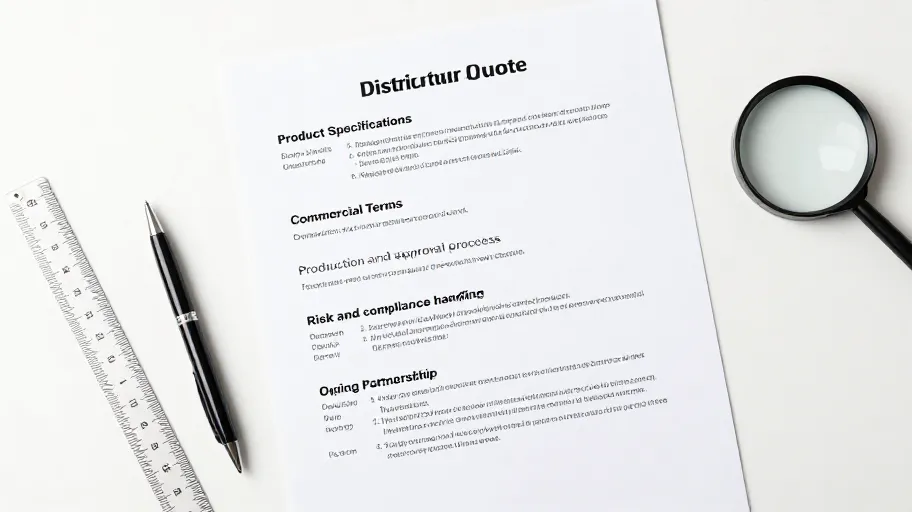
A useful quote from hat distributors should make five things clear in writing: the exact product specification, all commercial terms, the production and approval process, risk and compliance handling, and how the ongoing partnership will work. If any of these five are missing, vague or verbal-only, the quote cannot be fairly compared with alternatives — and the buyer is accepting avoidable sourcing risk.
Most sourcing problems between overseas buyers and hat distributors are not pricing problems. They are clarity problems. Two suppliers quote the same cap style at different prices, but one quote assumes a different closure, a different decoration method and a different sampling arrangement. The buyer compares numbers that do not describe the same product. This article gives you a structured way to prevent that.
The Quote-Clarity Ladder
The Quote-Clarity Ladder (QCL) is a five-rung evaluation sequence. You climb it in order, because each rung depends on the one below it: there is no point comparing commercial terms if the specification is undefined, and no point discussing partnership terms if risk handling is undocumented.
| Rung | Question it answers | What "clear" looks like |
|---|---|---|
| 1. Specification | What exactly will be made? | Style, panels, material, closure, sizing, decoration method, colour reference, labelling and packaging all stated in writing |
| 2. Commercial | What exactly will it cost? | Sampling terms, tooling or set-up terms, unit pricing basis, deposit and payment structure, incoterms and validity period all itemised |
| 3. Production | How will it be made and approved? | A documented pre-production approval step, an inspection checkpoint and a clear change-management process |
| 4. Risk | What happens when something goes wrong? | Written procedures for defects, delays, IP protection and third-party inspection access |
| 5. Partnership | Can this supplier support the programme long term? | Communication channels, English-language documentation, repeat-order handling and escalation paths |
A quote that only climbs rung two is a price, not a proposal. The strongest hat distributors distinguish themselves by answering rungs three to five without being asked.
Rung 1 — Specification clarity
Before you request pricing, write a specification sheet that any supplier can quote against without guessing. At minimum it should state:
- Cap style and construction (for example, six-panel structured vs. unstructured five-panel — define it, don't rely on a photo alone).
- Main material and any secondary materials (brim, sweatband, lining, eyelets).
- Closure type and adjustability range.
- Sizing basis and the measurement method used.
- Decoration method for each logo position (embroidery, printing, woven label, patch, laser, heat transfer) with stitch density or artwork detail where relevant.
- Colour reference system (for example, a Pantone number) rather than descriptive colour names.
- Interior labelling, hangtags and packaging format.
Then ask each distributor to confirm the specification back to you in their own words, in writing, inside the quote. If a supplier restates your spec incorrectly at quote stage, you have learned something valuable before paying anything.
Rung 2 — Commercial clarity
Every commercial variable that is not written into the quote becomes a negotiation later, from a weaker position. Ask each supplier to state in writing:
- How sampling is arranged, what the current sampling policy is, and what terms apply — the supplier must confirm current policy directly; do not assume any arrangement.
- Whether any tooling, digitising or set-up charges apply, and what they cover.
- The basis of the quoted unit price: specification, quantity, packaging and incoterms.
- The minimum order quantity for this specific project — this is project-specific and must be confirmed per supplier, per style.
- Payment structure and deposit terms.
- Quote validity period.
Send the identical question list to every distributor. Identical questions are what make the answers comparable.
Rung 3 — Production clarity
A quote is only as good as the process behind it. Three questions separate a proposal from a promise:
- Will there be a pre-production sample approval step? Ask for the approval gate to be named in the quote or accompanying process document.
- Where are the inspection checkpoints? Ask whether you or your nominated third party can inspect at defined stages, and how that access is arranged.
- How are changes handled? If you adjust artwork, colour or packaging after approval, ask how the change is priced, documented and re-approved.
Production lead time for your project is a question for each supplier to answer against your confirmed specification and quantity — never accept a duration quoted before the spec is agreed.
Rung 4 — Risk and compliance clarity
Ask each distributor to document, in writing, how they handle:
- Defect identification, reporting and remediation.
- Delay notification — will they tell you proactively, and through which channel?
- Intellectual property protection for your artwork, moulds and branding.
- Any testing or certification requirements relevant to your destination market — you must confirm with each supplier what they can currently evidence for your specific requirement, and verify documentation yourself rather than relying on claims.
Treat any supplier who resists putting risk procedures in writing as a data point in your comparison.
Rung 5 — Partnership clarity
If this is a recurring programme rather than a one-off order, add:
- Who is your named contact, and what is the escalation path?
- How is documentation handled in English at each stage?
- How are repeat orders processed — full re-approval or a defined shortcut?
- What happens to your exclusive artwork, tooling and labels between orders?
Decision table: comparing two distributor quotes
Use a table like this for every quote you collect. Score each cell: Clear / Partial / Missing.
| Clarity dimension | Distributor A | Distributor B | Action if not "Clear" |
|---|---|---|---|
| Written specification restated in quote | Request written confirmation before comparing prices | ||
| Sampling terms and current policy | Ask supplier to state current policy in writing | ||
| Itemised cost basis (spec, quantity, packaging, incoterms) | Ask for itemisation; do not compare totals | ||
| Project MOQ | Confirm per style and per project | ||
| Pre-production approval step | Require the gate to be named in writing | ||
| Inspection access and checkpoints | Confirm who can inspect and at which stages | ||
| Change-management process | Ask for a written change procedure | ||
| Risk procedures (defects, delays, IP) | Request written procedure | ||
| Destination-market compliance evidence | Ask what can be evidenced, then verify documents | ||
| Quote validity period | Confirm before internal approval |
The distributor with the lowest unit price but three "Missing" rows is not the cheapest option — it is the least defined one.
Approval questions to put in writing
Before you approve any quote, send this list and keep the replies:
- Please restate the full specification as you understand it.
- Please state your current sampling policy and terms for this project.
- Please itemise every cost element in the quote and its validity period.
- What is the MOQ for this style at this specification?
- What is the production lead time against this confirmed specification and quantity?
- Is a pre-production approval sample included in your process, and at which gate?
- How are inspections arranged, and can a third party attend?
- How are post-approval changes documented and priced?
- What is your written procedure for defects and delay notification?
- What IP protection applies to our artwork, tooling and labels?
A distributor's willingness to answer these ten questions completely is itself a selection criterion.
FAQ
Should I compare hat distributors on unit price alone? No. Compare on the full Quote-Clarity Ladder. Two prices are only comparable when both quotes describe an identical specification, the same commercial basis, and the same approval and inspection process.
What is the single most important item to get in writing? The supplier's restatement of your specification inside the quote. Everything downstream — pricing, approvals, inspection and dispute resolution — depends on that shared definition.
How do I handle sampling terms I don't yet know? Ask. Each supplier must confirm their current sampling policy directly in writing. Do not assume arrangements from previous projects or from other suppliers' quotes.
How many hat distributors should I quote before deciding? Enough to see structure, not just numbers — for most programmes, comparing a small shortlist with an identical question list is more useful than collecting many incomparable quotes.
What signals that a quote will cause problems later? Verbal-only answers, a quote that omits the approval and inspection process, refusal to document risk procedures, and a price issued before the specification was confirmed.
Ready to standardise your supplier comparison? Download our hat distributors quote checklist and send the identical question list to every supplier on your shortlist: 下载核对清单
Prefer to start smaller? Use the ten written approval questions above as your first-pass checklist — copy them into your next supplier email and compare which hat distributors answer in full.
#cap manufacturers china, #headwear manufacturers china, #cap factory








