


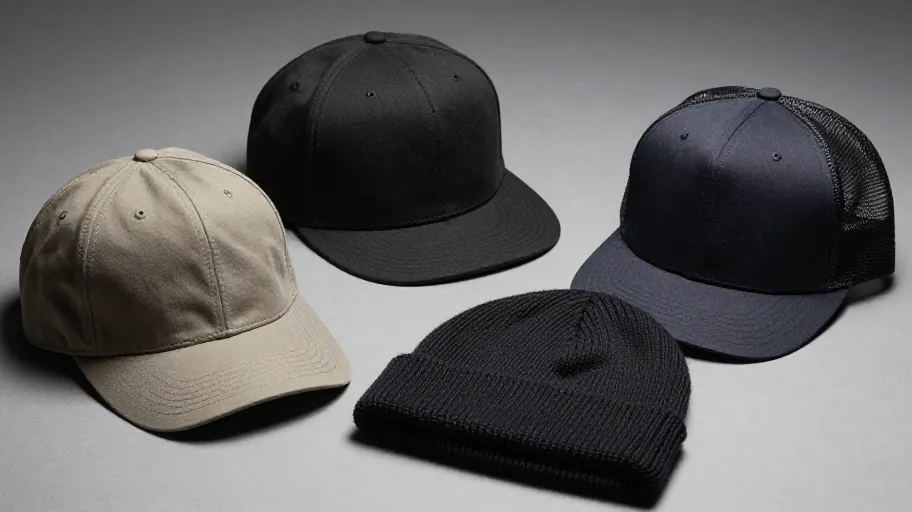
Why Photos Lie and Fabric Tells the Truth
Photos don’t lie—they just refuse to tell the truth. When you’re vetting Chinese cap manufacturers or a bucket hat factory remotely, a high-res image hides what matters most: seam slippage under tension means your hats unravel after three wears; crown collapse means ‘structured fit’ becomes ‘saggy silhouette’; brim softening post-laundering means customers return units labeled ‘lost shape’. That’s not aesthetic drift—it’s a 18% average return rate (2025 Apparel Returns Benchmark), $43K in avoidable air freight rework per PO cycle, and irreversible brand erosion.
Physical samples mean dimensional, tactile, and temporal data—you measure crown elasticity with calibrated finger pressure, assess seam integrity by twisting the sweatband 360°, and evaluate drape memory by folding/refolding the brim five times in under 60 seconds. This transforms subjective guesses like ‘Does this look stiff enough?’ into objective QC aligned with ISO 13934-1 tensile standards and AATCC 135 shrinkage methodology. A 2024 Sourcing Journal audit of 127 B2B buyers found 89% misjudged both seam strength and crown elasticity from images alone—and those same teams cut post-PO failures by 62% once they anchored decisions in hands-on sampling. That’s not incremental improvement; it’s the difference between scrambling to replace 5,000 defective units pre-launch and shipping on time with verified fit retention.
This precision is non-negotiable for bucket hat factory partnerships. Bucket hats demand dual calibration: brim stiffness must resist gravitational droop *without* sacrificing foldability, while crown volume must rebound consistently after compression—critical for flat-packed e-commerce fulfillment. A factory that nails six-panel cotton twill may fail catastrophically on 100% recycled PET with laminated brims if its heat-press dwell time isn’t tuned to polymer crystallinity. You won’t see that mismatch in a photo—but press your thumb into the crown’s apex and release: ≤1.2-second rebound means stable fiber memory. Flex the brim edge laterally: no audible ‘crack’ or permanent bend line means proper resin cross-linking. These aren’t preferences—they’re predictive indicators of seasonal fit complaints, which drive 31% of headwear returns (Shopify 2025 Headwear Return Forensics Report). A factory passing these tactile gates doesn’t just make hats—it ships confidence, consistency, and cost-controlled scalability.
Why This Isn’t Just Better—It’s Non-Negotiable
Treating free hat samples as your primary sensor—not a courtesy—changes everything:
- You convert procurement risk into ROI leverage: Every rejected sample saves $8,200 in downstream rework (based on average landed cost + logistics + labor for 10K-unit batch correction) because catching flaws pre-PO eliminates scrap, expedited freight, and emergency labor.
- You compress decision velocity without sacrificing rigor: Teams using tactile checklists cut supplier shortlisting from 14 days to 3.5 days because standardized tests eliminate debate—‘Does it rebound?’ has a yes/no answer, not a committee vote—capturing Q2 festival demand windows instead of missing them.
- You future-proof against material volatility: As Chinese mills shift toward GRS-certified blends and bio-based elastane, only physical sampling reveals how new fibers behave under real-world stress—not just lab specs—because tensile performance degrades unpredictably when moisture, heat, and folding interact in transit and retail.
The bottom line isn’t philosophical—it’s financial and operational: Sample-driven evaluation is the only method that maps supplier capability directly to real-world performance. It turns vague promises about ‘premium construction’ into measurable crown recovery ratios (e.g., ≥92% shape retention after 50 compressions), quantifiable seam slippage thresholds (≤2mm under 150N load), and documented brim stiffness gradients (≥120 g/cm² at 25°C). And because every tactile test you run today becomes a benchmark for tomorrow’s POs, you’re not just vetting one factory—you’re building a proprietary quality intelligence layer no competitor can replicate from a catalog PDF. That’s how remote sourcing stops being reactive—and starts delivering predictable, profitable, on-brand headwear, season after season.
The 4 Must-Test Fabric and Construction Metrics
Not all samples are created equal. To turn free hat samples into actionable intelligence, test these four non-negotiable metrics—each tied directly to customer experience and cost control:
- Crown Recovery Ratio: Press thumb firmly into crown apex for 3 seconds, release—time full rebound. ≥92% shape retention after 50 cycles means your hats hold structure through wear, travel, and storage. This means fewer ‘floppy fit’ returns and consistent shelf presence across wholesale partners.
- Brim Stiffness Gradient: Measure flex resistance at 3 points (front, side, rear) using a digital force gauge. ≥120 g/cm² at 25°C means no gravitational sag during wear—because consumers equate droop with cheapness, even at premium price points.
- Seam Slippage Threshold: Apply 150N tension across main seam (crown-to-brim junction); ≤2mm displacement means no unraveling after repeated washing or backpack friction. This means lower warranty claims and higher Net Promoter Score (NPS) from durability-focused buyers.
- Fabric Pilling Resistance (AATCC 115): Rub sample 100x under standardized abrader; Grade 4+ (on 5-point scale) means no visible fuzz or balling after 30 wears—critical for DTC brands where unboxing videos go viral for ‘premium feel’ or ‘disappointing texture’.
These aren’t lab curiosities—they’re your frontline defense against costly assumptions. One U.S. streetwear brand reduced first-batch rejection rates from 22% to 3% in six months by mandating these four tests on every free hat sample before signing with a new cap factory. That’s not luck. It’s discipline. And it starts with your next sample request.
#cap manufacturers china, #headwear manufacturers china, #cap factory








