


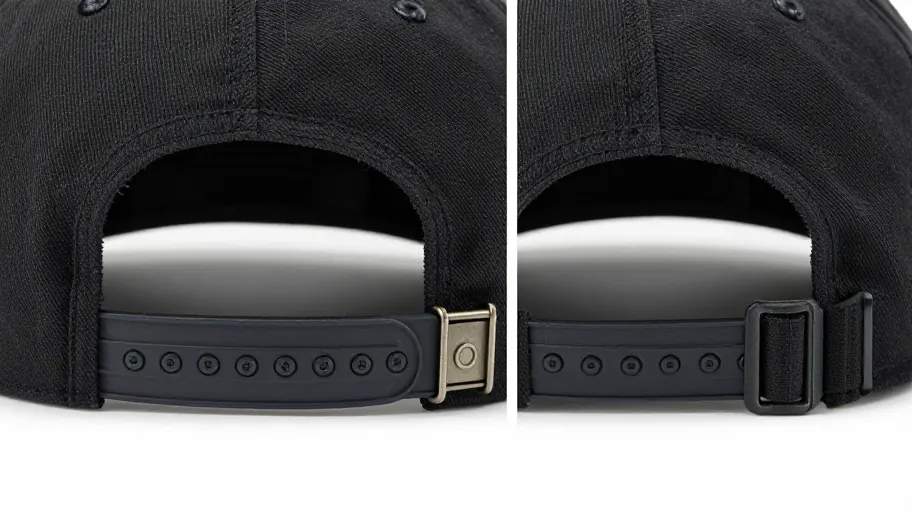
Snapback vs strapback comes down to three things you control as a buyer: the hardware material, the adjustment mechanism and how the closure presents your brand. A snapback closes with a row of plastic snaps on a rigid strap; a strapback uses a strap fed through a buckle — plastic, metal or elastic. Before you request samples, confirm material options, adjustment behaviour, branding placement and the exact specification your supplier needs. This article gives you the questions to ask.
The two closures, in sourcing terms
From a factory's point of view, the difference is not "fit" — it is a different set of components, assembly steps and quality checks.
- Snapback: a rigid plastic strap with punched holes, closed by a flat plastic snap connector. It is the flat-brim, streetwear-adjacent default, and the snaps themselves sit on the back of the crown where they are visible.
- Strapback: a softer strap — fabric, leather-look material or webbing — fed through a buckle, sometimes with a tuck-in tail, sometimes elastic. It reads as a more understated, lifestyle or heritage look, and the hardware choice changes the whole rear silhouette of the cap.
Both are one-size adjustment systems: the wearer adjusts at the back rather than relying on a fitted size. That is where the similarity ends, and where your specification work begins.
Which closure fits your programme? A decision table
| Your situation | Lean towards | Why | What to confirm before sampling |
|---|---|---|---|
| Streetwear drop, flat brim, bold rear branding | Snapback | Snap hardware is a recognised style cue; the closure is part of the look | Snap material and colour; hole spacing; whether the snap can carry a logo |
| Lifestyle brand, softer crown, minimal hardware | Strapback with tuck-in strap | Tuck-in hides the tail for a cleaner rear profile | Strap material, width, buckle metal or plastic, tuck-in construction |
| Corporate gifting or uniform programme | Either — decided by brand tone | The closure should match the cap's overall formality | Durability expectations and any client-side approval process (confirm feasibility with the factory) |
| Performance or active positioning | Strapback with elastic strap element | Elastic reduces fiddling for the wearer | Elastic specification, recovery behaviour and how it ages — ask the supplier what they can demonstrate on a sample |
| Mixed assortment under one brand | Offer both across SKUs | Different caps justify different closures | Consistency of hardware finish across the range |
Use this table as a starting hypothesis, not a verdict. Your reference images and brand tone will shift the answer — which is exactly why the closure decision belongs in a project-specific brief rather than a generic selector.
The Closure Confirmation Framework: five checkpoints before sampling
Treat the closure as a specification with five checkpoints. Complete all five in writing before the factory cuts a sample.
Checkpoint 1 — Material. New Generation's closure catalogue lists plastic snaps, metal belt buckles with tuck-in and elastic straps. That is the confirmed scope of options; start there and ask what variants exist within each category — finishes, colours, widths — for your project. Avoid assuming a fit range, weight rating or durability result for any of them: the catalogue does not establish those, so any such expectation must be raised as a question, not written as a given.
Checkpoint 2 — Adjustment behaviour. "Adjustable" is not a specification. Ask:
- For a snapback: how many hole positions, and how is spacing defined?
- For a strapback: how much travel does the strap allow, and how does the tuck-in behave when the strap is at its tightest?
- For elastic: what does the supplier need from you to match the tension you want?
Checkpoint 3 — Security and comfort in wear. You cannot judge this from a spec sheet, and neither can we promise it in an article. Put it in the brief as an approval criterion: state the wearing scenarios you care about, and agree with the supplier what the sample must demonstrate for you to approve the closure. Confirm what testing or assessment the factory can actually perform — do not assume a standard test exists until they tell you it does.
Checkpoint 4 — Branding surface. The closure is prime real estate or invisible detail, depending on your choice:
- Can the snap connector be moulded, printed or finished in a brand colour?
- Can a metal buckle be engraved or plated to match your hardware across other products?
- Does an elastic or fabric strap accept a woven label or print?
Ask which branding treatments are available for the specific hardware in your brief, and request them on the sample, not just in a mock-up.
Checkpoint 5 — Sampling approval. Decide before sampling what "approved" means: which closure attributes you will check, on how many sample units, and against which agreed descriptions. Write the closure line of your tech pack so precisely that the sample can be judged pass/fail against it — material, colour reference, strap width if applicable, hardware finish and branding treatment. This is the single most effective protection against a bulk run that drifts from the sample you liked.
What the catalogue tells you — and what it doesn't
The confirmed facts are straightforward: New Generation's closure catalogue covers plastic snaps, metal belt buckles with tuck-in and elastic straps. It does not establish a universal fit range or a durability result, and no sample, cost, shipping or production policy has been published for this article to quote. That is not a gap in the article — it is a boundary every responsible sourcing adviser respects. Fit behaviour, hardware longevity, sample terms, timelines and pricing all depend on your specific design and volume, and must be confirmed directly with the manufacturer for your project.
The practical implication: when a supplier conversation or another article states closure "facts" without a project behind them, treat those as prompts for questions, not answers for your tech pack.
Sample-stage verification checklist
Print this into your sampling workflow and check each item against the physical sample before approving:
- Closure type matches the approved tech pack (snapback or strapback variant specified).
- Hardware material and finish match the colour/finish reference agreed in the brief.
- Snap: hole count, spacing and snap engagement match the approved spec.
- Strapback: buckle type, strap width and tuck-in construction match the approved spec.
- Elastic (if used): tension and feel are as agreed; note how it is defined in the spec.
- Branding on the closure (if specified) is present and matches the approved artwork or finish.
- Closure is assembled so the rear panels sit as approved on the sample.
- Any condition you agreed as an approval criterion has been demonstrated — or escalated — before sign-off.
If any line fails, document it with photos and resolve it with the factory before approving anything downstream.
FAQ
Is a snapback or strapback better for a first custom cap programme? There is no universal answer. Snapbacks suit a bold, flat-brim aesthetic where the hardware is part of the look; strapbacks suit softer crowns and cleaner rear profiles. Decide by brand tone and target customer, then confirm material and branding options for that specific closure with your manufacturer before sampling.
Can the closure hardware carry our logo? Potentially — but which treatments are available depends on the hardware. Ask the factory whether your chosen snap, buckle or strap can be finished, printed, engraved or labelled with your branding, and request it on the physical sample. Do not assume a treatment is possible until it is confirmed for that component.
What does the factory need from us to quote and sample a strapback correctly? At minimum: closure type, strap material and width, buckle choice (including tuck-in construction), colour references and any branding treatment. A reference image plus a short written brief resolves most ambiguity — which is exactly what the project review CTA below is for.
Does one size really fit all with these closures? Both systems are adjustable rather than sized, but "one size fits all" is a marketing claim, not a specification. Adjustment range depends on hole count, strap length or elastic behaviour — details that must be defined in your tech pack and confirmed on a sample. The catalogue does not establish a universal fit range, so agree your expectations project by project.
How do we make sure the bulk run matches the approved closure sample? Write the closure into the tech pack with pass/fail-checkable detail, agree the approval criteria before sampling, and verify the physical sample against the checklist above. Then ask the supplier how sample-to-bulk consistency is controlled for your specific order — a question to raise directly, not an assumption to carry into a contract.
Submit your closure decision for project-specific review
If you are weighing snapback vs strapback for a live programme, don't resolve it from an article — resolve it from a brief. Submit a cap brief, reference image or logo to New Generation for project-specific review, and the closure options for your design can be confirmed against what the factory can actually produce, including the plastic snap, metal buckle with tuck-in and elastic strap categories in the closure catalogue.
Prefer to prepare first? Download the thinking, not a brochure: copy the Closure Confirmation Framework checkpoints and the sample-stage checklist above into your sourcing document, fill in what you know, and mark the rest as questions. Bring the marked-up version with your brief — it shortens every conversation that follows.
#cap manufacturers china, #headwear manufacturers china, #cap factory








