


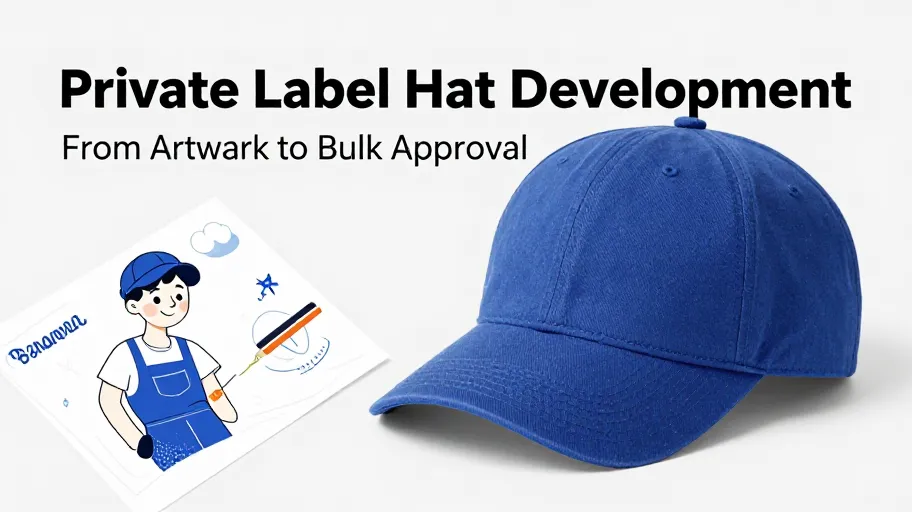
Developing a private label hat line requires bridging the gap between creative design and physical manufacturing. For overseas brands, the risk lies in the interpretation of artwork. A successful partnership with a private label hats manufacturer hinges on a rigorous approval process that documents every specification—from fabric weight to thread color—before mass production begins. By establishing clear quality gates at the sample stage, you ensure the bulk shipment matches your expectations.
Navigating the Prototype-to-Production Gate
To mitigate the risks of outsourcing, we utilize a "Prototype-to-Production Gate" framework. This approach divides the development process into distinct stages, each requiring a formal sign-off. The goal is not just to produce a hat, but to produce a standard that can be replicated. You are not approving a single item; you are approving the specifications that generate thousands of items.
Phase 1: Artwork Preparation and Technical Translation
The first common point of failure is the artwork submission. A JPEG or PNG file, while visually clear, is insufficient for manufacturing. To ensure accuracy, you must provide vector formats (AI, EPS, or PDF) that allow the factory to scale the design without quality loss.
However, vector files are only the beginning. You must engage in "technical translation" with your manufacturer. This involves defining:
- Placement: Exact measurements for the logo center relative to the cap seam or visor.
- Sizing: Physical dimensions of the logo in millimeters or inches, not just percentage scales.
- Color Matching: Providing Pantone (PMS) color codes for both the hat fabric and the embroidery threads. Relying on screen colors (RGB) will result in variance.
A professional private label hats manufacturer will provide a "digital mockup" or "tech pack" for review before any fabric is cut. This document serves as the initial contract. Verify that all Pantone codes and dimensions are listed explicitly on this mockup.
Phase 2: The Pre-Production Sample (PPS)
Once the artwork is approved, the factory creates the Pre-Production Sample (PPS). This is arguably the most critical stage in the lifecycle. The PPS is made using the actual production materials and machinery, but it is a singular unit created for your review.
When evaluating the PPS, do not simply look at it and say "it looks good." You must stress-test the item.
- Check the dimensions: Does the crown height match your spec?
- Inspect the decoration: Run your finger over the embroidery. Is the backing stiff? Are the thread ends trimmed? Is the density consistent?
- Assess the structure: Does the buckram stay firm? Does the visor maintain its shape?
If the PPS deviates from your request—such as the shade of navy blue being too light or the logo being slightly off-center—this is the moment to halt the process. Request revisions. Do not accept a sample that is "good enough," as "good enough" in a single unit often magnifies into a defect in bulk.
Phase 3: The Golden Sample and Bulk Approval
After revisions, the factory will produce a "Golden Sample" (or Counter Sample). This is the definitive unit that represents the standard for the entire order. Upon signing off on the Golden Sample, you are essentially stating: "Produce 5,000 units exactly like this."
This stage requires a shift in mindset from designer to quality control inspector. You are no longer judging aesthetics; you are judging consistency. The Golden Sample must be kept by you (or a third-party inspector) as a benchmark. When the bulk goods are ready, this sample is used to compare against the shipment.
If you are sourcing from overseas, consider hiring a third-party inspection agency in China to perform a "During Production Check" (DUPRO) using your approved Golden Sample. They verify that the assembly line is adhering to the standard you set.
Decision Framework: Types of Approvals
Understanding what you are approving prevents scope creep. Use the table below to categorize your focus during the sample stage.
| Approval Type | Focus Area | Key Verification Points | Risk if Ignored |
|---|---|---|---|
| Visual Approval | Aesthetics & Branding | Color accuracy (Pantone match), logo clarity, correct artwork placement. | Brand damage, unsellable inventory due to "ugly" or wrong colors. |
| Functional Approval | Wearability & Utility | Closure mechanism strength (snapback/strapback), sweatband absorbency, fabric breathability. | High return rates due to poor fit or discomfort. |
| Construction Approval | Durability & Assembly | Stitching consistency, thread tension, secure attachment of visor/crown, no loose threads. | Products falling apart after minimal use; negative reviews. |
Critical Approval Questions for Your Manufacturer
To maintain control over the development process, ask the following specific questions before signing off on the Golden Sample. Avoid "yes/no" questions; seek specifics.
- "What is the exact thread count and fabric weight being used for the Golden Sample?"
- Why: Ensures the factory doesn't substitute cheaper, lighter fabric for the bulk run.
- "Can you provide the Pantone color swatches used for the threads and fabric for my physical records?"
- Why: Creates a physical paper trail for color verification.
- "How will you measure the logo placement consistency across the bulk production?"
- Why: Forces the factory to explain their internal QC jig or measurement process.
- "If the bulk production varies from the Golden Sample, what is your specific rectification protocol?"
- Why: Establishes the remedy process (re-work vs. discount) before the problem occurs.
A Note on Sourcing from China
When working with a Shenzhen-based manufacturer, the advantage lies in the supply chain ecosystem, but the challenge is often communication speed and time zones. To bridge this gap, consolidate your feedback. Do not send feedback piecemeal (e.g., one email about the logo, another about the fabric). Compile a comprehensive report with photos and marked-up diagrams.
Batching your communications reduces the chance of translation errors and ensures the production team receives a complete set of instructions simultaneously.
FAQ
How long does it take to go from artwork to a physical sample? The timeline varies significantly based on the complexity of the decoration and the current factory workload. A standard custom cap may require a few weeks for sampling, while complex designs with mixed media (embroidery plus printing) can take longer. You should confirm the specific schedule with your manufacturer during the inquiry stage.
What is the difference between a sales sample and a pre-production sample? A sales sample is often pulled from existing stock or made quickly to show a concept, sometimes using similar materials. A pre-production sample (PPS) is made using the exact molds, fabrics, and machines intended for the mass order. Never approve bulk production based solely on a sales sample.
Can I make changes to the design after approving the Golden Sample? Technically, yes, but it is strongly discouraged. Changes made after the Golden Sample approval incur "changeover costs" and will almost certainly delay the delivery schedule. The factory must stop the line, re-tool, and re-approve the process, which introduces a high risk of error.
What happens if the bulk shipment arrives and looks different from the sample? This depends on the terms agreed upon prior to production. If the deviation falls within agreed-upon tolerances (e.g., slight shade variation due to dye lots), it may be accepted. If it is a significant deviation (wrong logo, wrong fabric), the issue lies in the QC process. Using a third-party inspection service before the goods leave the factory is the primary method to prevent this scenario.
Conclusion
Transitioning from artwork to bulk approval is a systematic process of risk elimination. By treating the sample phase as a rigorous exercise in defining standards—rather than just "seeing a design"—you protect your brand from the variability of offshore manufacturing. The most successful private label buyers are those who demand precise specifications and verify them physically before the first machine starts running.
Ready to standardize your headwear production?
[ 获取开发 Brief ]
Not sure if your artwork is factory-ready? Download our Artwork Preparation Checklist to ensure your files are optimized for the first round of sampling.








