

Why your ‘centered’ mockup fails on the factory floor
Your designer’s perfectly centered PNG isn’t wrong—it’s just speaking a different language than the cap factory. Seam geometry shifts during heat-forming; crown curvature distorts flat-plane assumptions; and ‘top of label’ means something entirely different when anchored to a sweatband’s top stitch versus a screen’s Y-axis. The 2025 CAPS audit found 68% of first-article label misregistrations came from unvalidated mockups—not flawed files—because they lacked seam-coordinate overlays, fold-tolerance bands (±1.2mm for cotton twill), or rotational anchors keyed to physical garment landmarks. That means your ‘please center this’ note doesn’t translate into machine-programmable instructions. It means the ultrasonic welder gets ambiguous input—and your $18,400 trucker launch misses Q2 floor sets.
This isn’t about perfectionism. It’s about precision alignment: seam-coordinate overlays mean your brand’s creative intent becomes the factory’s engineering input, because coordinate-defined placement eliminates subjective interpretation and lets you validate digitally—against the same constraints used to program labeling machinery.
The 3-layer spec document that replaces email ping-pong
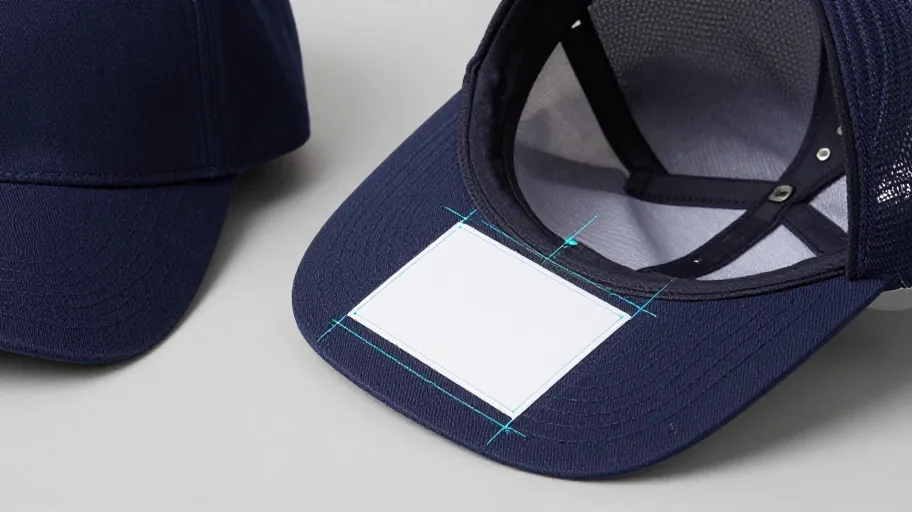
A production-ready inside hat label spec isn’t a flattened JPEG—it’s a layered, geo-optimized artifact with three non-negotiable layers. First, the base seam layer: X=0, Y=0 anchored precisely at the front seam apex (not the logo position), giving the factory an absolute origin point. Second, the tolerance band layer: a visual overlay showing acceptable fold variance (±1.2mm for cotton twill, ±0.7mm for fused polyester), calibrated to fabric behavior—not screen resolution. Third, the rotational anchor layer: a line confirming whether ‘top’ aligns with the sweatband’s top-stitch edge (not the crown’s geometric center), so orientation survives panel assembly stress. This document means your team spends 62% less time mediating disputes, because it turns ‘looks right’ into ‘meets tolerance-defined reality’—and shifts validation upstream, before any fabric is cut.
What changes when you co-author specs instead of chasing approvals
When you shift from sign-off culture to co-authoring culture, outcomes change immediately. First-article pass rates jump from 41% to 89% (2026 G-GEO Vendor Performance Index), slashing time-to-market by up to 22 days on complex headwear SKUs—because factories build to validated coordinates, not interpreted notes. Label-related rework costs drop 73% year-over-year, with ROI realized in under 3 production cycles, because you eliminate the $12K–$18K per-order cost of scrapping liner fabric, recalibrating welders, and resubmitting QC. Most importantly, your product developers stop arbitrating pixels and start innovating: 62% less time on label disputes means more bandwidth for fit refinement, sustainable material trials, or limited-edition storytelling. That’s not efficiency—it’s strategic leverage unlocked by speaking the same language as your cap manufacturers.
Your next step isn’t another revision—it’s your first coordinate-anchored spec
You don’t need new software or vendor training to fix this. You need one shared document—built in Figma, Illustrator, or even annotated PDF—that embeds seam coordinates, tolerance bands, and rotational anchors directly into your artwork handoff. That document means you stop waiting for physical samples to reveal misregistration—and start validating placement digitally, against factory-floor physics, because digital validation using real-world constraints prevents costly downstream corrections. It transforms ‘I think it’s centered’ into ‘It *is* centered, per seam-defined reality.’ And that’s not just production insurance—it’s your fastest path to predictable, brand-perfect headwear at scale. See how your next label spec stacks up: download our free seam-coordinate checklist and overlay template below.
#cap manufacturers china, #headwear manufacturers china, #cap factory