


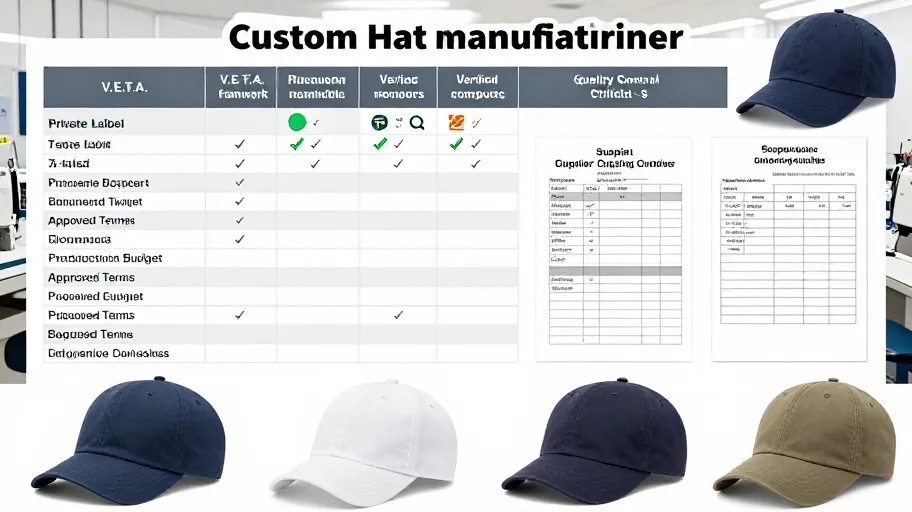
There is no single “best” custom hat manufacturer — only the best fit for a specific private-label project. Evaluate candidates on evidence: verified capabilities, documented communication, tested samples, and approved terms. Use a structured scorecard to compare suppliers objectively before committing production budget to any one factory.
The V.E.T.A. framework for comparing manufacturers
When buyers ask who is the best custom hat manufacturer for their program, the honest answer is that rankings cannot substitute for verification. A factory that suits one brand's structured five-panel cap program may be wrong for another brand's fashion-driven bucket hat line. The V.E.T.A. framework gives you four gates to move through before signing anything:
- V — Verify capabilities
- E — Evaluate communication
- T — Test quality through samples
- A — Approve terms in writing
Each gate produces documented evidence. By the end, you are comparing files, not marketing claims. Below is how to run each gate in practice.
Gate 1: Verify capabilities
Capability means more than a product listing. For a private-label headwear project, ask each candidate manufacturer to confirm in writing:
- Construction range. Which hat constructions can they produce — five-panel, six-panel, trucker, snapback, dad cap, bucket, beanie? Ask for photos of physical samples they made, not renders.
- Decoration methods. Embroidery (flat, 3D puff, chenille?), screen print, patch application, heat transfer, woven labels. Ask which methods are done in-house and which are subcontracted, because that affects accountability.
- Materials and trims. Can they source the fabrics, brims, closures and sweatbands your spec requires? Can they provide material documentation on request?
- Design support. Do they offer ODM-style input — pattern adjustments, tech-pack development, prototyping — or only OEM production from your finished files?
- Compliance documentation. Ask what certifications or test reports they can provide for your target markets, and confirm currency and scope yourself. Do not accept a logo image as proof.
Approval questions to send: “Please confirm which of the following constructions and decoration methods you currently produce, and send photos of physical samples for each.” If a supplier answers vaguely at this stage, that vagueness will compound later.
Gate 2: Evaluate communication
Communication quality predicts project outcomes better than any catalogue. Across time zones and languages, slow or ambiguous responses create spec drift, revision loops and missed ship windows.
Score every supplier on the same observable behaviours:
| Behaviour to track | What to record |
|---|---|
| Response time to your first enquiry | Date and time of each reply |
| Willingness to answer in writing | Whether answers arrive by email or only by voice call |
| Spec comprehension | Whether they restate your requirements correctly without prompting |
| Proactivity on problems | Whether they raise issues before you discover them |
| Revision handling | How they document changes to artwork, materials or fit |
A practical method: keep a communication log for your first ten exchanges with each candidate. Suppliers who answer precisely before you have paid anything tend to maintain that standard; suppliers who are vague pre-sale have no incentive to improve post-deposit.
Gate 3: Test quality through samples
Listings prove nothing. Samples prove something. A structured sampling step is the cheapest risk control in the entire sourcing process.
- Request a sample based on your design or a close analogue, not a generic showroom piece.
- Inspect stitching density and consistency, panel alignment, brim shape retention, closure function, embroidery registration and interior finishing.
- If your market requires specific tests (colour fastness, content verification, safety testing), ask which the supplier can support and request documentation. Verify the documents yourself with the issuing bodies where possible.
One sample is a screening tool, not a guarantee. For a significant private-label program, plan a sampling stage that mirrors production methods before approving bulk.
Gate 4: Approve terms in writing
This is where most sourcing problems are created or prevented. Before any deposit, get the following confirmed in a written document — quotation or proforma — and compare candidates side by side:
Decision table: term-by-term supplier comparison
| Term to confirm | What to demand | Red flag |
|---|---|---|
| MOQ per style/colour | Written minimum for your specific program | “It depends” with no follow-up number |
| Unit pricing basis | What the quoted price includes (decoration, trims, packaging) | Price that changes after deposit |
| Sample policy | Current cost, timeline, and how it applies to bulk orders | Refusal to state the policy in writing |
| Lead time | Production duration stated per order, in the contract | Vague commitments with no written basis |
| Payment structure | Deposit and balance terms, in writing | Requests for full prepayment |
| Revisions | How many rounds included, and cost of extras | Unlimited free revisions promised verbally |
| Quality criteria | Agreed inspection method and acceptance criteria for bulk | No written quality reference at all |
| IP protection | Written commitment on design confidentiality | Reluctance to discuss design ownership |
Note deliberately: no numbers appear in this table. Minimums, prices, durations and policies are project- and supplier-specific, and any figure quoted in an article would be unverified. The evaluation skill you need is extracting and comparing each supplier's actual numbers, not benchmarking against a fictional average.
Red-flag checklist before you commit
Use this checklist as a final gate. Walk away or escalate if a candidate:
- Cannot provide photos of physical samples they produced for comparable constructions
- Avoids putting MOQ, pricing basis or lead time in writing
- Cannot explain which processes are in-house versus subcontracted
- Pushes for full payment before sampling
- Refuses to define quality acceptance criteria for bulk production
- Cannot state a current sample policy for you to confirm
- Responds inconsistently across your first ten communications
A supplier who passes V.E.T.A. with documented answers at every gate is a candidate worth negotiating with — regardless of how their marketing reads.
FAQs
How many custom hat manufacturers should I compare before choosing? Compare at least three through all four V.E.T.A. gates. Two gives you a binary choice; three or more reveals whether a supplier's answers are strong or merely adequate for the category.
Should I choose an OEM or ODM manufacturer for a private-label hat line? OEM means you supply complete design files and the factory produces them; ODM means the factory contributes design or pattern development. If you lack in-house tech-pack capability, ODM support matters — ask each candidate directly what design assistance they provide and how it is documented and charged.
What documents should I collect before paying a deposit? A written quotation covering MOQ, unit price basis, production duration, sample policy, revision terms, payment structure and quality acceptance criteria — plus any compliance documentation relevant to your market, which you should verify independently.
How do I verify a manufacturer's claims about quality or compliance? Ask for physical samples, request the underlying documents rather than summary claims, and verify certificates with issuing organisations. Where possible, arrange third-party inspection of bulk production against written acceptance criteria.
Is a Chinese manufacturer the right choice for private-label headwear? Shenzhen and the wider Pearl River Delta host a deep supplier base for headwear, and many overseas brands source there. Whether a specific Chinese factory fits your program is exactly what V.E.T.A. is designed to test — capability, communication, quality evidence and terms, verified one gate at a time.
Compare candidates on evidence, not adjectives
The question “who is the best custom hat manufacturer?” only has a defensible answer once you replace adjectives with artifacts: sample photos, written quotations, communication logs and documented terms. New Generation, a Shenzhen-based OEM/ODM manufacturer of custom caps and headwear, invites exactly this kind of scrutiny — verify our capabilities, test our samples and approve terms in writing before you commit.
[下载 Supplier Scorecard] — a ready-made scoring template to run every candidate through the four V.E.T.A. gates and compare results side by side.
Not ready to contact suppliers yet? Start with the red-flag checklist above and tick off what you can already document for each candidate — it takes minutes and exposes gaps before they cost money.
#cap manufacturers china, #headwear manufacturers china, #cap factory








