


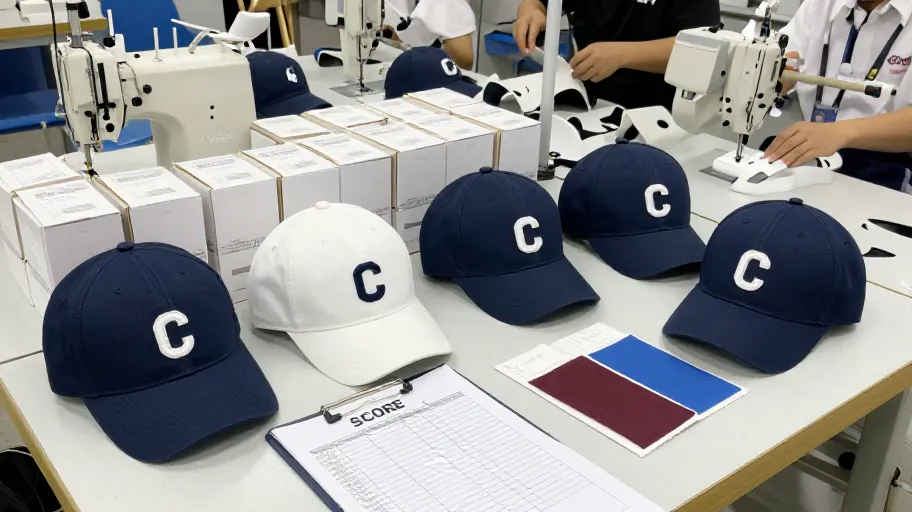
Evaluating a custom team cap manufacturer China candidates list is easiest when you force every supplier through the same evidence-based filter: the SCORE framework — Specification, Capability, Output evidence, Responsibility, Engagement terms — turns unverifiable promises into a documented, comparable scoring exercise before you commit a deposit to any private-label headwear project.
Why structure beats intuition in supplier selection
Most sourcing disappointment traces back to an evaluation that happened in conversations rather than in documents. A supplier conversation can feel productive while leaving every critical term — specification control, revision handling, sample policy, production scheduling — undefined. When three or four candidate factories are compared on impressions, the buyer has no record of what was actually promised and no basis for a defensible decision inside their own organisation.
A structured evaluation changes the dynamics. Each candidate receives the same questions, the same evidence requests and the same scoring criteria. Differences become visible and discussable. Equally important, the process itself reveals how a supplier behaves under scrutiny — responsiveness, precision of answers, willingness to document terms. Those behaviours are project signals no brochure can provide.
This article does not assert any supplier's MOQ, pricing, sample policy, lead time, capacity or certification status. Those figures vary by project and change over time; each one is framed below as a question you put to the supplier and confirm in writing.
The SCORE framework for private-label cap sourcing
SCORE gives you five evaluation dimensions. Score each candidate supplier against each dimension using evidence, not impressions, and keep the scoring sheet per supplier.
| Dimension | What you are evaluating | Evidence to request | Questions to confirm in writing |
|---|---|---|---|
| S — Specification | Whether the supplier can translate your design into a controlled, repeatable spec | Sample tech pack template, material and construction description format, size and colour control method | How will my design be documented? Which spec elements are locked before sampling? How are changes versioned? |
| C — Capability | Whether OEM/ODM scope matches your project type | Description of OEM vs ODM service scope, decoration methods offered, fabric and closure options handled | Which construction and decoration methods do you handle in-house versus subcontract? What is your ODM design input? |
| O — Output evidence | Whether past work supports the claims | Product photographs relevant to your cap category, references you may contact, factory documentation the supplier chooses to share | Can you show comparable team-cap projects? What documentation can you provide for verification? |
| R — Responsibility | Who owns defects, revisions and communication | Named contact structure, revision and re-sample process description, inspection approach | Who is my single point of contact? How are quality issues raised and resolved? What inspection steps occur before shipment? |
| E — Engagement terms | The commercial conditions of working together | Written quotation basis, sample policy statement, production schedule framework, payment and shipping terms | What is the current MOQ for my spec? Who covers sample and shipping costs, and what is the current policy? What is the quoted lead time for my quantity? |
Score each dimension on a simple scale — for example, evidence provided in full, partially, or not at all — and require a written answer for every question before any supplier advances to the sample stage. A supplier that declines to put terms in writing is telling you something useful.
Turning the framework into a decision table
When your scoring sheets are complete, compare candidates side by side:
| Evaluation item | Supplier A | Supplier B | Supplier C |
|---|---|---|---|
| Spec documentation received and reviewed | |||
| OEM/ODM scope confirmed in writing | |||
| Output evidence relevant to team caps | |||
| Named contact and revision process documented | |||
| MOQ, sample policy and lead time confirmed in writing | |||
| Responsive under written scrutiny | |||
| Advance to sample stage? |
Fill the table only from documented answers. Leave blanks open rather than guessing — an open blank is a follow-up question; a guess is a future dispute.
Approval questions to put in writing before any deposit
Before funds move, send each shortlisted supplier this set of approval questions and require written confirmation of each answer:
- What is the confirmed MOQ for the exact cap specification I have submitted?
- What does the current sample policy cover for my project — including any sample fee, shipping arrangement and how revisions are handled?
- What is the quoted production lead time for my confirmed quantity and specification?
- Which materials and construction details are locked in the approved spec, and how are substitutions handled if a component becomes unavailable?
- What quality inspection steps apply to my order, and what documentation will I receive at completion?
- What are the payment terms, and which shipping terms apply to my destination?
- Who is accountable for my order end to end, and how are issues escalated?
Do not accept verbal answers on any of these. Ask for them in the quotation or a short written confirmation, and file them with your project record. If a term is not yet determined, get that stated too — "to be confirmed before deposit" is an acceptable written answer; silence is not.
Sample-stage discipline
The sample round is where private-label projects are won or lost, so run it as a documented process:
- Submit a complete tech pack, not a reference photo. Include profile, crown height, closure type, fabric, decoration placement, colours with references, and labelling requirements.
- Ask what the current sample policy is for your project — including who arranges and pays for sample shipping and how revision rounds are handled. Policies differ by supplier and by project scope; confirm the current terms directly with each supplier rather than assuming any arrangement.
- Compare samples against the spec line by line, and record every deviation in writing. A deviation you do not record is a deviation you have approved.
- Get the approved sample documented as the production reference, with photographs and a written description both parties hold. Everything downstream is measured against that document.
One caution: a good sample demonstrates capability for that sample; it is not a promise about production output. Keep your inspection and documentation expectations active through production, not only through sampling.
What separates a workable supplier from a risky one
In practice, the difference shows up in behaviour rather than in claims. Workable candidates answer written questions precisely, volunteer documentation, flag constraints early, and treat your spec as the controlling document. Risky candidates answer vaguely, resist putting terms in writing, redefine agreed points mid-project, or push you to decide before you have evidence. None of these signals is conclusive on its own — but a pattern across your SCORE sheet is hard to ignore, and it is far cheaper to discover during evaluation than during production.
FAQ
How do I compare several custom team cap manufacturer China candidates fairly? Give every candidate the same question set and evidence requests, score them against the same SCORE dimensions, and compare only documented answers. Fairness in supplier comparison comes from identical inputs, not from equal trust.
What evidence should I request before paying a deposit? At minimum: written confirmation of MOQ, sample policy, lead time and payment terms for your exact specification; spec documentation; and output evidence relevant to your cap category. Do not release funds until these items exist in writing.
Is a sample enough to approve production? A sample demonstrates the supplier's ability to produce that sample against your spec. It becomes meaningful only when documented as the production reference, and when you have confirmed what inspection and documentation you will receive during the production run.
How should I handle language and specification misunderstandings? Reduce reliance on free-text emails. Use a structured tech pack, numbered questions, written confirmations and versioned spec documents. Ask the supplier to restate key requirements back to you in writing — the restatement catches most translation gaps.
What should I do if a supplier will not put terms in writing? Treat it as a material evaluation finding. Note it on the SCORE sheet, ask once more in writing, and if the refusal persists, weight that supplier accordingly. Documentation willingness is a project-behaviour signal, not an administrative preference.
Where does the supplier scorecard fit into my sourcing workflow? Use it at the longlist stage to structure first enquiries, again after written responses arrive, and as the record supporting your sample-stage decisions. The same sheet then becomes your internal approval document.
Ready to run this evaluation on your candidate list? [下载 Supplier Scorecard] and score every custom team cap manufacturer China candidate on the same five dimensions before you commit a deposit.
Quick start checklist: list your candidate suppliers → send the identical question set → record written answers on the scorecard → score each SCORE dimension → shortlist for sampling → confirm sample policy in writing → document the approved sample as the production reference.
#cap manufacturers china, #headwear manufacturers china, #cap factory








