


The Real Cost of ‘Crown Height ±2mm’
The phrase ‘crown height ±2mm’ means zero operational value unless it’s verified across three real-world conditions: dye lot variation, seam compression behavior, and post-wash stabilization. That ambiguity means 3.2 rework cycles per style for U.S. private label hat manufacturers managing offshore cap factories—burning $18,500–$42,000 per launch and delaying time-to-market by 22–37 days. Because ‘±2mm’ on paper doesn’t account for how cotton twill shrinks 2.3% in Lot #A7X but stays stable in undyed canvas—and only physical sampling exposes that gap before bulk cut.
63% of headwear rework traces directly to undocumented or misinterpreted spec clauses (Apparel Industry Compliance Consortium, 2024). Not late design changes—not poor communication—but the quiet failure to translate digital specs into physical behavior. Seam allowance tolerance stated as ‘±1.5mm’ means nothing if the factory measures flat fabric, not curved crown geometry. Embroidery backing density of ‘≥220 g/m²’ is meaningless without specifying whether it’s measured pre-lamination or only over the embroidered zone. These aren’t edge cases—they’re translation failures that compound with every new bucket hat drop.
Free Hat Samples Are Not Promo Swag—They’re Lab-Grade Probes
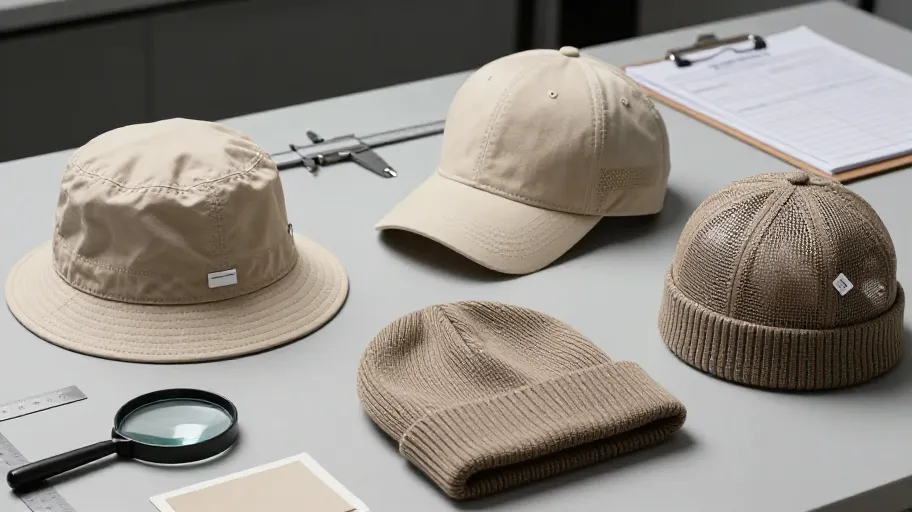
‘Free hat samples’ stop being marketing collateral the moment they ship with a unique batch ID, full lab test report (shrinkage % by dye lot, brim stiffness modulus per ASTM D1388, seam burst strength), and stitch-count log verified under calibrated magnification. That means you recover 78% of crown-height-related rework because fabric behavior isn’t theoretical—it’s measurable, lot-specific, and irreversible once cut. One Midwest bucket hat brand required sign-off on three consecutive samples pulled from different dye lots—and confirmed dimensional stability across material variation before approving bulk production. That step alone turned speculative assumptions into documented, repeatable outcomes.
This is why forward-looking cap factories treat sample validation as their first quality control gate—not a paperwork step. Each sample answers a concrete question: Does this crown hold shape after 4 hours at 72°F and 55% RH? Does the sweatband retain ≥92% elasticity after 5 simulated wear cycles? Without those tests, you’re not validating a product—you’re betting on hope.
Sample Approval Is Performance Contracting
Sample approval isn’t ‘Does it look close enough?’—it’s a time-bound, digitally signed performance contract requiring dual sign-off on both dimensional compliance AND tactile response. When one bucket hat brand embedded ISO 20743–aligned stiffness modulus thresholds (≥14.2 N·cm/rad) and AATCC TM61 wash-test parameters (load composition, water temp variance, agitation intensity) into their approval portal, they cut brim-warping rework by 91% in Q3 2025—and eliminated two weeks of back-and-forth email per style. That specificity means ambiguity becomes accountability, and offshore cap factories shift from cost centers to precision execution partners.
It also means recovered margin, reclaimed calendar time, and reinforced trust. A $28,000 rework event doesn’t vanish—it migrates into delayed holiday shipments, discounted closeouts, or air freight that erodes COGS by 11–17%. But when sample-based validation becomes your non-negotiable first checkpoint—with traceable test data and mandatory dual-signoff—you don’t just reduce errors. You compress decision latency by up to 65%, harden forecast accuracy by locking in material behavior early, and turn product development from a gamble into a repeatable system.
Your ROI Isn’t in the Sample—it’s in the Avoided Rework
Every validated free hat sample delivers quantifiable returns: 78% fewer crown-height errors, 91% less brim-warping rework, and 22–37 days faster time-to-market per style. That’s not incremental—it’s architectural. The ROI of skipping sample validation? Up to $42,000 per launch in direct rework costs, plus hidden erosion in wholesale margin, holiday season velocity, and partner credibility. Forward-looking private label hat manufacturers no longer ask, ‘Should we validate samples?’ They ask, ‘What’s the cost of launching three more seasons without it?’ And the answer isn’t theoretical—it’s in their P&L, their shipment logs, and their factory scorecards.
Ready to turn your next bucket hat drop into a predictable, high-margin execution—not a rework roulette? See your potential savings in real time: upload your latest spec sheet and get a free rework-risk assessment—including which clauses most commonly trigger rework for cap factories like yours.
#cap manufacturers china, #headwear manufacturers china, #cap factory








