
Ordering custom hat labels for an overseas cap programme comes down to three confirmations: the artwork files you supply, the placement and attachment method you approve, and the physical sample you sign off before production. Treat each as a documented step with your manufacturer, because every one of them is project-specific.
Why label details are approval questions, not assumptions
A woven label is one of the most visible branding elements on a cap. New Generation, a Shenzhen-based OEM/ODM manufacturer of custom caps and headwear, lists woven labels among its first-party logo customisation options. But the catalogue listing is only a starting point. Placement, dimensions and sewing details remain project-specific approval questions that depend on your cap style, fabric, artwork and brand guidelines.
This distinction matters for buyers because the most expensive label mistakes — an artwork that blurs at small size, a fold that catches on the crown seam, a fold direction that reads upside-down when the cap is worn — are not factory errors. They are approval gaps: details nobody documented before production started.
The Label Approval Loop: a four-stage framework
Use the Label Approval Loop to turn label ambiguity into a signed-off specification. Each stage produces a documented confirmation you can reference later.
| Stage | What you confirm | What you document |
|---|---|---|
| 1. Artwork | Logo files, colour references, text content, size intent | The file formats and versions both parties agree are final |
| 2. Placement | Label position, orientation, fold style, attachment method | A marked reference image or physical sample showing the exact position |
| 3. Physical sample | How the label looks and feels sewn into an actual cap | Written approval (or revision request) against the sample you received |
| 4. Approval | Final sign-off before bulk production | Your approval record, attached to the purchase specification |
The loop is deliberately simple. Its value is that no stage relies on verbal agreement or on the assumption that "the factory will handle it". Importers managing multiple cap styles or seasonal reorders find the documented approvals become reusable references for repeat orders.
Choosing label type and placement: a decision table
The right label choice depends on where the branding must appear and how it will be read. Use this table to frame your initial request — then treat every row as a question to confirm, not a rule.
| Branding goal | Label option to discuss with the supplier | Questions to confirm |
|---|---|---|
| Brand mark at the rear of the cap | Woven label sewn at the back seam or closure area | Exact position, orientation, fold direction, sewing thread colour |
| Size/fit identification | Woven size label | Placement inside the sweatband or rear, sizing text per market |
| Care and content information | Woven care or content label | Required text, language, placement, durability expectations |
| Subtle premium branding | Small folded woven label at the side or closure | Minimum legible size for your artwork, fold style |
| Prominent front branding | Discuss with the supplier whether a woven label suits the front panel or whether another logo method fits better | Suitability for your artwork detail and cap construction |
Note the last row carefully. A woven label is one logo method among several, and whether it is the right method for a given position is a technical question the manufacturer should answer against your specific artwork. Do not specify the method before seeing how the supplier evaluates your files.
Artwork preparation checklist
Before you submit anything, work through this checklist. It protects you from the most frequent cause of sampling delays: incomplete or ambiguous artwork.
- Supply your logo as a vector file, or as the highest-resolution original you hold, and ask the supplier which format they prefer.
- List exact text content — brand name, size designations, care symbols, registration numbers — spelled out in writing, including capitalisation.
- Provide colour references for the label ground and weave colours, and ask how the supplier matches them.
- State the intended label purpose (brand, size, care) so the supplier can advise on appropriate dimensions for that purpose.
- Send a reference photo of a cap whose label placement you like, clearly marked as a style reference, not a specification.
- Note any brand guidelines that restrict logo size, clear space or colour use.
- Ask explicitly which of these items the supplier still needs after submission.
The last item matters more than it looks. A good manufacturing partner tells you what is missing; a rushed one starts with what it has. Making the gap check an explicit step puts that responsibility on the record.
Approval questions to send your manufacturer
Alongside the checklist, put these questions in writing. They convert unknowns into confirmed answers for your specific project — which is precisely why this article does not answer them generically.
- Artwork evaluation. Given my files, can the artwork be reproduced cleanly at woven-label size, and if not, what simplification or adaptation does the supplier recommend?
- Dimensions. What label dimensions does the supplier propose for my artwork, purpose and cap style — and can I see that proposal visually before sampling?
- Placement and orientation. Where exactly will the label sit, in which direction will it read, and can that be marked on a reference image I approve?
- Attachment and sewing. Which sewing method and thread colour does the supplier propose, and how will that appear on the finished cap?
- Sampling. Will I receive a physical sample with the label sewn in, and what does the supplier's current sample process involve? Confirm the current sample policy directly — including any costs, shipping arrangements and timeframes — as these are project-specific and subject to the supplier's current terms.
- Approval record. What form of sign-off does the supplier require from me before bulk production begins?
Question five deserves emphasis. Sample policies vary by project and change over time, so this article makes no claim about fees, shipping or turnaround. Ask, get the answer in writing, and file it with your project documents.
Why the physical sewn sample is the stage buyers skip — and shouldn't
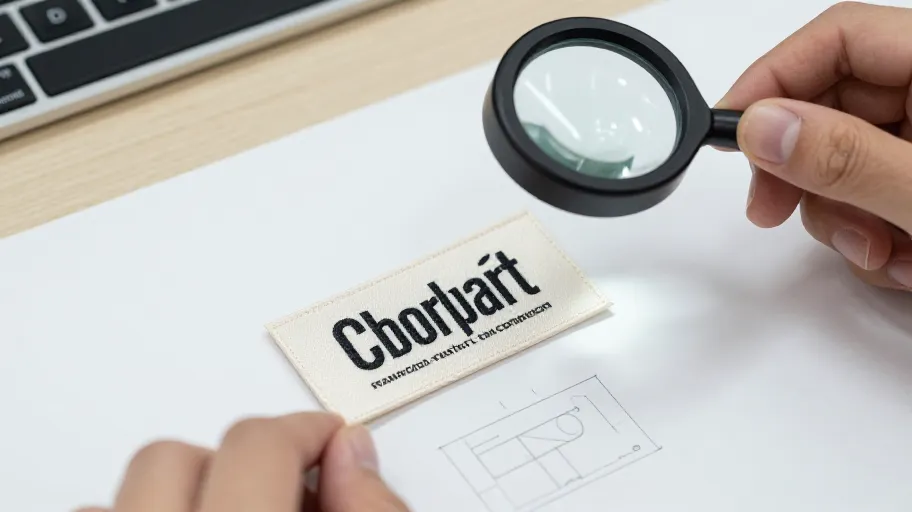
Digital mock-ups answer questions about artwork; they cannot answer questions about a cap. A label that looks correct on screen can read differently once sewn into a curved seam, folded over a closure, or positioned inside a sweatband against the wearer's head. The physical sample is where you check:
- Legibility of fine text at actual sewn size.
- Whether the fold direction reads correctly when the cap is worn, not just when it lies flat.
- Colour accuracy of the woven ground against your brand reference.
- How the label edges and sewing lines sit against the cap's construction.
Check each of these against the marked reference image from Stage 2 of the loop. If the sample differs from the approved placement, send a written revision request referencing the marked image — not a general note that "it looks wrong".
Frequently asked questions
What file should I send for a custom hat label? Send your best available original — ideally vector artwork — plus a written list of all label text and colour references. Then ask the manufacturer which formats they prefer and whether any adaptation is needed before sampling. Requirements are project-specific, so confirm them with your supplier rather than assuming a universal format.
Can I place a woven label anywhere on the cap? Placement options depend on the cap construction, the label purpose and how the label attaches. Work with the supplier's proposal, have the position marked on a reference image, and approve that marked image before sampling. Rear, closure and interior placements each carry different orientation and sewing considerations your manufacturer should advise on.
How do I know my logo will reproduce well at label size? You don't know until the supplier evaluates the files — and you shouldn't assume. Fine detail, small text and complex colour gradients can challenge woven reproduction. Submit your artwork early in the enquiry and ask directly whether any simplification is recommended. The physical sample then confirms the answer.
What happens after I approve the sample? Once you have documented approval against the physical sample, production proceeds against that approved reference. Confirm with the supplier what their sign-off process requires — a written approval, an annotated sample returned, or a signed specification — and keep your approval record with the project file for repeat-order consistency.
What should I ask about label sampling before committing to an order? Ask what the supplier's current sample process involves, what it costs, who arranges shipping, and how long it takes — all confirmed directly, in writing, because these terms are project-specific and can change. Also ask whether the sample will include the label sewn into a finished cap or presented another way, and approve that method in advance.
Submit your cap brief for project-specific review
Label decisions get easier the moment a real project replaces a generic enquiry. New Generation reviews project-specific submissions from overseas brands, importers, wholesalers and corporate buyers sourcing custom headwear.
Send your cap brief, reference image or logo, together with your placement intent and any brand guidelines, and you will receive a project-specific review covering artwork suitability, placement options and the questions you still need to answer before sampling. This turns the Label Approval Loop from a framework into a working document for your order.
Or start smaller: copy the artwork preparation checklist and the six approval questions above into your next supplier enquiry. Even without a submission, you will have converted the most common label ambiguity into documented, answerable questions — and you can submit the brief whenever you are ready.
#cap manufacturers china, #headwear manufacturers china, #cap factory