
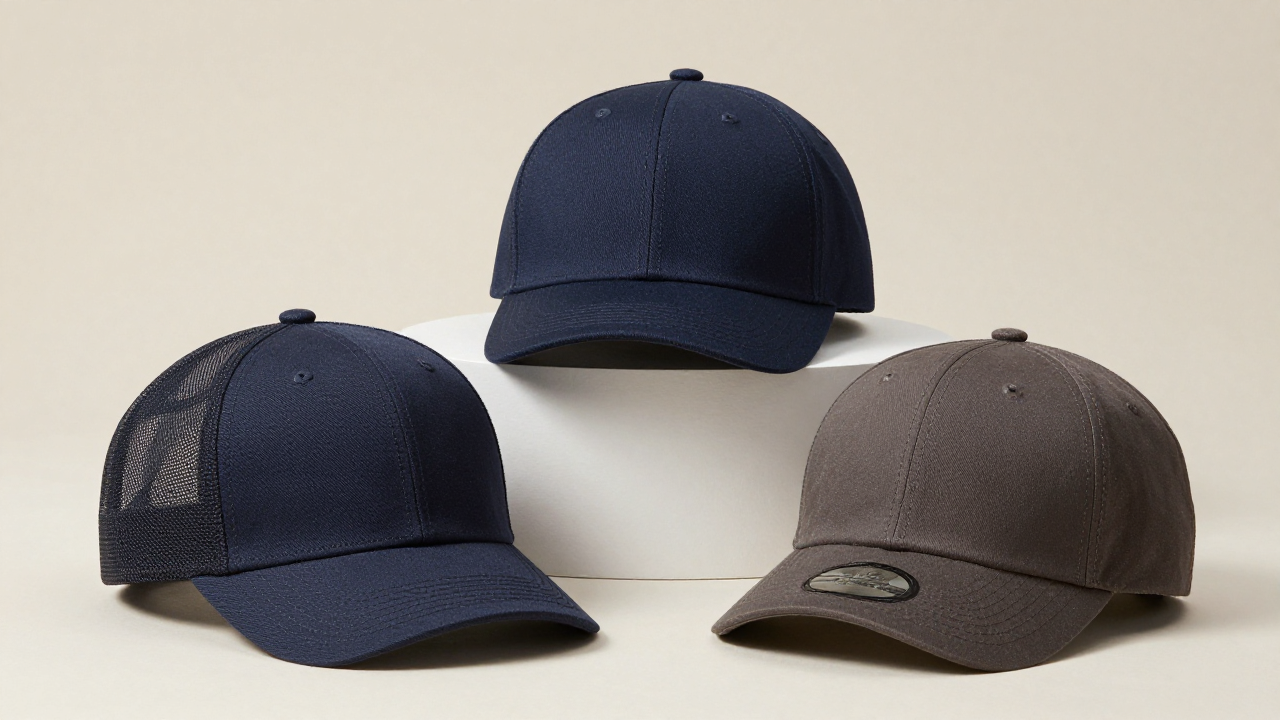
Buyers who qualify cap manufacturers on how a sample feels in the hand are measuring the one variable that will not repeat.…
In August 2021, a promotional distributor in Irving, Texas approved a 7 1/4 fitted cap off a sample and placed 4,800 units for a corporate account. The production caps came back reading 7 1/8 after the customer's first wash cycle. Root cause took two weeks to find: the sample room had pre-washed its fabric before cutting. The bulk fabric went straight from the mill to the cutting table. A 4% shrinkage on a 22.75-inch sweatband circumference is roughly 0.9 inches — about a size and a half.
Why Your Cap Sample Fits and Your Production Run Doesn't
A sample cap fits because it is a single artifact, measured once, on one block, at one temperature, by one person. Production caps fail because fit is the output of a tolerance stack — block geometry, fabric shrinkage, seam consumption, embroidery pull, sweatband elasticity, and ambient conditioning — and no single sample can represent that stack.Here is the reconciliation formula we use on the floor to catch this before a cut ticket is released:
C_finished = (ΣW_cut − 6 × SA) × (1 − S) − PRun the numbers on a typical 7 1/4: 26.5 inches of cut width, minus 2.25 inches of seam consumption equals 24.25, times 0.96 equals 23.28, minus 0.30 of pull-back equals 22.98. Target is 22.75. You are a quarter inch over, which is exactly where you want to sit before relaxation pulls it home. If your prediction misses the measured sample by more than 1/8 inch, your shrinkage factor is wrong — not your block, not your pattern. Stop and re-test the fabric.
The Production Variables That Expose Weak Cap Manufacturing
Circumference is the only dimension most buyers measure and the least diagnostic one. Crown height, panel taper, bill curve radius, sweatband width, and stitch density all drift independently, and they drift at different rates.A six-panel mid-profile crown sits between 3.5 and 4.0 inches at center front. Two panels from the same factory can land at 3.55 and 3.95 and both pass a circumference check while reading as different products on a shelf. We have seen a retailer reject an entire 9,600-unit program over crown height variance that no dimension report ever captured, because the report only tracked the sweatband.
Fabric behavior drives most of the rest. Cotton twill at 10–12 oz/yd² shrinks 3–5% over three home launderings under AATCC 135. Performance polyester moves 0.5–1.5%. Acrylic knit for beanies can move 2–4% in length, and a yarn lot change mid-program in February 2024 moved a customer's cuff length enough that the fold-over stopped covering the ear.
Bill construction deserves its own paragraph. The board inside the bill — polyethylene or buckram — sets the curve and holds it. Lamination temperature drifts on older presses, and a 15°F drop produces a bill that ships flat and curls three weeks later in a warehouse. Ask for the lamination setpoint and the tolerance band. If the answer is "the operator watches it," you have found your failure mode.
Reference Parameters for Cap Tolerances, Shrinkage, and Stitch Density
These are the operating windows we hold on continuous headwear programs. Treat them as starting points to be tightened against your own wear-test data, not as universal law.What Cap Textbooks Leave Out About Sizing Drift
A cap measured one hour off the embroidery machine reads large. A cap measured 72 hours later reads true. The difference is polymer and fiber relaxation, and it is worth up to 3/16 inch — more than the entire tolerance band.Nobody teaches this because it does not photograph well. Relaxation is boring until a container shows up.
Two conditioning variables do most of the damage. The first is time. Cotton twill and poly-cotton both hold residual stress from the embroidery hoop and the seam puckering. It releases over 24 to 72 hours at 70°F and 65% relative humidity. If your factory measures at final inspection the same shift the caps come off the line, your inspection data is describing a product that no longer exists by the time it reaches a shelf in Ohio.
The second is heat. In summer 2023, a 40-foot container of performance caps sat 19 days at the Port of Long Beach. Interior temperature hit 141°F on the asphalt. The polyethylene bill boards softened, the caps settled into the shape of the carton corner, and roughly 600 units arrived with a curl that no amount of steaming fixed. The factory's inspection data was flawless. The product was not.
The practical fix costs almost nothing: hold finished goods 48 hours in a conditioned space before final dimensional inspection, and specify a bill board with a softening point at least 30°F above the expected container peak. If a supplier cannot tell you the softening point, that is your answer.
How to Qualify Cap Manufacturers Before a Full-Scale Order
Ask for six documents before you ask for a price: block certification, the cut marker, a wash-test report per dye lot, an SPI verification record, SPC data on finished circumference, and a written change-control procedure.Most of those requests get a blank stare. That stare is diagnostic.
Block certification matters because the block is the product. A factory running 12 blocks in a humid room in Guangdong can drift a quarter inch in a season as the wood or resin moves. Ask when each block was last measured against a master.
SPC data on finished circumference tells you whether the factory is controlling the process or inspecting the output. A process capability index of 1.33 or better on a ±1/8 inch band means the line is in control. If they send you a spreadsheet of pass/fail counts and no distribution, they are sorting, not controlling.
For the validation protocol itself, run three separate production lots rather than three samples from one lot — the whole point is lot-to-lot variance. Pull 30 caps per lot, condition them 48 hours, measure circumference, crown height, and bill length flat, then wash five per lot under AATCC 135 and re-measure. Send a set to a third-party lab for colorfastness (AATCC 61) and, for anything sized for kids under 12, CPSIA lead and phthalate screening. We run this protocol on every new program at New Generation, and it has caught more problems in the fabric mill than in our own sewing lines.
Also confirm the tariff line. Headwear under HTS 6505 has carried Section 301 duties since 2019, and the landed cost difference between a correctly declared entry and a corrected one can erase a program's margin. A manufacturer who cannot discuss this fluently has not shipped much to the U.S.
Troubleshooting: Match the Failure Symptom to the Root Cause
Buyers usually treat every fit complaint as a sizing problem and order the next run a size up. That fixes the symptom in roughly one case out of four and quietly breaks the other three.The pattern across all of these is the same. The failure is in a component or a lot, and the buyer responds by changing the whole specification. Approving by hand fit, adding torque, switching liners — the headwear version is ordering a size up across the board. It always looks like a fix and almost never is one.
One more trap worth naming: ignoring line speed. A sample is sewn by the sample room's senior operator at maybe 40 caps a day. Production runs at 300. Stitch density drops, seam allowance wanders, and the pull-back value P you built into the formula quietly changes. Ask for SPI data from the actual production line, not from the sample room.
Frequently Asked Questions
How many samples do cap manufacturers need to provide before a production order?
Three to five wear-test samples plus a "golden sample" sealed and signed by both parties. The golden sample matters more than the count, because it becomes the contractual reference when the first bulk shipment arrives and someone has to decide whether the caps are right.
What measurements should a cap manufacturer provide before production?
Finished circumference at the sweatband, crown height at center front, bill length and width, sweatband width, and stitch density on structural seams. Require the measurement conditions too — tape tension, relaxation time, and room temperature — because an unstated method makes the numbers meaningless.
Why do production caps run smaller than the sample?
Usually pre-shrunk sample fabric against unwashed bulk fabric, or a shrinkage factor taken from the mill's nominal spec instead of a finished-goods wash test. A 4% error on a 22.75-inch circumference costs more than a full size, and it does not show up until the customer washes the cap.
How long does a custom cap production order take?
Plan on 25 to 35 days for production plus 30 to 40 days ocean transit to a U.S. port, with another week for drayage and receiving. Add two weeks if the order needs a custom dye lot. Air freight is viable for reorders under 3,000 pieces, not for first runs.
What tests should be run on a finished cap?
Dimensional check after 48 hours of relaxation, AATCC 135 shrinkage over three washes, AATCC 61 colorfastness, and a four-hour wear test on at least three head sizes. For youth products, add CPSIA lead and phthalate screening through a third-party lab before the purchase order is confirmed.