
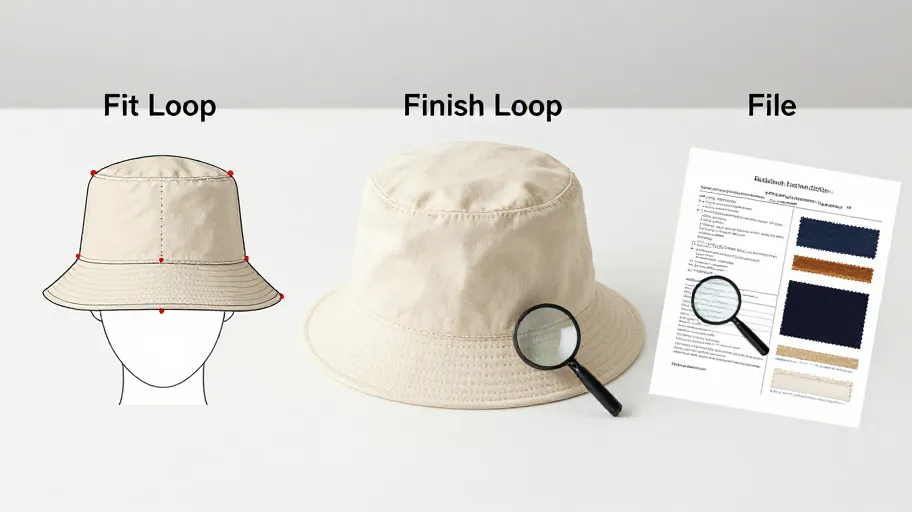
When a revised bucket hat sample arrives and still is not perfect, the fastest path forward is rarely a full restart — it is a structured review. Use the Three-Loop Sample Review: judge Fit Loop (how it wears), Finish Loop (how it is made), and File Loop (what is written down). If each loop is checked against a written brief, most issues can be closed with one targeted revision instead of a new sampling cycle.
Why revised samples stall
In practice, revised samples fail to converge for one predictable reason: the change request was not specific enough to be actionable. "Make it fit better" or "improve the finish" gives the workshop no fixed target, so the next sample moves in a different direction and the buyer loses confidence in the process. The cost is rarely the sewing — it is the undocumented scope.
The fix is procedural, not technical. Before you comment on a revision, you need three things on your desk:
- The original brief or tech pack you approved as the reference.
- A written list of what was supposed to change in this revision.
- A decision rule for each comment: must-fix, nice-to-have, or accept-as-is.
Any comment that cannot be traced back to the brief is opinion, and opinions multiply rounds. A disciplined bucket hat factory will work the same way from its side — but you control half of the discipline by controlling your own comments.
The Three-Loop Sample Review
Loop 1 — Fit. Wear the sample. Do not judge fit on a table. Check the crown depth when the hat sits naturally, the brim's hold once softened by handling, and whether the band grips without pressure points. If your market expects the brim to hold a specific shape, note that the reference is your description and photos, and confirm with the supplier what shape-holding behaviour the chosen materials can and cannot achieve — do not assume it.
Loop 2 — Finish. Inspect seams at the brim junctions, the stitch density along the crown panels, the cleanliness of any embroidery or patch application, eyelet reinforcement, and internal finishing. Photograph every fault next to a ruler or a coin, name the location (panel number, seam position), and classify it: functional fault (affects durability or wear), cosmetic fault (visible at arm's length), or acceptable variation. This classification is what lets a workshop fix one panel instead of remaking the hat.
Loop 3 — File. Update the document, not just the sample. Every confirmed correction — measurement, material, colour reference, construction detail — goes back into the tech pack or spec sheet, and the supplier confirms in writing which version they are working from. A sample that is approved in person but not reflected in the file will drift in bulk. This loop is what prevents you from starting over later, because the file — not the memory — becomes the production reference.
Decision table: what to do next
| Finding after review | Condition | Recommended action | What to send the supplier |
|---|---|---|---|
| Fit acceptable, minor cosmetic faults only | Faults are clearly cosmetic and you can tolerate the described variation in bulk within your own quality limits | Approve with notes | Written approval listing the accepted variations and stating they are noted, not silently waived |
| One or two must-fix items, clearly located | Every fault is photographed, located and classified; the fix does not change materials or construction | Revise in place — targeted revision of the affected parts only | Change request with photos, locations, and confirmation that the file has been updated |
| Fit is wrong at a structural level | Crown depth, brim construction or pattern needs re-engineering, or materials change | Restart the round, but scoped | New brief version, confirmed by the supplier as a new reference — a scoped restart, not an unscoped one |
| Disagreement about what was agreed | Supplier and buyer hold different versions of the brief | Pause revisions, reconcile the file first | Side-by-side comparison of both spec versions before any new sample is made |
The point of the table is not to eliminate second rounds — it is to make sure any next round is the smallest one that closes the gap.
Approval questions to send with every revision request
Attach these questions to your next revision email. They convert vague frustration into scoped, answerable work:
- Which exact pattern, panel and seam are affected by each fault I photographed?
- What will change in your construction method to close this fault, and what will stay untouched?
- Which version of the spec sheet will this revision be made against — please confirm the file reference in your reply.
- Will this revision change any material, trim or colour reference, or is it construction-only?
- What is your current policy on sample rounds at this stage — sample fees, who covers sample shipping, and how the timeline is counted? Please confirm these terms directly, as they are commercial terms I will not assume.
- What photos or measurements do you need from me to avoid a wrong-direction revision?
Two of those questions protect the schedule; four of them protect the file. Together they make the difference between a revision and a restart.
What your approval record must contain
An approval is only as strong as the document behind it. Before you send the word "approved", make sure the record includes:
- The spec sheet version reference and date.
- Photos of the approved sample, tagged as the golden sample reference.
- A list of accepted variations — the things you noticed and chose to tolerate — so they cannot reappear later as disputed defects.
- The confirmed basis for bulk: which measurements, materials and construction details are binding.
- Any open commercial terms to be confirmed in writing: MOQ, unit pricing at your quantity, production lead time, sampling or revision fees, shipping terms, and inspection arrangements. Confirm each of these directly with the supplier; none of them should be assumed from a previous project or another factory.
If your approval email cannot answer "what exactly did we agree to?", it is not an approval — it is a hope.
Working with a bucket hat factory as a partner, not a vending machine
Buyers who cycle through factories after every imperfect sample pay for the cycling twice: once in restarted sampling and once in a factory that never learns their standards. The alternative is to treat revisions as joint file maintenance. Send located faults, ask scoped questions, and keep one authoritative spec version on both sides. A factory that responds to that discipline with clear confirmations is showing you how it will handle bulk — which is a far better signal than a flawless first sample.
FAQ
If I reject a revised sample, does the whole process start over? Not if the rejection is scoped. Structural fit problems that require re-pattern or material changes do justify a new reference version — but that is still a scoped restart with a confirmed file, not a from-scratch reset. Cosmetic or single-location faults should close with a targeted revision. Confirm with your supplier how they count and charge sample rounds under their current policy.
How many revision rounds should I expect before bulk? There is no fixed number, and any figure a factory quotes you is a policy statement, not a guarantee. What you can control is convergence: located faults, updated files, and one authoritative spec version per round. Buyers who review this way converge faster regardless of the round count. Confirm the supplier's current sample-round policy in writing.
Should the golden sample or the spec sheet be the production reference?
What if the supplier and I disagree on what the revision was supposed to fix? Pause and reconcile the file before making another sample. Exchange both spec versions, mark the differences, and re-confirm a single agreed version. Revising on top of a misunderstanding produces another wrong sample and erodes trust faster than an honest pause.
Who pays for revised samples and their shipping? That is a commercial term, not a given. Sample fees, revision fees and shipping cost allocation vary by supplier and by project stage, and policies can change. Ask the factory to confirm its current policy in writing before the revision is made, and record the answer in your project file.
Request the Bucket Hat Enquiry Brief
If you are preparing a revised-sample round or a first enquiry, request the Bucket Hat Enquiry Brief from New Generation. It structures your fit references, finish classifications, file version control and the commercial terms to confirm — so your next sample is judged against a document, not a mood.
Before you approve anything: the revised-sample checklist
- Fit checked by wearing, not by looking.
- Every fault photographed, located and classified (functional / cosmetic / acceptable).
- Spec sheet version updated and confirmed by the supplier in writing.
- Golden sample photos archived with the approval record.
- Accepted variations written down, not assumed.
- Commercial terms (MOQ, pricing at your quantity, lead time, sample and revision fees, shipping terms, inspection arrangements) confirmed directly with the supplier.
- Next step scoped: approve, targeted revision, or scoped restart.
Send the completed checklist to your supplier with your decision — it turns your approval into their instruction.
#cap manufacturers china, #headwear manufacturers china, #cap factory