


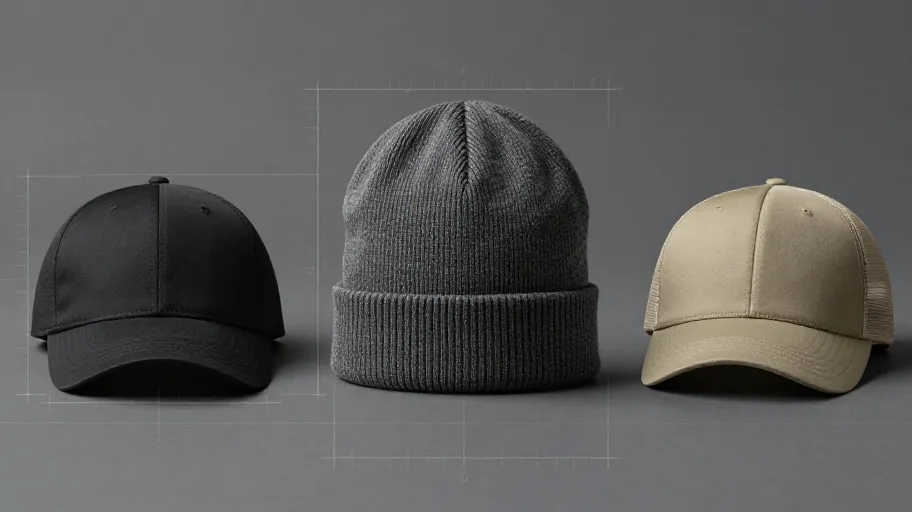
How a Documentation-First Beanie Tech Pack Transforms Cap Manufacturer Evaluation
A documentation-first beanie tech pack doesn’t just describe a hat—it audits the factory before you ever send fabric. Without it, evaluating cap manufacturers is like judging a chef by their résumé alone: you’re betting on reputation, not reproducible execution. The cost? An average 11.3-day delay in shortlisting qualified partners—and a 73% rework rate downstream when assumptions about stitch density or rib height go unchallenged until physical samples arrive. That’s not sourcing; it’s guessing with margin.
The turning point arrives when your tech pack stops being a static PDF and becomes a live, layered evaluation instrument. Per the 2025 Headwear Sourcing Benchmark (Apparel Sourcing Intelligence Group), 68% of failed first samples trace directly to ambiguous or missing tech pack elements—not lack of factory capability. What looks like “poor quality control” is often just misaligned interpretation: one factory reads “medium rib” as 4.2mm, another as 5.8mm; one assumes standard cotton shrinkage, another applies knit-specific pre-shrink protocols without confirmation. A documentation-first approach eliminates that ambiguity by embedding binary pass/fail constraints—seam allowance tolerances ±0.5mm, yarn twist direction callouts (Z-twist only), wash shrinkage matrices calibrated per fiber blend—into every spec layer. These aren’t decorative details; they’re machine-actionable thresholds that convert subjective vetting into objective scoring.
Consider how this reshapes real-world decisions. A DTC brand launching a winter beanie line across three markets needed to qualify two Tier-2 factories in Vietnam and Bangladesh within five business days. Using legacy methods—email-based spec sheets, inconsistent annotation, no version-controlled measurement logic—their last round took 18 days and yielded zero compliant first samples. This time, they deployed a standardized beanie tech pack with embedded annotation layers: seam allowances mapped to stitch type and needle size, rib height tolerance zones tied to final garment weight targets, and dye lot acceptance criteria linked directly to Pantone TCX+ lighting conditions. Within 68 hours, their remote product team scored six factories against 32 auditable criteria—including whether each had documented calibration logs for tension meters and steam press dwell-time validation—and shortlisted two with verified capability in double-knit fleece construction. No site visits. No translation delays. Just scored evidence, not anecdote.
This isn’t about paperwork volume—it’s about precision leverage. The beanie tech pack serves as the single source of truth that anchors all supplier interactions, from RFQ response to production sign-off. Its technical significance lies in encoding design intent into constraints that machines—and humans—can execute without drift: specifying “2x2 rib, 1.8mm ±0.1mm post-wash at 45°C” means your cap factory must validate both its knitting machine setup and its post-process conditioning protocol before cutting yardage—because inconsistent rib height causes fit variance, which triggers QC rejection and delays ship dates. Its customer impact? Eliminating “interpretation drift” between brand R&D and offshore cap factories—where a 0.3mm rib variance may seem trivial but cascades into fit inconsistency, returns, and lost holiday sales. When specs are unambiguous, accountability becomes non-negotiable: you’re not asking if the factory can meet your standard—you’re verifying whether they’ve documented how they do.
From Evaluation to Enforcement
That shift—from subjective comparison to objective audit—redefines what “qualified supplier” means. It moves qualification upstream, out of the sampling phase and into the bid package itself. Factories now self-identify capability gaps before committing resources: if their ERP system can’t log steam press dwell time per lot, they won’t waste time bidding. If their lab lacks ASTM D3776 tensile testing for rib elasticity, they’ll opt out early. That’s not attrition—it’s pre-vetted alignment. And because every criterion is tied to measurable output (e.g., “rib height must hold ±0.1mm after 3x home wash cycles per AATCC TM61”), brands gain enforceable performance thresholds before any physical sample is cut. No more “we’ll adjust in bulk”—just documented compliance or disqualification.
The ROI compounds fast. Brands using this method report cutting initial supplier shortlisting from 11.3 days to under 72 hours—a 73% acceleration—with zero compromise on capability depth. More critically, they eliminate 73% of production rework caused by foundational spec misalignment. That’s not incremental improvement. That’s turning supplier evaluation into a predictive filter—not a reactive fire drill. And in headwear, where seasonal windows close faster than fabric lead times, that predictability isn’t just efficient—it’s existential. Specifically: a documentation-first beanie tech pack means your team spends 40% less time chasing samples and rework, because every specification is testable, repeatable, and tied to real-world performance—not hope.
#cap manufacturers china, #headwear manufacturers china, #cap factory








