


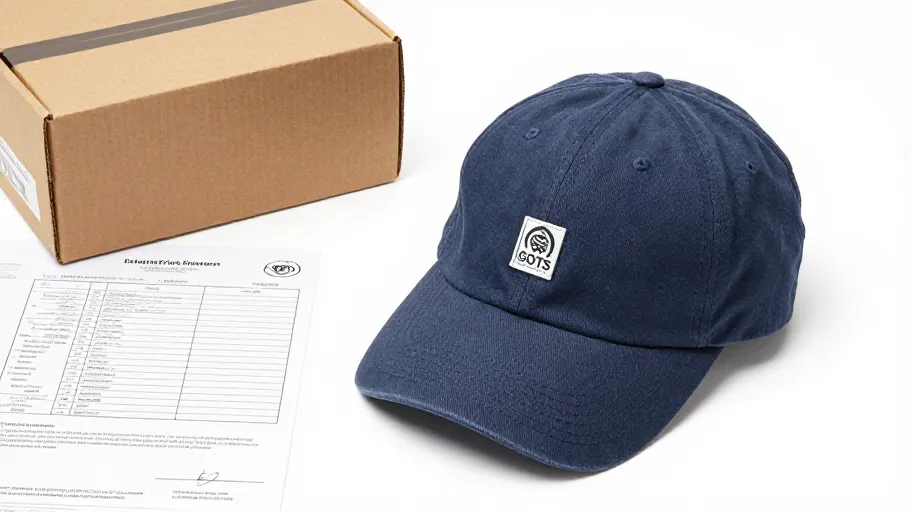
Buying sustainable custom caps wholesale succeeds or fails before production starts. The buyers who avoid disputes are the ones who lock written specifications, request verifiable sustainability evidence, approve a physical sample against that spec, and record the approval before mass production begins. This guide gives you a four-stage framework — S-S-A-A: Specification, Sustainability evidence, Sampling, Approval gate — so you can compare any Shenzhen headwear supplier, including New Generation, on evidence rather than marketing language.
Why sustainability claims need a procurement process, not a tagline
“Sustainable” means different things across suppliers. For one factory it may refer to a recycled fibre in the crown panel; for another it may extend to dye chemistry, trims, packaging and energy sourcing. Neither claim is automatically wrong — but neither should be accepted on a catalogue page alone. The commercial comparison job is to convert vague green language into a documented specification you can enforce during sampling and inspection.
That is what S-S-A-A is for. Each stage produces a written artefact: a spec sheet, an evidence file, a physical approved sample, and a signed approval record. If any stage is missing, you have no reference point when you need to compare offers or resolve a disagreement.
Stage 1 — Specification: decide before you ask for a quote
Every component of a cap is a spec decision. The table below maps the decisions you must make, and what goes wrong when you leave them to the supplier's discretion.
| Cap component | Spec decision you must make | Risk if left undefined |
|---|---|---|
| Crown and panel fabric | Fibre content and origin claim (e.g., recycled or organic input), weave, weight | “Sustainable” becomes whatever fabric is convenient; bulk differs from expectations |
| Structuring | Structured vs unstructured, buckram or crown backing material | Stiffness and shape differ from sample; hidden non-sustainable interlining |
| Brim | Curved, flat, pre-curved; visor core material | Shape inconsistency between samples and bulk |
| Sweatband and lining | Material, backing type, moisture finish | Comfort and finish complaints from your end customers |
| Closure | Strapback, snapback, buckle, elastic; trim material and finish | Mismatched trims undermine the sustainability story |
| Embellishment | Embroidery thread type, patch material, print method and inks | Decoration may not match your sustainability positioning |
| Sewing and construction | Stitch density, seam type, panel alignment standards | Quality perception varies between production runs |
| Packing | Recyclable or reduced packaging, individual polybags vs bulk | A sustainable cap shipped in heavy plastic undermines the claim |
For each row, ask the supplier to state the exact current material option, its available substitutions, and what documentation supports any environmental claim. Do not accept a number, tolerance or duration quoted verbally — request it in writing, dated, attached to the spec sheet.
Stage 2 — Sustainability evidence: request documents, not adjectives
When comparing sustainable custom caps wholesale offers, run every supplier through the same evidence request. Ask for:
- Material composition documentation for each component claiming a sustainable input — what the fibre or material is claimed to be, and what supporting document the supplier can provide for the current production batch.
- Traceability statement — where the supplier says the material comes from, and whether that statement can be traced to a supplier of record.
- Third-party or audit references — whether any audit, certification or testing framework applies to this factory or material, in its current valid form, with document number and validity period for you to verify.
- Finish and dye information — what the supplier can document about dye and finishing processes relevant to your market's requirements.
- Packaging option evidence — what documentation supports any recycled or reduced-packaging claim.
If a supplier cannot produce current documentation, that does not make them dishonest — but it means the claim cannot be enforced contractually, and your comparison should price that risk accordingly. Whether New Generation holds any specific credential for your target material is a question to raise directly with our team, with your target market and certification requirements stated, so the answer can be specific and current rather than general.
Stage 3 — Sampling: approve with your hands, not your eyes on a screen
Photographs cannot validate hand feel, stitching quality, brim structure or colour accuracy under your own lighting. Insist on physical samples at the right stage of the process:
- Development sample — to confirm construction and material direction.
- Pre-production sample — produced on the production line with production materials, which becomes your approval reference.
- Counter sample — if revisions were made after the first sample, re-approve; never approve a sample and then accept undocumented changes.
Questions to put to the supplier in writing before sampling begins:
- What types of samples do you offer, and what is the current sample policy — cost, timing and whether any charge applies to development versus pre-production samples?
- Who covers sample shipping, under what terms, and to which destinations? Confirm the current arrangement directly.
- Will the pre-production sample be made on the same line and with the same material lots as bulk?
- If the sample needs revision, how is the change recorded and re-approved?
- What happens if bulk differs from the approved sample — what is the remedial process, and where is it written?
Do not assume the answers. Sample policies differ by project complexity, and any fee treatment, shipping responsibility or timing must be confirmed for your specific enquiry.
Stage 4 — Approval gate: record it before mass production
The approval gate is the moment most sourcing disputes are prevented. Before authorising production, complete this checklist and keep it with your order file:
Pre-production approval checklist
- Spec sheet complete for all components in the table above, in writing, dated
- Sustainability evidence file received and reviewed for each claimed material
- Physical pre-production sample inspected against the spec sheet
- Colour checked against the agreed reference under agreed lighting
- Embellishment method, thread/patch material and placement confirmed on the sample
- Any deviation from spec documented and either corrected or accepted in writing
- Approval recorded in writing (email or signed sheet) referencing the sample's identifier
- Agreement on how bulk will be checked against the approved sample before shipment
Concrete approval questions to close the gate:
- Does this sample match every line of the spec sheet — yes, no, or with documented deviations?
- Is the evidence file complete for every sustainability claim we intend to make to our customers?
- Do we have written confirmation that bulk materials will match the approved sample's materials?
- Have we documented what inspection reference the supplier will check bulk against?
- Is our own legal or marketing team comfortable making the environmental claim we plan to make, based on this evidence?
If the answer to any question is unclear, the gate stays closed.
OEM versus ODM in a sustainability comparison
Frequently asked questions
What should I ask a sustainable custom caps wholesale supplier on the first call? Ask for their current sustainable material options with documentation, their sampling process and policy, how pre-production approval is recorded, and what production capacity and lead time apply to your specific quantity and decoration method. First-call answers should produce a written follow-up, not a verbal commitment.
How do I verify a sustainability claim before ordering? Request the supporting document for the current material batch, note its number and validity period, and verify it against the issuing body where one exists. If no document exists, record the claim as unverified in your comparison file and decide whether the price justifies the risk.
What is the difference between a development sample and a pre-production sample?
Should I approve a sample remotely? Photographic review can precede physical approval, but the final gate should be a physical sample you or your appointed inspector has examined. Fabric hand, stitching and colour rendition cannot be fully validated on screen.
Can one supplier handle both custom development and sustainable documentation? That is a capability question to confirm directly. Ask whether the supplier can develop to your spec and, separately, what documentation they can provide for the sustainable inputs you require — the two answers together determine whether the offer is comparable.
Your next step
If you are preparing to source sustainable custom caps wholesale, 获取采购 Brief — a structured sourcing brief covering the spec sheet, evidence request list, approval questions and pre-production checklist from this guide, ready to send to any supplier including us.
Prefer something lighter first? Download the pre-production approval checklist above and use it on your next sample review — it works with any supplier, and it will show you immediately where your current documentation has gaps.
#cap manufacturers china, #headwear manufacturers china, #cap factory








