


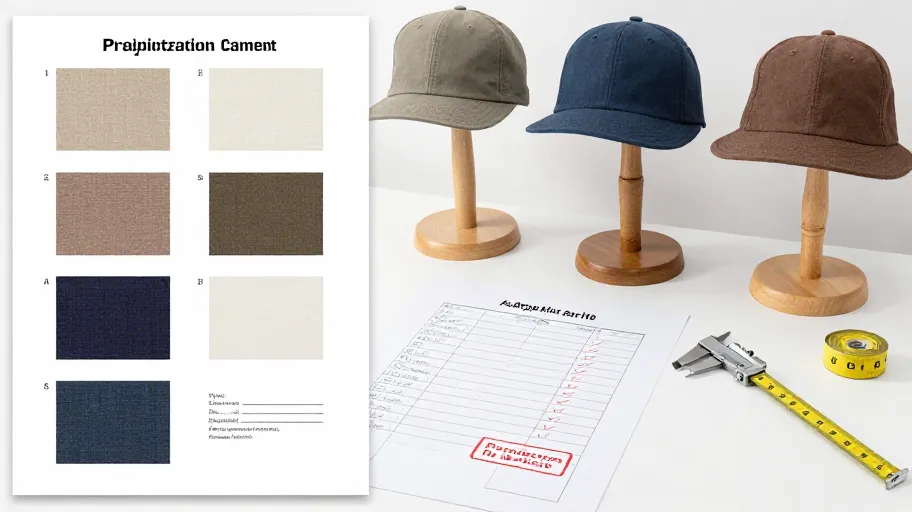
Choosing among men hat distributors is less about finding the lowest quote and more about controlling the process between your specification and the product that ships. Use the Spec-to-Approval framework — write the spec, verify it in samples, document approval, then release production — and evaluate every distributor on how they handle those four stages, not on price alone.
Why process discipline beats a single quote
When you compare men hat distributors, the quote tells you what a supplier charges under one set of assumptions. It does not tell you what happens when your logo colours shift between fabric and embroidery, when the sample sits slightly off your spec, or when the factory interprets "structured crown" differently than your design team does. Those moments — and how a distributor documents and resolves them — determine whether the order ships as intended.
A thoughtful sourcing approach therefore separates the conversation into two parts: commercial terms, which you negotiate, and process control, which you verify. The second part is where most buyers lose money, because the controls are invisible until something goes wrong.
The Spec-to-Approval framework
The framework has four stages. Each stage produces a document or an artefact that the next stage depends on.
| Stage | What you produce | What you verify | What you keep as evidence |
|---|---|---|---|
| 1. Spec | A written spec sheet: style, materials, colour references, construction details, branding placement | That the distributor quotes against the same document, not a verbal summary | Dated spec sheet sent to all shortlisted distributors |
| 2. Sample | One or more pre-production samples built to that spec | Measurement, colour, materials and branding against the spec sheet | Sample photos, your written comments, the revised sample |
| 3. Approval | A declared golden sample and a written approval record | That the golden sample matches the final spec and that all changes from earlier rounds are closed | Signed or emailed approval referencing the sample |
| 4. Production | A released production order | Conformity to the golden sample and spec, confirmed through whatever inspection arrangements you agree with the supplier | Approval record plus agreed inspection terms in writing |
The value of the framework is that it turns vague trust into testable steps. A distributor who engages well with stage one and two is signalling how they will behave in stage four.
Comparing men hat distributors: a decision table
Use this table to score each distributor on the same criteria. Score high only where the supplier answers in writing and the answer is specific to your project.
| Criterion | What to ask | Strong signal | Weak signal |
|---|---|---|---|
| Spec engagement | "Will you quote against my written spec sheet, item by item?" | Confirms and flags assumptions in writing | Quotes from a photo or verbal brief |
| Sampling process | "How do you handle changes between sample rounds, and how are revisions documented?" | Each round is versioned and commented in writing | Informal updates, no record of what changed |
| Approval discipline | "Can you hold a golden sample and produce against it?" | Explicit golden-sample practice and written approval | Approval happens verbally or not at all |
| Communication | "Who is my single point of contact for spec questions?" | Named contact who answers construction questions directly | Contact rotates or deflects technical questions |
| Documentation | "What project documents will you provide at each stage?" | Spec, sample comments and approval all traceable | Documents only on request, inconsistently |
| Commercial terms | "What are your MOQ, pricing, sample fee, shipping and lead-time terms for this project?" | Terms stated per project, in writing | Vague or shifting answers |
Specs: what to put in writing before any sample is made
The spec sheet is the anchor document for everything that follows. At minimum, put these in writing:
- Style and construction: cap type, structured or unstructured crown, closure type, brim shape.
- Materials: main fabric, sweatband, closure material, with colour references by a recognised system where possible.
- Branding: exact technique (embroidery, woven label, print or other), placement, dimensions as a design reference, and thread or ink colour references.
- Finishing: stitching details, labelling and hangtag requirements, packaging expectations.
- Reference standard: a statement that the approved golden sample governs where the spec sheet is silent.
Send the same document to every distributor you are comparing. When two quotes differ, you will be comparing interpretations of one document rather than two different mental models.
Samples: running rounds without drift
Sample drift — where each round moves away from what you actually asked for — is the most common failure in custom headwear sourcing. Three habits prevent it:
- One comment sheet per round. Consolidate every stakeholder's feedback into a single written list per sample round, and send it as one document. Split feedback across emails invites partial revisions.
- Version your samples. Ask the distributor to label each round and photograph it before shipping. When round two arrives, you should be able to compare it against round one photos and your comment sheet, not against memory.
- Close every comment explicitly. Before the next round, confirm in writing which comments were addressed and which were deferred. Open comments at approval stage become disputes at production stage.
Approval questions to ask before production starts
Before you release mass production, ask the distributor these questions and require written answers:
- "Which exact sample do you hold as the golden sample for this order, and how is it identified?"
- "Does the golden sample match the final spec sheet version, including every closed comment from earlier rounds?"
- "If any material, colour or component in the spec is unavailable at production time, what is the process for notifying us and getting approval for a substitute?"
- "How will conformity to the golden sample be checked during production, and what inspection arrangements have we agreed in writing?"
- "What documentation will accompany shipment so we can verify what was produced against what was approved?"
The answers are not formalities. A distributor who answers these crisply is demonstrating the same discipline they will apply on your order. A distributor who resists documenting approval is telling you how a future dispute will go.
Pre-approval checklist
Before you say yes to production, confirm each item:
- Written spec sheet, final version, dated and acknowledged by the distributor.
- All sample-round comments closed and confirmed in writing.
- Golden sample identified, held and referenced in the approval record.
- Approval record issued (email or signed document) referencing the sample and spec versions.
- Commercial terms — MOQ, pricing, sample fee policy, shipping responsibility and lead time — confirmed in writing for this specific project.
- Agreed inspection and conformity-check arrangements documented.
- Named point of contact for production-stage questions.
If any box is unchecked, hold the production release. Every unchecked box is a risk you are accepting knowingly.
FAQ
Do I need multiple sample rounds for custom caps? There is no fixed number; it depends on how complete your spec is, how complex the branding and construction are, and how your feedback converges. What matters is that each round has a written comment sheet, that changes are documented, and that you do not approve while any comment remains open.
What should I do if a sample does not match my spec? Compare the sample against the spec sheet and the previous round's photos, then send a single consolidated comment sheet identifying each deviation and the corrective action you expect. Confirm in writing what the distributor will change before the next round. Do not approve a sample with open deviations unless you are consciously amending the spec.
How do I compare quotes between different men hat distributors fairly? Require every distributor to quote against the same written spec sheet, and ask each to state their MOQ, pricing, sample policy, shipping responsibility and lead-time terms for that specific project in writing. Terms that are not in writing are not comparable — and you must confirm each supplier's current policies directly, as these vary by project and can change.
Ready to run a controlled sourcing process?
获取采购 Brief — send us your project details and receive a structured procurement brief covering the spec, sampling and approval steps above, so you can compare men hat distributors on documented process rather than promises.
Low-friction alternative: copy the pre-approval checklist above into your next supplier email and use it as your production-release gate — no commitment required.
#cap manufacturers china, #headwear manufacturers china, #cap factory








